Showing posts with label Book Review. Show all posts

Tuesday, October 21, 2025

"To be" is to Inter-Be

"If you look deeply, you will see that there is a cloud floating in this sheet of paper. Without a cloud, there will be no rain; without rain, the trees cannot grow; and without trees, we cannot make paper. The cloud is essential for the paper to exist. If the cloud is not here, the sheet of paper cannot be here either. So we can say that the cloud and the paper inter-are. 'Interbeing' is a word that is not in the dictionary yet, but if we combine the prefix 'inter-' with the verb 'to be,' we have a new verb, inter-be.
...
If we look into this sheet of paper even more deeply, we can see the sunshine in it. If the sunshine is not there, the forest cannot grow. In fact, nothing can grow. Even we cannot grow without sunshine. And so, we know the sunshine is also in this sheet of paper. The paper and the sunshine inter-are. And if we continue to look, we can see the logger who cut the tree and brought it to the mill to be transformed into paper. And we see the wheat. We know the logger cannot exist without his daily bread, and therefore the wheat that became his bread is also in this sheet of paper. And the logger’s father and mother are in it too. When we look in this way, we see that without all these things, this sheet of paper cannot exist.
...
Looking even more deeply, we can see we are in it too. This is not difficult to see, because when you look at a sheet of paper, the sheet of paper is part of our perception. Your mind is in here and mine is also. So we can say that everything is in here with this sheet of paper. You cannot point out one thing that is not here – time, space, the earth, the rain, the minerals in the soil, the sunshine, the cloud, the river, the heat. Everything co-exists with this sheet of paper. That is why I think the word inter-be should be in the dictionary. 'To be' is to inter-be. You cannot just be by yourself alone. You have to inter-be with every other thing. This sheet of paper is, because everything else is."

- Thích Nhất Hạnh (1926 - 2022)
The Heart of Understanding

Postscript. As is likely obvious to even casual visitors to my humble blog during the last week, I am currently immersed in the world of cymatics (although my wife thinks of it as more of an obsession). "Cymatics" refers to the study of sound and vibration; specifically, when the two are combined in a way that creates complex patterns in different media such as sand, water, or - what Swiss physician Hans Jenny (who coined the term) liked to use - corn starch in water. For example, if a metal plate is covered with a thin layer of flour or sand and is made to vibrate at specific frequencies, so-called standing-wave Chladni patterns appear in which the flour or sand collects along "nodes" (i.e., lines or points that undergo minimal vibration), while areas that undergo the greatest motion (i.e., the "anti nodes") are effectively left empty as the vibration pushes the flour or sand away. Chladni patterns are named after physicist Ernst Chladni who performed the first such experiments in the late 1700s.

I thank my left-brain/day-job as a physicist for introducing me to cymatics in the late 1990s when I stumbled across this paper describing what (at the time, were never before seriously studied) complex emergent patterns in vibrating layers of small granular media (e.g., cylinders filled with BBs from a toy shotgun). One line from this paper immediately grabbed my attention when I first read it and that still haunts me (both as physicist and photographer): "These excitations [called "oscillons"] have a propensity to assemble into 'molecular' and 'crystalline' structures." I remember musing, Whoa!, pump energy into an otherwise static structureless pile of 'things' and get self-organized geometric patterns?!? It was during my (absurdly slow, pre-Google days) search for related experiments that I discovered Jenny's work on cymatics, the underlying dynamics of which has a far-from-superficial overlap with the physics of oscillons.

So, having known about cymatics for about 25 years - and having even posted about it briefly in 2006 on this same blog! - why has it taken me so long to photograph it? I have no easy answer to that, just as I cannot explain why I never photographed my dad-working-as-an-art-restorer when he was still alive, which is something that - 23 years after his passing - I now profoundly regret (see Postscript 1 in this post from 2010). The creative process and the muse that guides our path are both mysterious and ultimately unknowable, which is as it should be. So, I'll leave it at that. But, whatever the reason(s) for my flurry of recent purchases of frequency generators, vertical vibration generators, lights, and more plates, goblets and petri dishes than any sane photographer has reason to own (and our kitchen cupboards have room for), I am - at the moment (and for the foreseeable future) - completely and utterly "obsessed" with cymatics. The reason is simple enough to state: cymatics is a quintessentially perfect amalgam of all three of my aesthetic and intellectual passions - physics, photography, and mysticism

The first two separately play obviously critical roles. The physicist-side of my brain is giddy over the vast phase space waiting to be explored: vibration frequency + medium (type + mix type) + vessel (type + diameter + depth) + ... And the photographer side is not too far behind: light (type + source(s) + directionality) + angle-of-view + f-stop + exposure time + ... But it is the idea of "cymatics as creative bridge" between seen and unseen, between energy and pattern, and between physical and spiritual that I resonate most deeply with, and is most ripe with creative possibilities. (For example, it has not escaped my attention that, in a "mystical" sort of way, the energy that the universe ineffably pumps into an otherwise structureless bag full of 'elemental things' gives rise to an emergent multidimensional dynamic cymatic-like sentient geometry called "Andy")

Since I've only started exploring the cymatics-scape universe, I have no idea what patterns await to be discovered and/or how long the search will keep my interest. But, given that I'm still looking for synesth-scapes after being mesmerized by reflective patterns in my mother-in-law's Nambe-like metal salt and pepper shakers in 2009,  cymatics may take a while 😊

For those still reading this, here is a link to a newly revised version of Hans Jenny's opus, Cymatics: A Study of Wave Phenomenon and Vibration. This version includes both volumes of the original work, as well as new chapters that include a biographical sketch of Hans Jenny, a non-technical primer on the physics of cymatics, and commentaries by researchers, sound therapists, designers, and artists. Indeed, I strongly recommend perusing the entire CymaticSource website, since it is a veritable storehouse of additional information, books and videos. (I am not affiliated with this website in any way. But, having recently purchased the aforementioned reprint of Jenny's revised Cymatics volume, I can personally attest to its quality - it is a stunningly beautiful book.)

Monday, April 18, 2022

Communicating the Joys of Doing Photography

“A great photograph is one that fully expresses
what one feels, in the deepest sense,
about what is being photographed.”
- Ansel Adams (1902 - 1984)

To my ever-patient readers, I will dispense with my usual (and likely tiresome) "excuses" for yet another prolonged period of inactivity on my blog. Suffice to say, that photography is something I am able to pursue only as time - i.e., "day job" constraints - allow; and to which I look forward to soon returning. But this is not to say that the pleasures of photography are ever far from my mind (or soul); even as the making of photographs goes through the inevitable crests and troughs of daily realities. It is in this spirit that I offer not one of my own recent photographs (since there are none I dare share), but instead introduce - and provide links to - a few prodigiously talented YouTube photographers/storytellers that I'm sure my kind readers would enjoy spending some quality time with. By "talented," I mean that these photographers are not just gifted artists (something that is immediately obvious by looking at their online portfolios), but that they all possess a preternatural gift of (seemingly effortlessly) conveying the joy of doing photography through visual narrative. As I wallow in my current state of creative non-being, I have repeatedly turned to these "YouTubers" for inspiration, solace, and the simple pure pleasure of immersing myself in beautiful imagery. (To be clear: though I sense a deep creative kinship with each of these storytellers, I do not know nor have I ever met any of them, except through the videos and portfolios they post online.)

So, who are these magnificent "aesthetic storytellers"? I follow about a dozen or so photographers on YouTube (and there are certainly many more that deserve attention), but the ones whose channels I go back to again and again - and why I always smile when my iPhone notifies me that a new video has been posted - are: Henry TurnerThomas HeatonNigel Danson, Simon Booth, and Gary Gough

First and foremost, these are all magnificent photographers, in the purest sense of the word; i.e., if they did nothing but stare into a camera each week and pull up whatever new images they produced since their last video, it would still be a privilege to view. But each of them does so much more (as explained below). Overall, their channels are mostly landscape oriented (which is easy to understand, since they all live in the U.K. and are within easy reach of the Lake District, the Scottish Highlands and the Isle of Skye, among other spectacular places), but it would be foolish to blindly categorize the imagery that any of these photographers produce as "just landscapes," for their artistic sensibilities and repertoires run considerably deeper.

"Photography for me is not looking, it's feeling.
If you can't feel what you're looking at,
then you're never going to get others to
feel anything when they look at your pictures."
- Don McCullin (1935 - ) 

Turner, who is my favorite (for reasons I'll immediately explain), has a bit less experience than some of the others in this esteemed group (Turner posted his first video only four years ago, while Heaton's first is seven years old and Gough's eight), but - my oh my - what a God-given gift Turner has to inspire even time- and weather-beaten old photographers such as myself (for whom straggling down a short slope at a local park to get to a "shot" depends more on the state of my 61yo knees than how good the shot is that I think I might get!). Turner's joy of photography - his utter delight in just being out and about in nature, hiking, exploring, doing photography (or, sometimes, just looking, with his camera still in the bag) - infuses each and every frame of the videos he posts. He comes across as a genuinely unassuming, humble and creative soul; his instinctive reaction to beauty appears deeply visceral (on at least one occasion, I recall seeing him shed a tear because of what he was "seeing"). His infectious enthusiasm for being/reveling in nature is utterly mesmerizing and intoxicating (in a good way)! I challenge you to watch any of Henry's videos without discovering a smile on your face, and finding yourself in a relaxed, meditative state of mind after seeing his trademark signoff - "Out!" - at the end. Turner is an impassioned, sometimes humorously self-deprecating, master photographer and storyteller; and his stunning videos are experiential wonders. A few of my favorites are: Isle-of-Sky, Stop complaining about the conditions, and What landscape photography gives.

Heaton is the first "YouTuber" I became a devoted follower of a few years ago, and - as is true for the others in this group - I rarely miss any of his episodes. He is both a consummate photographer and an experienced, and creative, YouTuber. Indeed, I am often left in awe at the care he takes in putting together and editing his videos. All are masterful, and are a treat to experience. His 2021 two-part series recounting his north-to-south hike on Scotland's Isle-of-Skye (part 1 and part 2) is one of my personal favorites. Heaton is as comfortable - and gifted at - capturing "Wagnerian" epic like vistas, the likes of which most of us will never get to see (simply because we lack the will or stamina, or both, to trek up some mountainside hours before a glorious sunrise reveals itself at its peak!), as he is at finding quiet abstract compositions of nothing but sand on some otherwise nondescript beach.

"Great photography is about depth of feeling, not depth of field."
- Peter Adams

Danson, who started his channel about five years ago, has a quiet and inviting demeanor. The relaxing tone of his voice and cadence gently lulls you into a creatively receptive state of mind, as he explores the practice and philosophy of what it means to "do photography." Endearingly, he is often accompanied on his "adventures" by his adorable English Springer Spaniel, Pebbles. (Equally endearing, at least to me, is that Danson and I share a love of physics: Danson's Ph.D. is in optics, mine is in complex systems.) While Danson is a superlative all-around landscape photographer (and founded the World Landscape Photographer competition in 2020), his work with trees is among the most accomplished I've ever seen. A few favorites: woodland photography, trees of scotland, and woodland photography tips.

Simon Booth, whose channel I have only recently "discovered" (but who has been uploading video content for five years), is both a landscape and wildlife photographer with over 30 years experience. Like Danson, he a scientist; specifically, an ecologist. His research interests often play an integral part in his adventures, as he uses his scientific knowledge to help guide his aesthetic choices. Dedicated viewers of his channel learn as much about the flora and fauna of the places he saunters in as they do about the creative process. His graceful unassuming manner belies a keen eye for composition. If ever there was a photographer who can find a photograph where others see nothing - with the magical ability to transform (what to most people's eyes, even to other photographer's eyes, is) an "uninteresting" leaf or fungus into an otherworldly, exquisitely beautiful image - it is Simon. He is a master of turning the "ordinary" into the extraordinary! A few of my favorite Simon Booth videos are: hidden gems, summer photography, and looking beyond the obvious.

"Don’t shoot what it looks like.
Shoot what it feels like."
- David Alan Harvey (1944 - )

Gough is a landscape, commercial, wedding, and portrait photographer, though his YouTube channel is focused mainly on landscape. What I love about Gough's videos is an amalgam of what I admire about what all five of my favorite YouTube photographers do so well. He is a talented artist, unassuming and unarrogant, knowledgeable about the art and craft of photography, takes his work seriously but not always himself doing it, and is a wonderful story teller. Gough is also a dedicated experimentalist, by which I mean that he often injects an element of "play" into his photography; such as when he recently challenged a $20 (old, old, so very old) camera to taking long exposures, combined wide-angle and telephotos shots of a railroad track and train into a single image, and discussed shooting landscapes in poor light. Gary's channel also include wonderful video tutorials on myriad specific topics; watching them is akin to being part of a master workshop (albeit, remotely, observing and learning, but - alas - unable to interact; and Gary's cheerful and inviting "video personality" certainly makes one want to engage with on a personal level). 

It is often said (as evidenced by the quotes above) that what distinguishes a "fine art" photographer from someone who merely takes "snapshots" is (in part) the ability to create an image that shows the viewer not just the "thing" or "place" the photographer was looking at, but to convey what the photographer experienced, emotionally (even spiritually) while engaged in the creative process that led to capturing the image. Each of the YouTubers introduced above shines in this regard! They all have a gift for story telling and for expressing their obvious love of being out in nature and capturing its beauty. YouTube may even be the perfect medium for communicating what it feels like to do photography, since it directly shows the photographer in his or her element; provided, of course, that there is something worth communicating, and that the photographer is skilled in doing so. YouTube provides a powerful new channel through which a special group of artists - those who are skilled equally in image making and storytelling - can engage with their followers; not by just showing them finished products of their work, but by taking viewers along with them on the walks (or hikes) the photographers themselves went on as they find and create their images. But you do not have to take my word that these five "photographer storytellers" are among the very best at communicating the joys of photography on their YouTube channels; just follow the links and enjoy the journey! 😊

Sunday, August 15, 2021

Oysters, Beyuls, and Palimpsests


"We are surrounded and embraced by her;
powerless to separate ourselves from her,
and powerless to penetrate beyond her.
We live in her midst and know her not.
She is incessantly speaking to us,
but betrays not her secret.


As I - finally! - jump back into the practice of posting an image or two with accompanying quotes (I've been busy with "day job" activities and travel for what seems like forever! - for those kind readers who are still with me, a humble bow and "Thank you!" for your patience), there is no better place to start than by explaining what the title of this blog entry ("Oysters, Beyuls, and Palimpsests") is referring to.

I have written before of viewing old subjects with new eyes (that summarizes how a Kauai I thought I knew well after multiple visits that began in the early 1980s, gradually revealed new truths about herself, but only after I changed my own way of "looking"), but never before have I experienced this as deeply as I did on the most recent trip my family and I took to the Pacific Northwest; specifically, the eastern part of the Olympic Peninsula that opens into the Hood Canal. As on myriad past trips, my reading material played an unexpected but vital part in steering my eye/I toward specific elements of the physical environment. In Scotland, I was "accompanied" by a biographies of William James (in 2009) and of Jon Schueler (2016), and both shaped the photography I did on those trips; likewise, in Kauai (in 2014), my compositions arose in part from a book about the island's history that I was immersed in on that trip; and the same in Alaska (in 2018), when a book on Alaska's history gently fueled my imagery. On our first trip to the Northwest (in 2019), I was reading histories and biographies of 19th century Western/U.S. photographers (William Henry Jackson and Carleton Watkins), and my photographs from that trip tended toward the Ansel-Adams-ish "epic" macro landscapes. But, on this most recent trip, my lens was almost always trained on far quieter and subtler kinds of micro-landscapes.

To be sure, part of the reason was the weather. While July's "heat dome" (that descended over much of the Pacific northwest) had dissipated by the time we arrived, it had not gone entirely, and the area was blanketed in unseasonably high temperatures and perfectly clear skies (i.e., far from ideal conditions for landscape photography). Luckily, the book I chose to accompany me on this trip provided both solace (from the physical conditions) and nourishment (of a spiritual kind), that together compelled me to view an old subject with astonishingly new eyes. 

The book is called The Heart of the World, one of seven that Ian Baker has written on Himalayan and Tibetan cultural history, environment, art, and medicine. This particular book - written in 2004, and one of the very best adventure/spiritual-quests I have ever read (!) - is ostensibly about finding a fabled colossal waterfall deep within an unexplored part of Tibet’s Tsangpo gorges in the Himalayas (Baker has subsequently been honored by the National Geographic Society as one of six ‘Explorers for the Millennium’ for the ethnographic and geographical research he was a part during his quest to find this waterfall), but is really an extraordinary (and extraordinarily spiritual) account of how one's state-of-mind/reality determines access to Beyul, or "hidden lands where the essence of the Buddhist Tantras is said to be preserved." 

Writing of Beyul, the Dalai Lama asserts in the book's introduction, that "...such sacred environments ... are not places to escape the world, but to enter in more deeply. The qualities inherent in such places reveal the interconnectedness of all life and deepen awareness of hidden regions of the mind and spirit. Visiting such places with a good motivation and appropriate merit, the pilgrim can learn to see the world differently from the way it commonly appears..."

While in the Pacific northwest, I read small bits of The Heart of the World each day, cherishing and relishing it's quiet insights and deep wisdom before drifting off to sleep, and anticipating the next day's activities. The result was that my attention was drawn far less to "Wagnerian epic"-like vistas, and more (so much more!) to the timeless essence of place - such as the Oyster-shells seen in the triptych above. Why Oysters? For one thing, our Airnb rental was close to the Hamma Hamma oyster saloon near Lillywaup, WA; so - given the "non photographer's weather" - my wife and I wound up having a lot of time to kill during the day enjoying local quisine. For another - in dreams at least - oysters are associated with quiet meditation and “going within." And, since like palimpsests, oysters record both time and events, their ubiquity in Lillywaup (heck throughout the Hood canal) entwined with my nightly excursions into Tibetan Beyuls. Oysters became my own palimpsests of spiritual and aesthetic journeys, both real and imagined. I was utterly mesmerized by their siren call; the elegance of their form, and the numinous quality of their decaying shells. And on those rare occasions when I was lucky enough to have particularly "good motivation and appropriate merit" - such as when I chanced upon a small deserted beach strewn with oyster shells - the results were pure magic! I caught brief glimpses of the preternatural luminescence that permeates an ineffable Beyul-of-the-mind. 

For those of you interested in viewing a few more examples of what I'm tentatively calling "Numinous Palimpsests," I have posted a small portfolio on my main website.

Wednesday, January 13, 2021

"This is a Zen camera"


“After dinner I was distracted
by the dream camera, 
and instead of seriously
reading the Zen anthology
I got from the Louisville Library,
kept seeing curious things to shoot,
especially a window in the
tool room of the woodshed.
The whole place is full of
fantastic and strange subjects––
a mine of Zen photography.”
...
“Marvelous, silent,
vast spaces around
the old buildings.
Cold, pure light, and
some grand trees….
How the blank side of a
frame house can be
so completely beautiful
I cannot imagine.
A completely miraculous
achievement of forms.”
...
“Paradise is all around us
and we do not understand...
'wisdom,' cries the dawn deacon,
but we do not attend.”

Thomas Merton (1915 - 1968)

Postscript #1. The quote begins with an entry that Merton made in his journal on Sep 22, 1963, which marks the first time he refers to Zen photography. Four years would pass before his second entry (made after John Howard Griffin, author of the civil rights classic Black Like Me and photographer loaned Merton a Canon FX): The camera is the most eager and helpful of beings, all full of happy suggestions: 'Try this! Do it this way!' Reminding me of things I have overlooked, and cooperating in the creation of new worlds. So simply. This is a Zen camera.” 

I had seen a few of Merton's wonderful photographs through the years, but have only recently stumbled on two stupendous collections of his oeuvre, the first being Beholding Paradise, edited by Paul M. Pearson (and, literally, just published). For those of you into "Zen Photography" (which I expect make up a sizeable fraction of my kind readers), I strongly recommend you get this volume. It is replete with insights into how a deeply felt presence of world - of spirit - may be made manifest in visual form. 

It is said that photography, in its purest form, offers a path toward self-discovery, helping reveal how you perceive the world and who you "are" as an observer / participant living in it. But Merton discovered (and immersed himself in) photography only a few short years before his death (he was barely fifty at the time he took his first images, and died a short five years later). His "lens" was therefore immediately pointing outward from within an already well-formed core. Oh, and what a core. Quiet, gentle, and humble pointers to a spirit infused world. 

Merton's approach to photography is eloquently summarized in another fine collection of images, A Hidden Wholeness, edited by Griffin (though affordable copies are hard to come by, as this book is long out of print): His vision was more often attracted to the movement of wheat in the wind, the textures of snow, paint-spattered cans, stone, crocuses blossoming through weeds – or again, the woods in all their hours, from the first fog of morning, though noonday stillness, to evening quiet. In his photography, he focused on the images of his contemplation, as they were and not as he wanted them to be. He took his camera on his walks and, with his special way of seeing, photographed what moved or excited him – whatsoever responded to that inner orientation. His concept of aesthetic beauty differed from that of most men. Most would pass by dead tree roots in search of a rose. Merton photographed the dead tree root or the texture of wood or whatever crossed his path. In these works, he photographed the natural, unarranged, unpossessed objects of his contemplation, seeking not to alter their life but to preserve it in his emulsions. In a certain sense, then, these photographs do not need to be studied, they need to be contemplated if they are to carry their full impact.

Postscript #2. I should mention how the triptych of images that appears at the top of this post relates to Merton. The individual photos were all taken during a "meditative retreat" my family and I took back in November (which I wrote about briefly here). We rented a cabin nestled somewhere in the beautiful woodland of southern Virginia (not too far from Natural Bridge State Park); whose babbling-brooks-infused grounds and old storage sheds beckoned quiet walks and contemplation. It may not have been Gethsemani, and I certainly had far less time to ponder - and immerse myself in - our lodge's storehouse of humble riches than did Merton in his Abbey, but it gave me a glimpse of Merton's experience. Less Wagnerian-sized operatic landscapes, and more - much more - simple unassuming delights of everyday miracles and mystery: a vigilant cross protecting a decayed entrance, magic light dancing its way around an "ordinary" bathtub, and a mysterious portal into the ineffable.

Thursday, November 19, 2020

Emergence Magazine


 "Silence isn't the absence of something,
but the presence of everything.
When I speak of silence, 
I mean silence from the
noise pollution of modern life,
sounds that have nothing to do
with the natural acoustic system.
...
Silence is the poetics of space,
what it means to be in a place."


As so often happens when one encounters something one's soul resonates with on a deep level - such as my "accidental" discovery of the film In Pursuit of Silence and its accompanying book Notes on Silence (that I wrote about in a previous post) - other related phenomena soon make their appearance. Case in point: the quote above is taken from Emergence Magazine - or, more precisely, volume 1 of (what I hope is) a series of future publications - which I stumbled across by following up a link to a short essay on Hempton's ongoing efforts on documenting "silence." Since I have abused the adjective "extraordinary" far too many times on my blog (when referring to books and other things I've been touched by) for it to retain any semblance of intended meaning, please take your pick of any of a host of substitutes: exceptional, remarkable, phenomenal, magnificent,...for they all apply. Emergence is a quarterly online magazine that contains essays, interviews, podcasts, and photography on an enormous range of topics at the crossroads of culture, ecology and spirituality. Indeed, it is a veritable treasure trove of textual and visual wisdom, ranging from an homage to the photographic sensibilities of Christian mystic Thomas Merton, to David Abram's musings on animistic engagement with our perceptual world, to the poetic recollections of experiencing the first "Earthrise" from the moon by the Apollo 8 astronauts. But this short list hardly does justice to the wonders you'll find lurking in a Borges' Aleph-like Volume 1's 296 pages! Like In Pursuit of SilenceEmergence Magazine offers gentle guidance and meditative comfort as I struggle to shake the cobwebs off my creative muse. By happy coincidence, just as I was about to close the link I just opened to the online magazine to check that I got it right, I saw that Volume 2 is ready for pre-order! I suspect that those of you who have found something of value on my humble blog will find great - spiritually creative - value in the offerings this online magazine has to offer.

Monday, November 02, 2020

Meeting Yourself in Silence


"The rush and pressure of modern life are a form, perhaps the most common form, of its innate violence. To allow oneself to be carried away by a multitude of conflicting concerns, to surrender to too many projects, to want to help everyone in everything is to succumb to violence. The frenzy of the activist neutralizes one’s work for peace. It destroys one’s inner capacity of peace. It destroys the fruitfulness of one’s work because it kills the roots of inner wisdom which make work fruitful."

- Thomas Merton (1915 - 1968)

For regular followers of my blog (I hope at least a few of you remain!), I apologize for the recent dearth - heck, a veritable void - of posts and images. While legitimate reasons may (oh, so slightly) outweigh embarrassed half-baked excuses, the real truth(s) are revealed in Merton's quote: the dearth has as much to do with surrendering to too many (non photography related) projects as it does to my - and, everyone else's - ongoing battle to maintain some semblance of "inner peace" that - without which - it is impossible to sustain the creative process. 

I have always been a photographer of the heart; meaning, that I when I sense my left brain working - thinking, processing, analyzing - I put my camera back in its bag and turn my attention to other matters. I have also long embraced my heart's need for a deep contemplative quiet before my muse awakens. Unfortunately, such states have been increasingly hard to come by; what, with an unceasing pandemic, growing unrest in my country (a day away from a profoundly important election as I type these words), and spillage of day-time anxiety over what the next few months and year will bring over into dreams (and nightmares). And so, in turn, my camera sits patiently in its bag, and my blog wallows in its dearth of new images. But, alas, a ray of hope...

Merton's quote is taken from an essay ("The Modern-Day Desert") that appears in a truly extraordinary book, Notes on Silence, written and edited by Cassidy Hall and Patrick Shen. This book - discovered by chance as I was looking for something "completely unrelated" on the web a few weeks ago - has been a blessing; it is, at once, a spiritual salve, a place of solace, and a portal to precisely what my soul needs to help stumble its way through the muck and morass of this dark time. The book is also as much a metaphoric portal to otherworldly spiritual realms as it is a direct one to the mother project from which it was spawned; namely, an equally remarkable (and multiple award-winning film) called In Pursuit of Silence

Both film and book are joyously mystical meditations on the ineffability of silence. Not in a pedantic "let's listen to sounds of silence" sort of way (a topic well covered by other documentaries), but as revelatory / participatory pointers-to / glimpses-of what lies beyond the silence. Words, images, film stills, quotations, transcripts (in the book) - and, yes, "sounds" (and the lack of them) in the film - are brilliantly combined, mutated, and transformed into a new transcendent meta-language that hints of truths that pure silence is itself but a waystation to. You will meet myriad musicians, artists, mystics, philosophers, monastics, and theologians, and learn about the infinite variety of silences that permeate existence. 

Of course, the inner serenity I thought I had lost - and which I most certainly, and inexcusably, took for granted - was never gone! But it took this film and its accompanying Notes on Silence to remind me what "inner serenity" looks like. Seeing silence is akin to meeting yourself for the very first time.

I encourage anyone whose artistic muse dwells in inner silence to first view the film, and then order a copy of the book to keep by your bedside reading table. It is a treasure trove of timeless wisdom.

PS/Postscript. The image at the top of this post was taken mid-Oct at the Peaks of Otter Lake (along the Blue Ridge Parkway in VA). Apart from a few forgettable "snapshots" around the house and garden, this image is among the first "real" photographs I've taken in months. My muse may not have fully awakened, but I can see vestiges of an "inner serenity" that Notes on Silence reminded me never really left.

Sunday, September 01, 2019

An Unexpected Kindness


"Build pockets of stillness into your life. Meditate. Go for walks. Ride your bike going nowhere in particular. There is a creative purpose to daydreaming, even to boredom. The best ideas come to us when we stop actively trying to coax the muse into manifesting and let the fragments of experience float around our unconscious mind in order to click into new combinations. Without this essential stage of unconscious processing, the entire flow of the creative process is broken." - Maria Popova (1985 - )

Looking back over the life of my humble little blog, which I started in 2004 as an unsure, tentative "toe dip" into (what at the time) was still an untested world of on-line media, it has evolved into a quiet little oasis for me to spend time in, away from the stresses of life and job. Though it used to be replete with essays (something I look forward to getting back to, as time permits in the coming months), it has steadfastly remained a place for me to share my thoughts (albeit mostly via others' quotations in recent years) and images. Much to my surprise (and delight!), my blog has attracted (a still growing list of) people who find enough value in what I post here to "follow" my entries as they arise. I was reminded of this kindness - a fragile gift in this world that I try never to take for granted - while on vacation with my family in the Pacific Northwest (during which the image above was captured, on a beach on the western side of the Olympic Peninsula).

One beautiful morning during our stay, my wife and I were sipping coffee and "nature watching” with our binoculars in the solarium of a wonderful Airbnb home we had rented for our vacation. In-between numerous sightings of dolphins, sea-otters, eagles, and the like (each, an even more precious and fragile gift), I would occasionally glance at my iPad to continue reading my book-of-the week-vacation-reading biography (which on that day, happened to be of William Henry Jackson, whose photographs of the American West in the 19th century were, in part, responsible for the congressional vote that established Yellowstone National Park in 1872; but I digress). My iPad alerted me that I had a new email. I almost didn't look (and normally do not when on vacation), but look I did.

It was a lovely email from a recent "follower" who politely inquired about whether I'd abandoned my blog (reminding me that I had not posted anything new since the beginning of June!). While I post whenever I have the chance (and have new images to share), but have simply had no time for new work in recent months (a not uncommon occurrence throughout the 15 years I've had my blog), it didn't occur to me that I might actually have followers who'd miss my posts enough to send an email! The day this email arrived was already special - what, with a preternatural display of nature's beauty just outside our beachfront rental? - but my new follower's heartfelt concern for my blog's future (it is emphatically not abandoned), and the kindness he bestowed in taking the time to reach out to me, made the day that much more memorable. The impersonal sterility of our modern world makes it easy to forget (sometimes, but not on this day), that what connects us all are simple, genuine, human gestures, like one photographer reaching out to another over the technological ether to ask, "I enjoy seeing your pictures; you haven't stopped posting have you?" No, kind reader, I have not. And thank you so much for asking!

PS (to the person who sent me the email): You mentioned that you were also taking a trip, in your case to the Adirondacks in New York. I had emailed you a few "early" essays to tie you over until such time as I got back to posting, but forgot to include an old entry from a trip I made to the Adirondacks back in 2008. The entry - "Boinga, Boinga, Boinga" Shots - recounts a timeless experience that all photographers go through at one time or another. I have learned quite a bit in the time since I wrote that entry (in regards to the subject matter described therein), and will be sharing some thoughts in future posts.

PPS: I've posted a small portfolio of images from my family's trip to the Pacific Northwest.

Saturday, August 20, 2016

Skye: Suffused with Wonder II


"...reason has tended to collar intellect in our time... For reason knows that we all want to have reason on our side. But once we have seen reason plain, we can use it as the wonderful tool that it is, and then get on with the real business of being alive along the way whose milestones are momentary or timeless experiences of being whole - mind, body, and hand - in the delight that is memorable and breathe an immemorial air...


...And then you become aware of your self there, aware of rare self, the rare self that interpenetrates all, sees and knows with a final certainty. I know some such self has been splelt with a capital S, just as the word certainly has been called Truth or Reality. But I Don't want in this practical exercise to use capitals, or words like Mysticism, Transcendence, and so on. There is no need; only a little application, persistence, failure and more persistence. The way is open. But one must go along it far enough for thought to get blocked and the void of no-thought to open out, for only then can enlightenment come."

- Neil M Gunn (1891-1973)

Postscript: astute readers of my blog will have noticed that I have recently (since my return from Skye, Scotland in July) quoted heavily from Neil Gunn. For those of you who have not heard the name (I had not heard of him prior to my first trip to Scotland in 2009, where I "discovered" his writings while browsing through one of Scotland's many fine second-hand bookstores), Neil Miller Gunn was born in 1891 in Dunbeath, a small fishing and crofting community in Caithness, in North East Scotland. Arguably among the most important Scottish novelists of the first half of the 20th century (he wrote 20 novels between 1926 and 1954), Gunn's unique gift was the seemingly effortless manner in which he captured in prose the - physical and spiritual - essence of Highland life. His final book, published in 1956 was The Atom of Delight (from which the passage above is quoted, along with a few others in earlier blog entries). It is a profoundly moving, deeply spiritual autobiography that traces his interest in Zen Buddhism (his interest in which was ignited when he read Herrigel's Zen and the Art of Archery, the same book that, coincidentally, also jump-started Henri Cartier-Bresson's pursuit of the "decisive moment'). I find his writings a perfect complement to (and/or, prose-based analogue of) the feeling that Scotland, in general, and Skye in particular, instills in me.

Sunday, October 18, 2015

Masterful Meditation on Art, Photography, and Life

"It is easy to take a photograph,
but it is harder to make a masterpiece
in photography than in any other art medium."
- Ansel Adams

To Ansel's sage words I can add my own corollary that it is easy to write a book about photography, but it is harder - much harder - to create a masterpiece in this genre than in any other "here are my musings about..." creativity-centric medium. That Guy Tal has not only done so - that is, created a masterpiece of a "book about photography" - but has also seamlessly and additionally woven in a commensurate degree of timeless wisdom on art, creativity, and life, is nothing short of breathtaking.  To paraphrase Martin Gardner's often quoted (essentially one-line) 1979 review of Godel, Escher, Bach ("Every few decades, an unknown author brings out a book of such depth, clarity, range, wit, beauty and originality that it is recognized at once as a major literary event"): every decade or so, a book of such stunningly original beauty and elegance appears that it self-evidently redefines how the essence of a creative life may be communicated with 'mere' words. Tal's book is, arguably, this decade's book, and is one to which I happily give my highest and unqualified recommendation.

With the publication of More Than a Rock, Tal joins a small pantheon of preternaturally gifted guides to the core truths that underlie all aesthetic yearning and creative expression. My personal list includes: Doug Beasley, Nicloas Hlobeczy, Brooks Jensen, George DeWolfe, Freeman Patterson, John Daido Loori, Deborah Dewit Marchant, and (of course) Minor White. Yet, even among even these elites, Tal is unique in his ability to use the simplest intuitive language to express ineffable truths; his graceful style gently leads the reader, never pushes. Even those who have rarely if ever pondered "deep" questions while putting their eye behind a camera's viewfinder will inevitably find themselves eagerly and effortlessly tagging along on an amazing journey of ever-widening discoveries; including ways of finding art (in everything around us), of making art (alongside discovering ways of communicating what we have found and wish to share), and of discovering oneself by losing the ego to the creative process. This is not just hard to do; I had thought it impossible to do, before "eagerly tagging along" Tal's unpretentious, sage-like insights.

A dry recitation of the book's layout and content hardly does justice to what it really contains, but for those interested: it is broken into 4 sections (on art, craft, experiences, and meditations), and each section consists of short essays (most between 2 to 5 pages long) on specific topics, accompanied by a selection of photographs. What you will not find, unlike what typically makes up the vast majority of photography books (including those that purport to "reveal hidden truths") is any discussion about f-stops, lenses, or why Canon is so much better or worse than Nikon. These concerns, for Tal, are (and ought to be) as unimportant to serious photographers as discussions of the proverbial pots and pans are for chefs (and for those who aspire to become chefs). Each essay begins with a short quote - sometimes attributed to a well known artist or photographer, but just as often to a poet or philosopher - which sets the stage for brilliantly concise meditations that simultaneously leave the reader both in wonderment about how much has been said in so short a space, and a compulsion to just keep reading, looking, absorbing. 

My advice is to take Tal's book in slowly, contemplatively; take time to digest and assimilate what it has to offer. Though your mind will initially digest its contents, the book's real message speaks directly to your soul. Of course, the book can also be perused simply for Tal's imagery, which is masterful.

It is no coincidence that Lenswork magazine (perhaps the preeminent fine-art photography publication available today) has commissioned Tal to contribute an essay for each of its bi-monthly issues. He is a unique talent, and this book - and his essay/column in Lenswork - are precous gifts for this, and future, generations of photographers. It is available via Amazon and Barnes & Noble (in both print and eBook forms; though my review is based on the print version); and from Tal's own website, which rewards the customer who takes this last option by shipping a copy of the book that includes the author's signature.

Full disclosure: I have never met Guy Tal in person, though I have (on the heels of purchasing his book from a local Barnes & Noble) "friended" him on facebook. As readers of my blog know, I am also a fellow alumnus of Lenswork, but my mention of Lenswork has to do only with the fact that - as ought to be clear from my review - I am simply delighted as a reader of the magazine that I can look forward to Tal's column each issue.

Monday, March 30, 2015

An "Old" Technology Sparks a "New" Generation

I will dispense with my (by now, probably tiresome) apologies and excuses for not posting regularly, and will simply resume posting as time (and muse) permit. On this occasion, the subject is both old and new, on multiple levels. Specifically, old technology - as in Polaroid cameras and Polaroid-film-like one-step processing - and a new generation of photographers, exemplified by my 12 year old son, Josh, about whose discovery of - and burgeoning passion for - a bygone era of imaging I'd like to wax poetic about as both an admiring dad and "objective" observer.

Before we get to Josh, we need to first take a few steps back in time for context. A telling sentence that I have for years included in my artist's statement reads: "Photography became a life-long pursuit for me the instant my parents gave me a Polaroid Instamatic camera for my 10th birthday." This is indeed where my (now, 44th! year of) love of photography was born. While that old first camera of mine has long ago been relegated to an old dustbin, I have for years been  trying to find another camera I was convinced still existed and to which I have an even deeper attachment. After I moved away from long Island in 1988 to start my post-graduate life in northern VA, I gifted my dad a Polaroid Spectra camera so that he could continue archiving his art in my absence (a blessing that, years later, resulted in the book my mom and I wrote on his life, art and legacy, in the years following my dad's death in 2002). Ever since he died, I have regularly searched my mom's home for his camera, but to no avail; until, that is, my mom excitedly called me up one day to announce that she had finally found it. Miraculously, it had been tucked away in a quiet corner of the top-most shelf in her bedroom closet!

The timing, as it turns out, could not have been better, for two reasons; one technology related, the other very personal. From a technology standpoint, were it sometime in 2008, I would have been crestfallen, since Polaroid - after a sad, tragic even, downfall, in the years after its visionary genius founder and chief scientist, Edwin H. Land, left just before the landmark Polaroid vs. Kodak patent infringement judgment - stopped making new film. Happily, an extraordinary new effort - called the Impossible Project (named after Land's famous aphorism, "Don't undertake a project unless it's manifestly important and nearly impossible") - was founded (by Florian Kaps and Andre Bosman) to recreate polaroid instant film; albeit using a different recipe, due partly to the fact that details of the Polaroid's recipe had been destroyed, and partly to the fact that even had all of the details been retained, many of the required chemicals were either no longer available or, in some cases, illegal to manufacture. Though the young company's challenge was formidable, just two years after the project got going, it started producing reformulated versions of classic Polaroid instant film formats, including SX-70, 600, and Image-Spectra, as well as 8x10. As of this writing, the Impossible Project has announced Generation 2 of its 600-type B&W film, which promises to be even closer to the classic Polaroid film than its first generation recipes: image formation within 20 seconds, and a fully developed photo within 5 minutes!


And so we get to my 12 yo son Josh, who, after waiting patiently for the 30 or so minutes that needed to elapse before a ghost-like image formed after his dad took his first test shot with the rediscovered vintage Spectra (using a Gen-1 B&W film pack from the Impossible Project), stood utterly transfixed with his mouth open and proverbial jaw slackened. "Wow!" he genuinely and loudly gasped, "The image is forming by itself! That is SO COOL dad!" To emphasize how slack jawed I was at Josh's sincere, from-the-heart, reaction, I need to point out that none of the other tens of thousand images I have taken during his young life with my digital SLR (the creation of many of which he witnessed first hand, whether at the instant of capture - and instant display! - post-production in Photoshop, or via the final print) elicited so much as a peep! Indeed, I had surreptitiously probed Josh's possible interest in photography a few years ago by gifting him his own digital point-and-shoot, which he enjoyed for a time but was decidedly less than enthusiastic about. But his reaction to the polaroid was different; very different. 

In the roughly two months that have gone by between Josh's unabashed awe at witnessing what he later described as a small miracle ("I can hold the image in my hand!"), Josh, at his own request and partial payment using his own savings, has acquired a Polaroid Spectra, an SX-70 - the extraordinary SX-70 that many, myself included, consider among the finest art/science/technology blends of the 20th century), a shoulder bag and tripod (well, those were gifts from dad), and enough film to last a few months (though he is burning his way through his store like a photographer possessed). Speaking as a father, it is a joy to see such pure, unbridled passion. Speaking as a photographer (albeit, admittedly not quite an unbiased one), I take an even greater joy in witnessing an unmistakable talent anxiously bubbling up to the surface. The sample images you see sprinkled throughout this page are some early - very early (all were taken using his first 4 or 5 five film packs) - samples from Josh's eye and camera. I am impressed by both his choice of subject matter and composition.

For example, where most people (young and old, doesn't matter) inaugurate a newfound interest in photography with obligatory snapshots of friends, family, pets, and their impressions of the front lawn, Josh almost immediately turned his attention to slightly more esoteric subjects. Case in point, the picture at the top of the page (a "self-portrait of an SX-70"). Recalling a photography-related discussion he and I had about lengths of exposure, sharpness of image, and what is and is not necessarily captured on film, Josh - by himself - decided to set up his SX-70 on a tripod, so that it faced itself in a mirror in a slightly darkened room without flash. He did this so that he could take a long enough exposure so that the fraction of a second during which his hand needed to be in view of the lens (in order to click the shutter button) was too short for the film to record. The result was the beautifully crafted picture reproduced here. It is a deliberately "seen" image, somewhat reminiscent of Ansel Adams' self-professed visualization of "Monolith, the Face of Half Dome" (which is a remarkable accomplishment for someone so young). But I was equally astonished at the aesthetic elegance of Josh's composition. The image is essentially an ode to rectangles and other linear forms; with a beautifully placed Polaroid One-Step camera (my wife's, who is also getting into Polaroid photography in our family as a direct result of Josh's infectious enthusiasm) in the lower left corner, as a quiet echo of the "star attraction" of the overall image. This is just beautifully seen, especially by one who has taken so few pictures in his life. While Josh swears that his sole focus (no pun intended) was in capturing a self-portrait of the SX-70, and not composing a picture, I sense that an unconscious - but confident - will-to-order is in play and am impressed.


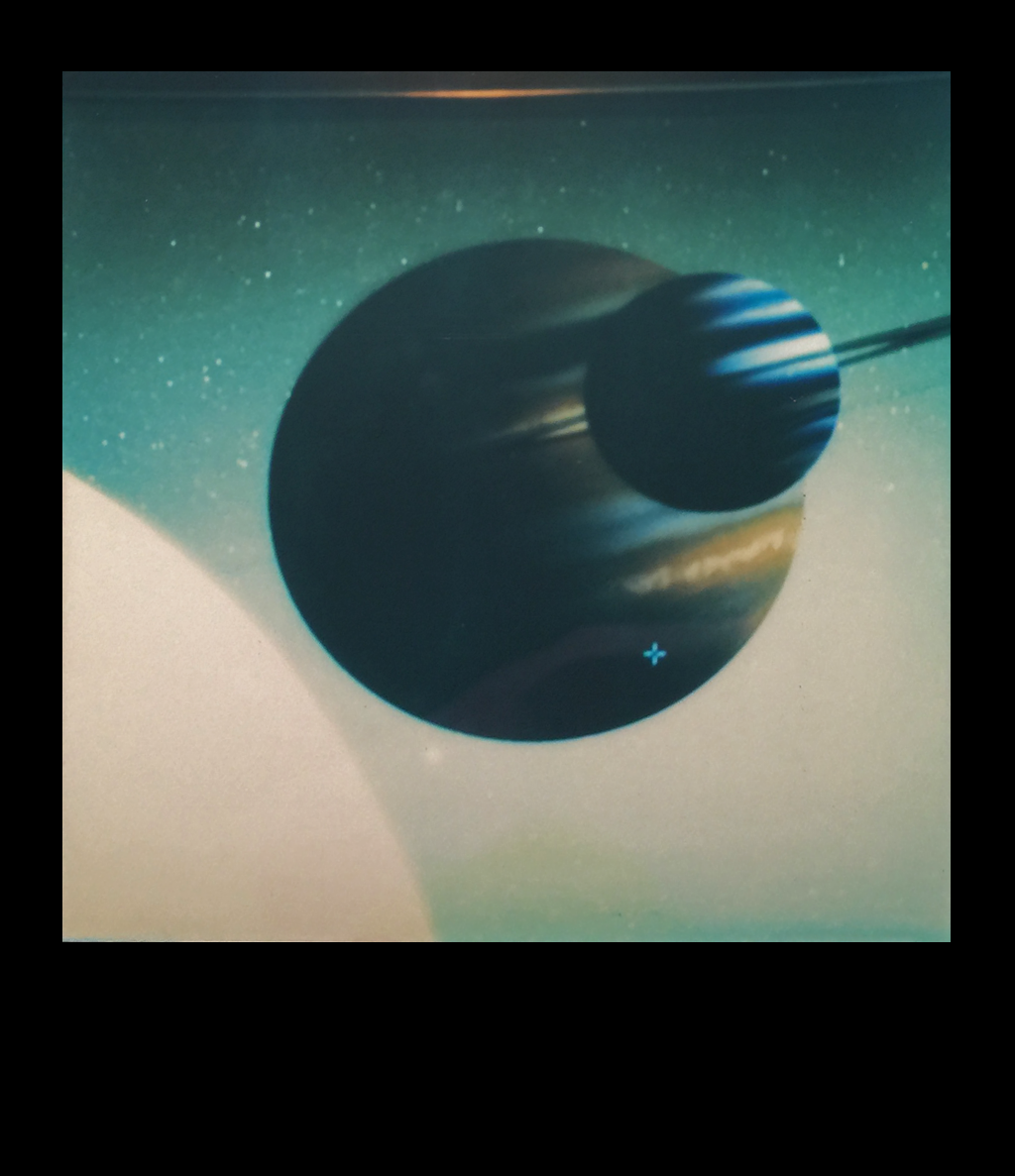
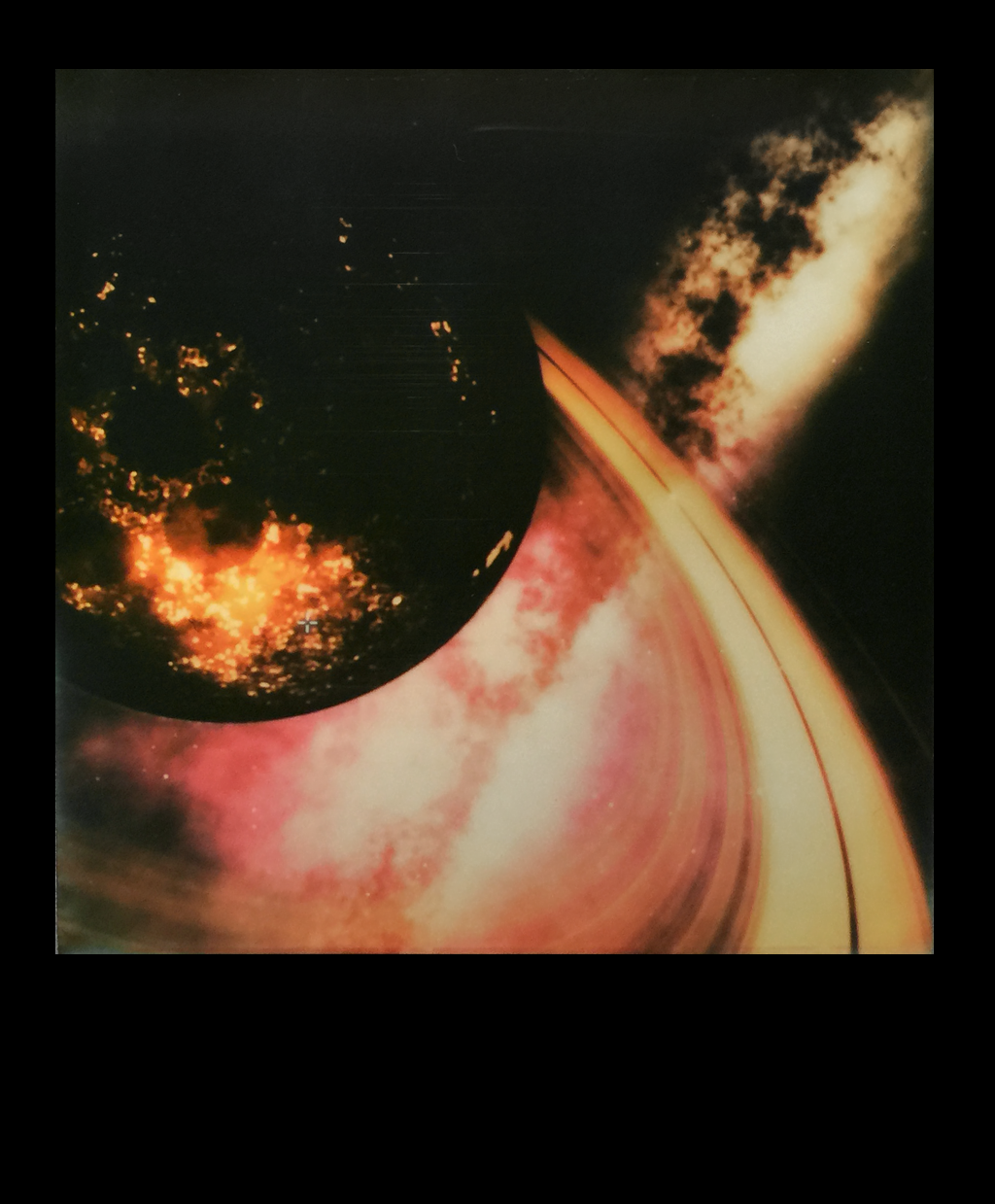
I am also impressed with Josh's first "abstract series," two samples of which are seen here. Josh has recently been enjoying the remarkable Space Engine program that is available for free for PCs (Space Engine allows the user to essentially navigate the entire cosmos; I have neither the time nor space ;-) to do justice to this truly visionary work. I encourage all readers with an interest in space to download this amazing simulation and explore its vast potential on their own). Thus, "naturally" (though, perhaps this does not come so naturally to everyone), Josh almost immediately pointed his SX-70 at some Space Engine screens he found during his explorations of the cosmos - and deliberately composed the appearance of specific shots to his liking. His captures show an ineffably beguiling beauty; not to mention a Zen-like compositional elegance. Once again, this is astounding for one who barely two months ago hardly ever touched a camera.

Finally, Josh's sheer exuberance with his new found passion for Polaroid photography is captured by my wife (with her iPhone) as he is unexpectedly gifted his third Polaroid on a visit to his grandmother in Florida. This kind of joy comes straight from the heart, cannot be faked, and just radiates sincerity.


Of course, I have no idea how long Josh's enthusiasm will last. It may die out, it may intensify, or it may transform into some other related art form. But if these early indications are a valid data source, he has clearly been very deeply bitten by his creative muse. May they forever more remain inseparable :-)

References: readers interested in exploring Polaroid's history (and, in particular, the biography of the great Edwin H. Land), can look at any of these sources: (1) history of the SX-70, (2) a 1970s commercial for the SX-70, (3) (short) biography of Edwin Land (at the Rowland Institute, which he founded after leaving Polaroid), (4) (video) Edwin Land's retinex theory of color vision, and (5) Time Zero is a wonderful documentary on the rise and fall of Polaroid, and the recent emergence of the Impossible Project; as of last month this documentary was available for subscribers to Netflix. Some of the better books include: (1) Insisting On the Impossible : The Life of Edwin Land, (2) Instant: The Story of Polaroid, (3) Land's Polaroid: A Company and the Man Who Invented It, and (4) A Triumph of Genius: Edwin Land, Polaroid, and the Kodak Patent War. For those of you who would like to dive a bit deeper into Land's work as scientist: (1) parts one and two of Land's 1959 papers on color vision for the Proceedings of the National Academy of Sciences, (2) a 1971 paper on his retinex theory of color vision, co-authored with John Mccann in the Journal of the Optical Society of America, and (3) a semi-technical paper (in Adobe pdf format) he wrote for Scientific American in 1977. Finally, a wonderful 16-min long film, The Long Walk, made in 1970, that shows Land giving a tour of Polaroid's offices and factories in Massachusetts.

Postscript: it is not a coincidence that Apple has often been called the latter-day Polaroid. At the top of Steve Jobs' (very) short list of visionary heroes is Edwin H Land. As Christopher Bonanos points out in his book, Instant: The Story of Polaroid, and confirms with published photos, the Ikea-like small but stylish tables that Land and Jobs both used on their respective stages (Land, while introducing the SX-70 to share-holders, and Jobs while demoing the iPad) were essentially the same model. Hardly a coincidence ;-) An hour-long talk that Mr. Bonanos gave at Google in 2012 is available here.

Sunday, June 16, 2013

Escher, Paul Klee, and a Turtle, Oh My...

...to which the tagline can read: a snapshot of the corner shelf in the study of a photographer prone to a gentle madness (where the "madness" refers to the deep passion for books, and is part of the title of a book - not shown - that describes that passion). My home, much to wife's dismay, is filled with books; all kinds of books; a veritable (countable) infinity of books, though a demonstrably smaller infinity than, say, the infinity represented by the categories one can imagine by which these books can all be distinguished, and that they collectively represent an intertwined wisdom about. Short books, and long; dime-store paperbacks and coffee-table-sized hardcovers; textured papers and glossy; those with pictures and others with only text; books about history and culture; philosophy, art, religion and Zen; the collected works of Chekov, Ellery Queen, Stanislaw Lem, and Philip K. Dick (with scattered books and tapes by Alan Watts); travelogues about conquests of Everest, Antarctica, and Ayahuasca; biographies of Maxwell, Dirac, and Feynman, as well as Ansel, Cartier-Bresson, and two Westons (Edward and Brett); books on self-organized vortices of consciousness and anything else mused on by Hofstadter; Christopher Alexander's magnum opus; and more books on physics and photography than most dreams can conjure over a dozen or more nights!

Borges famously introduced a ridiculously wondrous taxonomy of all knowledge in his 1942 essay "The Analytical Language of John Wilkins" (which he claims to have taken from an ancient Chinese encyclopedia, Celestial Emporium of Benevolent Knowledge). The categories of animals alone includes: 

"Those that belong to the emperor;
Embalmed ones;
Those that are trained;
Suckling pigs;
Mermaids (or Sirens);
Fabulous ones;
Stray dogs;
Those that are included in this classification;
Those that tremble as if they were mad;
Innumerable ones;
Those drawn with a very fine camel hair brush;
Et cetera;
Those that have just broken the flower vase;
Those that, at a distance, resemble flies."

And to this whimsical classification I introduce another that leads directly to the title of this blog: an image of the books (and of whatever else might fall onto your camera's sensor) that sits directly in front of you as you work on your images on a computer. Arbitrary? To be sure. Meaningful? Only to the extent that it is a well-formed query that has a definite answer; it may even provide a glimpse of what "interests one" most, right now, as in "I need this and that reference to be by my side." If we are what we read (and eat, and see, and do, ...) then surely our most immediate literary/visual companions are what we are at this moment (so long as they assembled on the shelf by themselves).

So my soul, right now, evidently needs these 15 books to be within easy reach as I muse and ponder and tinker with tones and forms on my computer: 9 are related to photography, 3 to art, and 1 each to mathematics, physics, and an "uncategorizable" category onto itself (best defined by its title: The Art of Looking Sideways); well, these books and an image of an old, wise sea turtle who - like a Zen sage -  quietly reminds me of the transience of all categories and classifications, and that, eventually, even my desire to look sideways will drift into a timeless void.

What do you, kind reader, find on your easy-to-reach shelf of books and memorabilia?

Saturday, March 23, 2013

Yesteryear Versions of Today's Magazines - Part 2

In my last post, I recommended a recently published book that collects some early articles and portfolios that appeared in Aperture Magazine while under the editorship of Minor White. All the articles appearing in the new book were first published between the years 1952 and 1976, and - as explained in the previous post - are very different in subject and content from what typically appears between the covers in the current incarnation of the magazine.  

I promised to introduce the second of two anthologies I've recently enjoyed of this type, to which we turn to now. The difference this time is that both the reprinted articles and the book itself are "old," the articles dating back to its inception through 1977 and the first (only, so far as I know) edition of book itself to 1979! The magazine is Popular Photography, and has been around since 1937. The anthology I'm recommending is called The Best of Popular Photography, edited by Harvey V. Fondiller, and available from Amazon in used form (which is the form I bought mine in) for as little as $0.85; new ones starting at $9. Barnes and Noble also lists "new" versions, but they seem needlessly expensive (running from $24 up to $130.00).

To say it has been a long time since I've done much else than inattentively flip through the heavily-laden-with-advertisements modern variant of this once-wonderful magazine at Barnes & Noble is an understatement. Rarely offering more than a few paragraphs that contain general musings (if you can find them in the thicket of adds!) - about how "one should not forget to take a tripod on a trip," or "here is yet another lens you absolutely need (that reads like the review of last month's lens-of-the-month, which reads like..," to "you too can become an Ansel Adams with a few easy steps " - the magazine IMHO contains effectively nothing of use to anyone even remotely interested in the art of photography.

But, alas, this was not always the case, as in the early decades of this once fine magazine some very memorable prose, reviews, insights - and even art! - found their way into its pages. The anthology contains 392 thick semi-gloss pages - which is good because a thick stock generally ensures that used copies will likely have stood the test of time and use (mine is old, but in very good condition) - is broken into 8 sections (that range from retrospectives, to personalities, to techniques (most of which are just as applicable to today's digital world as they are to the analog world they were spawned in), to photojournalism, to careers, to history. There are also short but interesting color and black&white portfolios.

There are articles by Margaret Bourke-White, Ansel Adams, W. Eugene Smith (on Dorothea Lange), and Beaumont Newhall; essays on Andre Kertesz, Edward Steichen, Paul Strand, Edward Weston, Robert Capa, Arnold Newman, Henri Cartier-Bresson, and Weegee (among a host of others); retrospectives on the early years of photojournalism; early "debates" on the differences between snapshots and "real" images, and speculations on "what makes a good photograph?" (that are typically deeper and more probing than many of today's sound-bit bits of "wisdom"); and essays on emerging technologies like holography (one article had the prescient audacity to ask, by its title, "Holography - Is It Art? ;-). To give you an idea of the loving detail most essays provide (in stark contrast to the "we'll give you all you need to know in a moment or less of your time" approach followed by most of today's glossy-magazine editors), an essay on Arnold Newman (first published in November 1973) runs 8 pages and contains 6 images (including a wonderful full-page reproduction of his famous portrait of Picasso); the essays on Alfreed Stieglitz (published in September 1946) and Cartier-Bresson (published in May 1967) run 8 pages each and contain 7 and 3 reproductions, respectively; and the one on Paul Strand that appeared in April 1972 runs a full 12 pages (with small type!) and contains 7 reproductions. A mini-course on portrait lighting - again, just as relevant today as in 1973 when first published - runs 11 pages and contains more useful information that most of today's magazines seem to publish collectively over the course of year.

An added bonus in this anthology is a sprinkling of pages in which yesteryear products and advertisements appear. You can read about what the Polaroid Land Camera cost in 1949 ($87.75), the "new Leningrad" SLR from Russia in 1958,  and the Polaroid SX-70 (introduced in 1972). The book concludes with a useful index of all authors and pages on which discussions about a particular photographer appear. Pages 91-103 contain the results of a 1958 international poll  (of 243 critics, teachers, editors, art directors, consultants, and photographers) on the world's "10 greatest photographers." I'd give away the results of this poll, but that would be spoil the fun;-)

This anthology is highly recommended, for reference, for consultation, or simple joy of reading with a warm drink in hand in your favorite easy chair on a cozy rainy Sunday afternoon.