"No permanence is ours;
we are a wave
That flows to fit
whatever form it finds"
- Hermann Hesse (1877 - 1962)
The Glass Bead Game
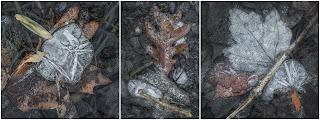
Postscript. One last "improvisation" on finding ways to render the ephemeral beauty that lives and dwells in flame (as described in Temporality #1) before I move on to other images and musings. The base images in this example are selected from the same set I used for my earlier examples (i.e., roughly 100 or so macros of flame, exposed between 1/2000th and 1/5000th sec). Also, just as in the last example (Temporality #2), each panel of the triptych is effectively an average (in terms of luminance) of three separate images. But this time, I loosened the constraint that individual photographs must retain their original orientation. I've written a short Mathematica program that automates the process of assembling triptychs of luminance-averaged layers, wherein each image either remains "as is" (i.e., in its original upright position), is reflected horizontally or vertically (as in a mirror), or is reflected both horizontally and vertically. Of course, this vastly increases the set of randomly assembled images. Assuming 100 "base" images - i.e., original flame macros - a 3 panel assembly consisting of 3 layered base images, each of which can assume any of four orientations, leads to over 50 million! combinations! But, while this makes it difficult, if not impossible, to sample even a small fraction of the "abstract triptych space," it can also yield striking images that would otherwise likely remain unknown. Of course, there are myriad associated aesthetic, conceptual, and philosophical depths that can be mined here (e.g., "What does the space of all possible 'creative' excursions from a starting set of images even look like?" - echoes of Stuart Kauffman's space of the "Adjacent Possible"), but I best end the discussion here, and let the lone exemplar above speak of what lives in that unimaginably larger universe of latent realities.