Showing posts with label Intimate landscape. Show all posts

Monday, November 03, 2025

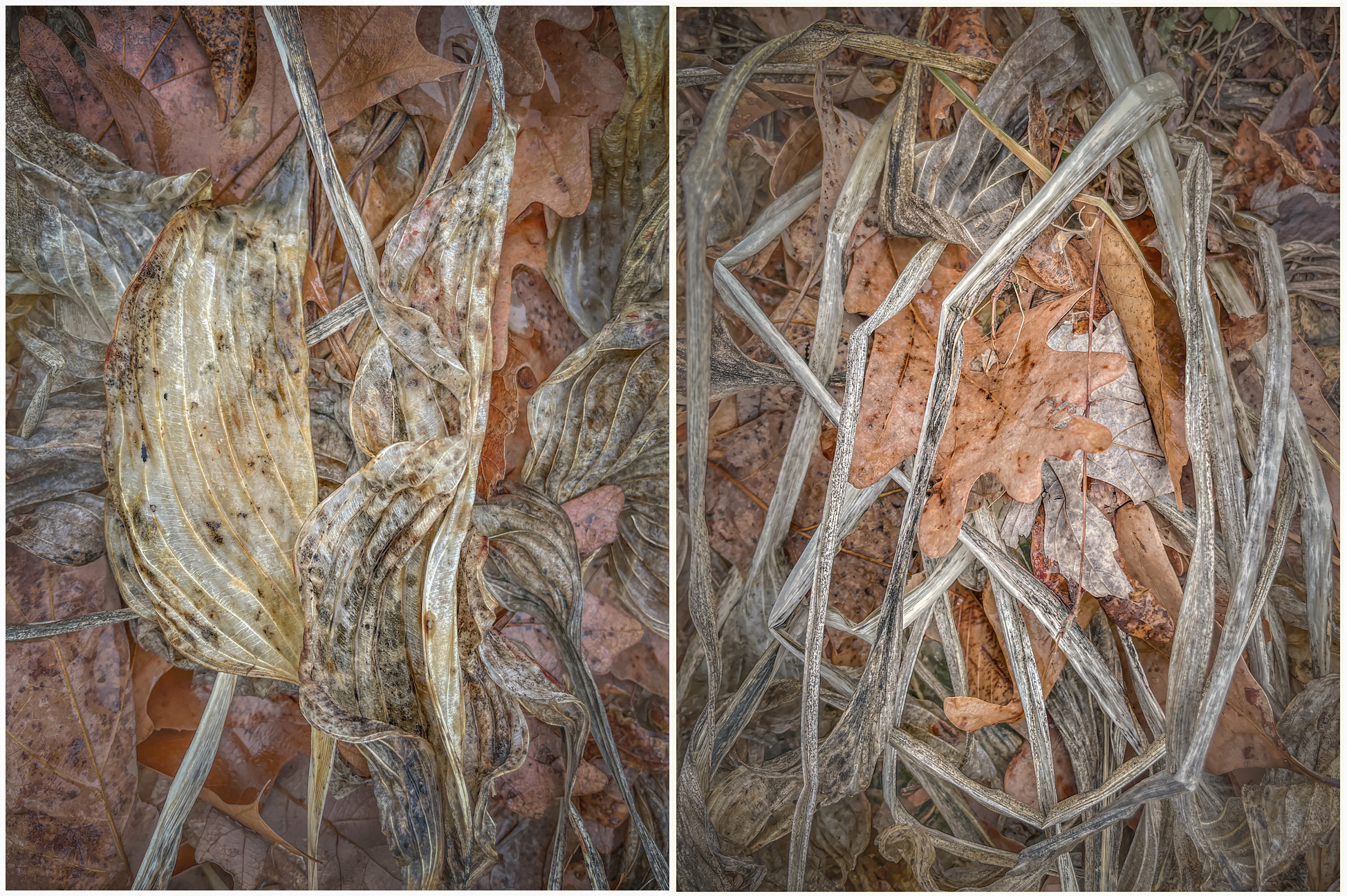
Perfect Imperfection


 "Wabi sabi is a state of the heart.
It is a deep in-breath and a slow exhale.
It is felt in a moment of real appreciation
—a perfect moment in an imperfect world."

Beth Kempton (1977 - )
Wabi Sabi

Sunday, October 05, 2025

Nature is Painting


"The truths of nature are one eternal change, one infinite variety. There is no bush on the face of the globe exactly like another bush; there are no two trees in the forest whose boughs bend into the same network, nor two leaves on the same tree which could not be told one from the other, nor two waves in the sea exactly alike.
...
Nature is painting for us, day after day, pictures of infinite beauty."

John Ruskin (1819 – 1900)

Saturday, October 04, 2025

Light of the Moment


"Life rises out of death, death rises out of life; in being opposite they yearn to each other, they give birth to each other and are forever reborn. And with them, all is reborn, the flower of the apple tree, the light of the stars. In life is death. In death is rebirth. What then is life without death? Life unchanging, everlasting, eternal? What is it but death-death without rebirth?
...
There is neither source nor end, for all things are in the Center of Time. As all the stars may be reflected in a round raindrop falling in the night: so too do all the stars reflect the raindrop. There is neither darkness nor death, for all things are, in the Light of the Moment, and their end and their beginning are one.
...
You are like a lantern swathed and covered,
hidden away in a dark place.
Yet the light shines;
they could not put out the light.
They could not hide you."

Ursula K. Le Guin (1929 - 2018)

Thursday, September 18, 2025

What is This Mind?


"You must only become the question ‘What is this Mind?’ or ‘What is it that hears these sounds?’ When you realize this Mind you will know that it is the very source of all Buddhas and sentient beings... While you are doing Zazen neither despise nor cherish the thoughts that arise; only search your own mind, the very source of these thoughts. You must understand that anything appearing in your consciousness or seen by your eyes is an illusion, of no enduring reality. Hence you should neither fear nor be fascinated by such phenomena... At last every vestige of self-awareness will disappear and you will feel like a cloudless sky."

- Bassui Tokushō (1327 - 1387)

Thursday, September 11, 2025

Silence and Stillness


"When I detect a beauty in any of the recesses of nature, I am reminded, by the serene and retired spirit in which it requires to be contemplated, of the inexpressible privacy of a life - how silent and unambitious it is. The beauty there is in mosses must be considered from the holiest, quietest nook.
...
Silence is the communion of a conscious soul with itself. If the soul attend for a moment to its own infinity, then and there is silence. She is audible to all men, at all times, in all places, and if we will we may always hearken to her admonitions.
...
The gods delight in stillness, they say ’st-’st. My truest - serenest moments are too still for emotion -they have woolen feet. In all our lives we live under the hill, and if we are not gone we live there still."

Henry David Thoreau (1817 - 1862)

Thursday, August 21, 2025

Patterns of Organic Energy


"'Wu Li' was more than poetic. It was the best definition of physics that the conference would produce. It caught that certain something, that living quality that we were seeking to express in a book, that thing without which physics becomes sterile. 'Wu' can mean either 'matter' or 'energy.' 'Li' is a richly poetic word. It means 'universal order' or 'universal law.' It also means 'organic patterns.' The grain in a panel of wood is Li. The organic pattern on the surface of a leaf is also Li, and so is the texture of a rose petal. In short, Wu Li, the Chinese word for physics, means 'patterns of organic energy' ('matter/ energy' [Wu] + 'universal order/organic patterns' [Li]). This is remarkable since it reflects a world view which the founders of western science (Galileo and Newton) simply did not comprehend, but toward which virtually every physical theory of import in the twentieth century is pointing!"

Gary Zukav (1942 - )
The Dancing Wu Li Masters

Thursday, July 24, 2025

Friday, July 11, 2025

Living Geometry


"We apprehend Him in the alternate voids and fullness of a cathedral; in the space that separates the salient features of a painting; in the living geometry of a flower, a seashell, an animal; in the pauses and intervals between the notes of music, in their differences of tone and sonority; and finally on the planes of conduct, in love and gentleness, the confidence and humility, which give beauty to the relationships between human beings."

Aldous Huxley (1894 - 1963)

Wednesday, June 11, 2025

Creating the World


"We create the world that we perceive, not because there is no reality outside our heads, but because we select and edit the reality we see to conform to our beliefs about what sort of world we live in. The man who believes that the resources of the world are infinite, for example, or that if something is good for you then the more of it the better, will not be able to see his errors, because he will not look for evidence of them. For a man to change the basic beliefs that determine his perception - his epistemological premises - he must first become aware that reality is not necessarily as he believes it to be. Sometimes the dissonance between reality and false beliefs reaches a point when it becomes impossible to avoid the awareness that the world no longer makes sense. Only then is it possible for the mind to consider radically different ideas and perceptions."

Gregory Bateson (1904 - 1980)
 Steps to an Ecology of Mind

Tuesday, May 27, 2025

Liminal Beauty


"The question is not what you look at,
but what you see. It is only necessary
to behold the least fact or phenomenon,
however familiar, from a point a hair's breadth
aside from our habitual path or routine,
to be overcome, enchanted by its
beauty and significance."

Henry David Thoreau (1817 - 1862)

Sunday, May 18, 2025

Cohered Confusion


"[It] is the peculiar gift of the truly great
detective that he can apply to the inexorable
rules of logic three catalyzers:
an abnormal observation of events, 
 knowledge of the human mind and
an insight into the human heart.
...
It is your task to cohere confusion,
to bring order out of chaos.
...
...the pattern must exist.
It’s the same story in detection:
recognize the pattern and you’re within
shooting distance of the ultimate truth."

- Ellery Queen
a.k.a., Frederic Dannay (1905–1982)
and Manfred B. Lee (1905–1971)

Note. I have written before about the meta-pattern that describes the pattern of how I search-for/discover photographic compositions while on travel (e.g., see my short essay, Fox-like Hedgehogian Photography, that describes my experience in Iceland). The first few days in any new place (or old place, newly revisited) are inevitably filled with excitement, awe, and an Ansel-Adams-esque drive to capture Wagnerian-epic landscapes in all their glory. My wife's and my recent trip to New Zealand certainly matched this pattern; and how could it not with truly otherworldly vistas such as Milford Sound! But, predictably, after a relatively few days of rapid-fire "Ooooh" and "Aaahhh!" shots, my eye/I reverted back to its typically quieter less dramatically Wagnerian reflective state to find the sorts of images I love best - i.e., those that are obviously grounded in places I visit, but which may have been taken anywhere - intimate patterns that catch my attention not because they scream "Capture me to show others before the light goes bad!", but because they mirror something looking through the lens, a thought, a memory, a feeling, whatever. My favorite images (however humble and possibly "uninteresting" they may be to others) are those that lift the veil between inner and outer realities. The very best are fragments of mystical experiences. To be sure, the image above is certainly not in that last category. But it is a typically Andy-esque post-first-travel-week intimate composition grounded on "seeing" an inner pattern depicted externally. In this case, a self-organized "Q" that remined me of Ellery Queen's signature letter that adorned the covers of his early mystery books. I wonder, would I have even "seen" this intimate landscape (captured in New Zealand, but not an image of New Zealand, per se) had I not spent the better part of my teen years devouring early Ellery Queen mystery novels?

Friday, May 16, 2025

The One "Before Whom Words Recoil"


"The purpose of all words is to illustrate the meaning of an object. When they are heard, they should enable the hearer to understand this meaning, and this according to the four categories of substance, of activity, of quality and of relationship. For example cow and horse belong to the category of substance. He cooks or he prays belongs to the category of activity. White and black belong to the category of quality. Having money or possessing cows belongs to the category of relationship. Now there is no class of substance to which the Brahman belongs, no common genus. It cannot therefore be denoted by words which, like 'being' in the ordinary sense, signify a category of things. Nor can it be denoted by quality, for it is without qualities; nor yet by activity because it is without activity—'at rest, without parts or activity,' according to the Scriptures. Neither can it be denoted by relationship, for it is 'without a second' and is not the object of anything but its own self. Therefore it cannot be defined by word or idea; as the Scripture says, it is the One 'before whom words recoil.'"

Aldous Huxley (1894 - 1963)
The Perennial Philosophy

Sunday, May 11, 2025

Intimate Landscapes


"Though it is generally accepted that abstract art refers to those works inspired by the imagination of the artist rather than by objective reality, in photography, in which images are produced by the lens, this distinction is difficult to sustain. In the broadest sense of the term, an optical image is an abstraction from the natural world-a selected and isolated fragment of what stands before the camera. When the selected image is self-explanatory and does not imply more than what lies within its area it is usually referred to as abstract, that is, independent of its surroundings-a pattern of rock, for example, or lichens, or grasses. On the other hand, in the wider scenic view common in most landscape photography, the selected image implies a world outside the limits encompassed by the lens."

- Eliot Porter (1901 - 1990)
Intimate Landscapes

Wednesday, May 07, 2025

New Zealand Zen #2


"I asked the leaf whether it was frightened because it was autumn and the other leaves were falling. The leaf told me "No. During the whole spring and summer I was completely alive. I worked hard to help nourish the tree, and now much of me is in the tree. I am not limited by this form. I am also the whole tree, and when I go back to the soil, I will continue to nourish the tree. So I don't worry at all. As I leave this branch and float to the ground, I will wave to the tree and tell her, "I will see you again very soon." That day there was a wind blowing and, after a while, I saw the leaf leave the branch and float down to the soil, dancing joyfully, because as i floated it saw itself already there in the tree. It was so happy. I bowed my head, knowing that I have a lot to learn from that leaf."

Thich Nhat Hanh (1926 - 2022)
Peace Is Every Step

Note. I saw these little Zen leaves at Queenstown Gardens in New Zealand. Of course, since New Zealand is in the southern hemisphere, our (i.e., northern VA's) spring is its autumn, we were treated to a spectacle of color and recently fallen leaves, not just at Queenstown, but throughout our stay on the southern island. The mostly 50/60ish degree weather was also a welcome respite from the looming 80/90ish weather we typically get where we live (and are now experiencing after we got back from our trip). Here are a few more leaves that caught my attention in Queenstown.


Wednesday, March 26, 2025

Withered Leaves


"If in our withered leaves you see
Hint of your own mortality:—
Think how, when they have turned to earth,
New loveliness from their rich worth
Shall spring to greet the light; then see
Death as the keeper of eternity,
And dying Life’s perpetual re-birth !"

- Poem attributed to the initials W.L. (Epigraph, Chapter 6)
Arthur E. Shipley, Life: A Book for Elementary Students

Saturday, March 22, 2025

Patience


"Nature does not hurry,
yet everything is accomplished"

Lao Tzu (6th century – 4th century BCE)

Wednesday, March 19, 2025

Subtle and Evanescent


"Greatness' exists in the inconspicuous and overlooked details. Wabi-sabi represents the exact opposite of the Western ideal of great beauty as something monumental, spectacular, and enduring. Wabi-sabi is not found in nature at moments of bloom and lushness, but at moments of inception or subsiding. Wabi-sabi is not about gorgeous flowers, majestic trees, or bold landscapes. Wabi-sabi is about the minor and the hidden, the tentative and the ephemeral: things so subtle and evanescent they are invisible to vulgar eyes."

- Leonard Koren (1948 - )
Wabi-Sabi: for Artists, Designers, Poets & Philosophers

Wednesday, March 05, 2025

Sentient Soul


"Form is what transforms the content of a work into its essence. Do you understand? The character of music arises out of its form like steam from water,’ Yury Andreevich said. ‘With solid understanding of the general laws of form, which encompass all that is amenable to formulation, one can, by groping further, perceive the individual, the particular. Then, subtracting the general, one can sense a residue where wonder lurks in its purest, most undiluted form. Herein lies the goal of theory: the more fully one grasps what is available for comprehension, the more intensely the ineffable shines."

- Ludmila Uliţkaia (1943 - )

""Forms acquire meaning for us
only because we recognize in them
the expression of a sentient (fühlend) soul.
Spontaneously, we animate
(beseelen) every object.

- Heinrich Wölfflin (1864 - 1945)

Thursday, February 13, 2025

Leafless Tree


"If we hadn’t our bewitching autumn foliage, we should still have to credit the weather with one feature which compensates for all its bullying vagaries-the ice storm: when a leafless tree is clothed with ice from the bottom to the top – ice that is as bright and clear as crystal; when every bough and twig is strung with ice-beads, frozen dew-drops, and the whole tree sparkles cold and white, like the Shah of Persia’s diamond plume. Then the wind waves the branches and the sun comes out and turns all those myriads of beads and drops to prisms that glow and burn and flash with all manner of colored fires, which change and change again with inconceivable rapidity from blue to red, from red to green, and green to gold-the tree becomes a spraying fountain, a very explosion of dazzling jewels; and it stands there the acme, the climax, the supremest possibility in art or nature, of bewildering, intoxicating, intolerable magnificence. One cannot make the words too strong."

Mark Twain (1835 - 1910)

Friday, December 27, 2024

Entanglement


"Indeed, it is the quantum entanglement between the 'object' and the 'agencies of observation,' in this case, between the atom and the apparatus that is precisely what we need to attend to in making the interference pattern evident. Once again we see evidence for the ontological priority of phenomena over objects. If one focuses on abstract individual entities the result is an utter mystery, we cannot account for the seemingly impossible behavior of the atoms. It’s not that the experimenter changes a past that had already been present or that atoms fall in line with a new future simply by erasing information. The point is that the past was never simply there to begin with and the future is not simply what will unfold; the 'past' and the 'future' are iteratively reworked and enfolded through the iterative practices of spacetimemattering—including the which-slit detection and the subsequent erasure of which-slit information—all are one phenomenon."

- Karen Barad (1956 - )
 Meeting the Universe Halfway