Showing posts with label Story Behind Photo. Show all posts

Tuesday, November 04, 2025

Cymatic Urphänomen


"She [nature] is the sole artist, creating extreme contrast out of the simplest material, the greatest perfection seemingly without effort, the most definite clarity always veiled with a touch of softness. Each of her works has its own being, each of her phenomena its separate idea, and yet all create a single whole."

Johann Wolfgang von Goethe (1749 - 1832)
 The Metamorphosis of Plants

"The notion of the Urphanomen is an invaluable illustration of the concrete nature of Goethe's way of thinking which dwells in the phenomenon. The primal phenomenon is not to be thought of as a generalization from observations, produced by abstracting from different instances something that is common to them. If this were the case, one would arrive at an abstracted unity with the dead quality of a lowest common denominator. For Goethe, the primal phenomenon was a concrete instance - what he called 'an instance worth a thousand, bearing all within itself.' In a moment of intuitive perception, the universal is seen within the particular, so that the particular instance is seen as a living manifestation of the universal. What is merely particular in one perspective is simultaneously universal in another way of seeing. In other words, the particular becomes symbolic of the universal."

Henri Bortoft (1938 - 2012)

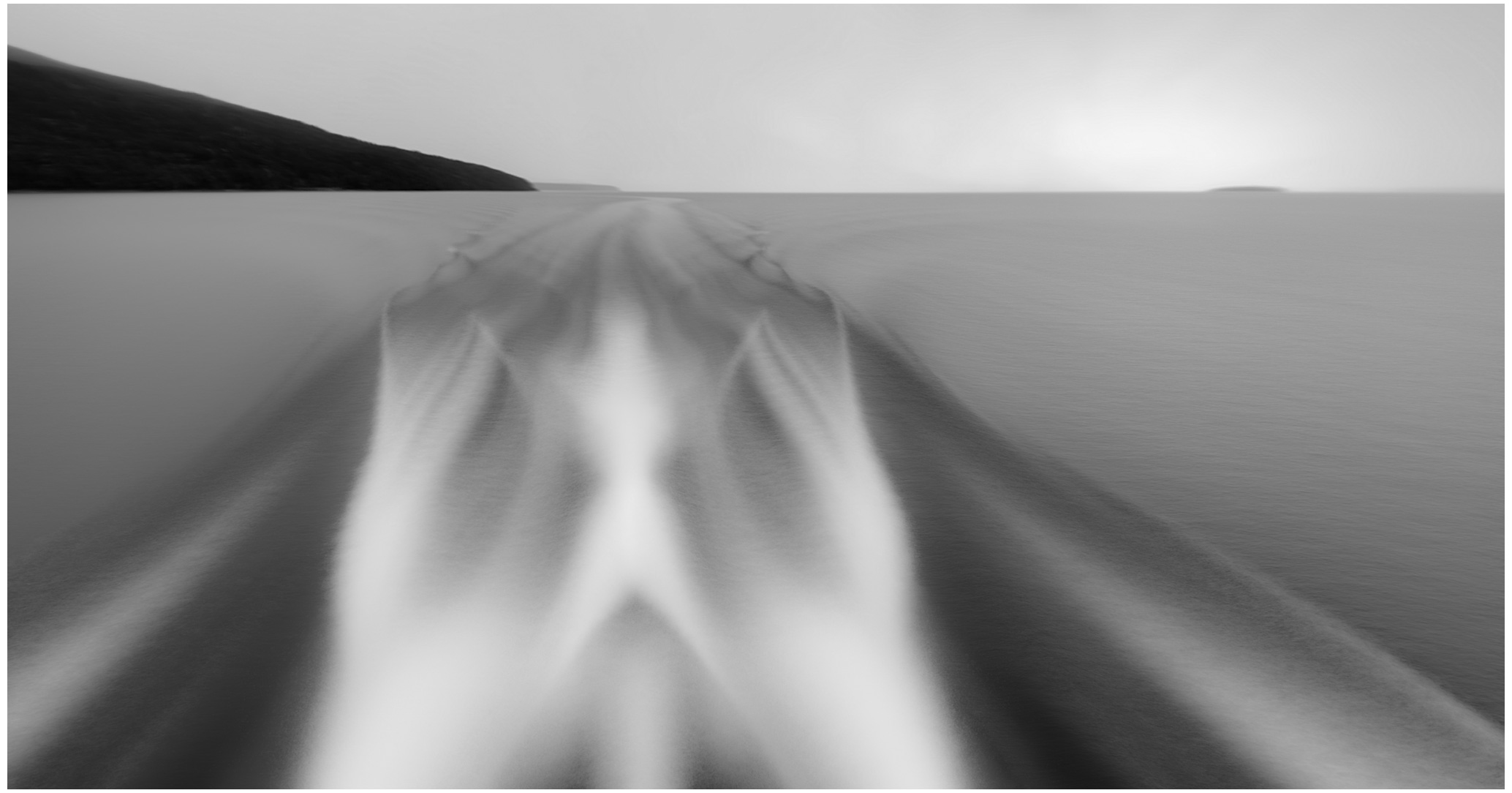
Photographer's note. To help contextualize the relevance of the quotes, I need to point out that the image above contains three (out of a total of about 24) "snapshot" views of a single unfolding cymatic process. Not only does the triptych show only a tiny fraction of what my eye saw through the viewfinder, but the apparent sharpness of the images also belies the frenetic swirling and rhythmic thrashing of the water because my relatively slow 1/40th sec to 1/60th sec exposures smear over finely detailed patterns. But, while we may be unable to "see" the cymatic Urphanomen in its full splendor (and, even if we could, perhaps would understand as little as does Philip K Dick's "electric ant" after it tries seeing all of reality at once), "each of her works has its own being, each of her phenomena its separate idea, and yet all create a single whole." 

Tuesday, October 21, 2025

"To be" is to Inter-Be

"If you look deeply, you will see that there is a cloud floating in this sheet of paper. Without a cloud, there will be no rain; without rain, the trees cannot grow; and without trees, we cannot make paper. The cloud is essential for the paper to exist. If the cloud is not here, the sheet of paper cannot be here either. So we can say that the cloud and the paper inter-are. 'Interbeing' is a word that is not in the dictionary yet, but if we combine the prefix 'inter-' with the verb 'to be,' we have a new verb, inter-be.
...
If we look into this sheet of paper even more deeply, we can see the sunshine in it. If the sunshine is not there, the forest cannot grow. In fact, nothing can grow. Even we cannot grow without sunshine. And so, we know the sunshine is also in this sheet of paper. The paper and the sunshine inter-are. And if we continue to look, we can see the logger who cut the tree and brought it to the mill to be transformed into paper. And we see the wheat. We know the logger cannot exist without his daily bread, and therefore the wheat that became his bread is also in this sheet of paper. And the logger’s father and mother are in it too. When we look in this way, we see that without all these things, this sheet of paper cannot exist.
...
Looking even more deeply, we can see we are in it too. This is not difficult to see, because when you look at a sheet of paper, the sheet of paper is part of our perception. Your mind is in here and mine is also. So we can say that everything is in here with this sheet of paper. You cannot point out one thing that is not here – time, space, the earth, the rain, the minerals in the soil, the sunshine, the cloud, the river, the heat. Everything co-exists with this sheet of paper. That is why I think the word inter-be should be in the dictionary. 'To be' is to inter-be. You cannot just be by yourself alone. You have to inter-be with every other thing. This sheet of paper is, because everything else is."

- Thích Nhất Hạnh (1926 - 2022)
The Heart of Understanding

Postscript. As is likely obvious to even casual visitors to my humble blog during the last week, I am currently immersed in the world of cymatics (although my wife thinks of it as more of an obsession). "Cymatics" refers to the study of sound and vibration; specifically, when the two are combined in a way that creates complex patterns in different media such as sand, water, or - what Swiss physician Hans Jenny (who coined the term) liked to use - corn starch in water. For example, if a metal plate is covered with a thin layer of flour or sand and is made to vibrate at specific frequencies, so-called standing-wave Chladni patterns appear in which the flour or sand collects along "nodes" (i.e., lines or points that undergo minimal vibration), while areas that undergo the greatest motion (i.e., the "anti nodes") are effectively left empty as the vibration pushes the flour or sand away. Chladni patterns are named after physicist Ernst Chladni who performed the first such experiments in the late 1700s.

I thank my left-brain/day-job as a physicist for introducing me to cymatics in the late 1990s when I stumbled across this paper describing what (at the time, were never before seriously studied) complex emergent patterns in vibrating layers of small granular media (e.g., cylinders filled with BBs from a toy shotgun). One line from this paper immediately grabbed my attention when I first read it and that still haunts me (both as physicist and photographer): "These excitations [called "oscillons"] have a propensity to assemble into 'molecular' and 'crystalline' structures." I remember musing, Whoa!, pump energy into an otherwise static structureless pile of 'things' and get self-organized geometric patterns?!? It was during my (absurdly slow, pre-Google days) search for related experiments that I discovered Jenny's work on cymatics, the underlying dynamics of which has a far-from-superficial overlap with the physics of oscillons.

So, having known about cymatics for about 25 years - and having even posted about it briefly in 2006 on this same blog! - why has it taken me so long to photograph it? I have no easy answer to that, just as I cannot explain why I never photographed my dad-working-as-an-art-restorer when he was still alive, which is something that - 23 years after his passing - I now profoundly regret (see Postscript 1 in this post from 2010). The creative process and the muse that guides our path are both mysterious and ultimately unknowable, which is as it should be. So, I'll leave it at that. But, whatever the reason(s) for my flurry of recent purchases of frequency generators, vertical vibration generators, lights, and more plates, goblets and petri dishes than any sane photographer has reason to own (and our kitchen cupboards have room for), I am - at the moment (and for the foreseeable future) - completely and utterly "obsessed" with cymatics. The reason is simple enough to state: cymatics is a quintessentially perfect amalgam of all three of my aesthetic and intellectual passions - physics, photography, and mysticism

The first two separately play obviously critical roles. The physicist-side of my brain is giddy over the vast phase space waiting to be explored: vibration frequency + medium (type + mix type) + vessel (type + diameter + depth) + ... And the photographer side is not too far behind: light (type + source(s) + directionality) + angle-of-view + f-stop + exposure time + ... But it is the idea of "cymatics as creative bridge" between seen and unseen, between energy and pattern, and between physical and spiritual that I resonate most deeply with, and is most ripe with creative possibilities. (For example, it has not escaped my attention that, in a "mystical" sort of way, the energy that the universe ineffably pumps into an otherwise structureless bag full of 'elemental things' gives rise to an emergent multidimensional dynamic cymatic-like sentient geometry called "Andy")

Since I've only started exploring the cymatics-scape universe, I have no idea what patterns await to be discovered and/or how long the search will keep my interest. But, given that I'm still looking for synesth-scapes after being mesmerized by reflective patterns in my mother-in-law's Nambe-like metal salt and pepper shakers in 2009,  cymatics may take a while 😊

For those still reading this, here is a link to a newly revised version of Hans Jenny's opus, Cymatics: A Study of Wave Phenomenon and Vibration. This version includes both volumes of the original work, as well as new chapters that include a biographical sketch of Hans Jenny, a non-technical primer on the physics of cymatics, and commentaries by researchers, sound therapists, designers, and artists. Indeed, I strongly recommend perusing the entire CymaticSource website, since it is a veritable storehouse of additional information, books and videos. (I am not affiliated with this website in any way. But, having recently purchased the aforementioned reprint of Jenny's revised Cymatics volume, I can personally attest to its quality - it is a stunningly beautiful book.)

Saturday, October 11, 2025

Zen Compositions


"The harder we try to catch hold of the moment, to seize a pleasant sensation..., the more elusive it becomes... It is like trying to clutch water in one's hands - the harder one grips, the faster it slips through one's fingers.
...
But you cannot understand life and its mysteries as long as you try to grasp it. Indeed, you cannot grasp it, just as you cannot walk off with a river in a bucket. If you try to capture running water in a bucket, it is clear that you do not understand it and that you will always be disappointed, for in the bucket the water does not run. To “have” running water you must let go of it and let it run.
...
Trying not to grasp is the same thing as to grasp since it's motivation is the same, my urgent desire to save my self from a difficulty. I can not get rid of this desire since it is one and the same desire as the desire to get rid of it."

Alan Watts (1915 - 1973)

Postscript. My last post explained what my recent series of "autumnal abstracts" has to do with quantum mechanics. This post is meant to convey the complementary explanation of what my autumnal abstracts have to do with Zen. Leaving aside the unintentional recursivity of the word "complementary" (since the concept has a formal meaning in quantum mechanics), here is an alternative summary of how using knee-high waterproof boots to get "up close and personal" to patterns of leaves in the creek - ostensibly to get better compositions - failed miserably. As I explained in the last post, no matter how slowly I approached a clump of leaves, invariably, the ripples induced in the water by my boots would dislodge one or more of the key elements of whatever composition I saw in my mind's eye. By the time I stood over the spot where I saw the original pattern, most of the leaves were gone. Here is where the Zen side of story begins...

The first day I donned my boots, it took me about a dozen attempts to learn how to "minimally disturb" whatever it was that caught my eye; to emphasize, not one, two or a few tries, but an embarrassingly many attempts. It was vastly harder than I anticipated. At some point - after my 3rd or 4th failure - I dejectedly poked my tripod into the water, angry with myself at being unable to do such a "simple” thing. So there I stood, knee-deep in water, immersed in a euphonious Siren call of delicately beautiful patterns I so wished to capture but which vanished the instant I approached them, when the absurdity of it all finally struck me like a Zen-master's cane! I doubled over with laughter, as multiple versions of Alan Watt's "the harder we try to catch hold of the moment..." aphorisms leapt to mind.

Adding to this genuinely Zen-like moment was the fact that two joggers just happened to be close enough to see and hear me. They both turned in unison to see what the source of the absurd laughter was. Without breaking stride or uttering a word, they just stared at what from their perspective must have seemed a "not quite all there and possibly drunk photographer" and ran off into the woods. I laughed for a few more moments, resolved to remember this little creek's Zen lesson, and resumed searching for interesting and evanescent patterns.

So, are my (still ongoing) "autumnal abstracts" a lesson in quantum mechanics? in Zen? or something else entirely? In the end, it's all just a matter of perspective 😊

Thursday, October 09, 2025

Quantum Compositions


"Science no longer is in the position of observer of nature, but rather recognizes itself as part of the interplay between man and nature. The scientific method ... changes and transforms its object: the procedure can no longer keep its distance from the object ... Every experiment destroys some of the knowledge of the system which was obtained by previous experiments.
...
Our scientific work in physics consists in asking questions about nature in the language that we possess and trying to get an answer from experiment by the means at our disposal. In this way quantum theory reminds us, as Bohr has put it, of the old wisdom that when searching for harmony in life one must never forget that in the drama of existence we are ourselves both players and spectators. It is understandable that in our scientific relation to nature our own activity becomes very important when we have to deal with parts of nature into which we can penetrate only by using the most elaborate tools.
...
Since the measuring device has been constructed by the observer … we have to remember that what we observe is not nature itself but nature exposed to our method of questioning. Our scientific work in physics consists in asking questions about nature in the language that we possess and trying to get an answer from experiment by the means that are at our disposal."

Werner Heisenberg (1901 - 1976)

Postscript. At the end of my last post, I promised to explain what my recent series of "autumnal abstracts" (which I started in mid September) has to do with quantum mechanics (yes, quantum mechanics). The simplest explanation (sure to induce a mild groan in readers) is that since my left-brain "day job" is anchored on my being a physicist, physics in general, and quantum mechanics in particular, is never far from my thoughts 😉 But no, that's not the full explanation. The real connection is part whimsy and part serious (the serious part is expertly summarized by one of the founding fathers of quantum mechanics, Heisenberg, above). As I explained in my previous post, I've recently been "rewarding" myself after long work days by driving to a local trail that runs along a shallow leaf-strewn creek, and spend however much time remains before the sun goes down searching for intimate compositions of leaves, rocks, and reflections within the water.

For my first few outings, I had no issues. I would park myself on the little bridge I need to cross to get to the trail from where I leave my car, set up a tripod, and use a telephoto zoom to isolate patterns of interest. Here is a taste of what I see from the bridge:


Of course, I didn't limit myself to just standing on the bridge. I prowled around the area surrounding the bridge, and explored different perspectives made accessible by positioning myself somewhere along the left and right banks of the creek. And, indeed, in this way, I usually walked away with at least few decent keepers. But I also noticed that the best compositions (at least in my mind's eye) were always just beyond my reach. I needed to get into the water! And that's where quantum mechanics comes in ...

The solution was simple enough. I put on a pair of knee-high waterproof boots, tucked in my pants, grabbed a waterproof (well, water resistant) tripod, and started composing "up close and personal" in the water; or so I thought. I immediately ran into an unexpected "quantum mechanics"-like problem: after seeing some pattern of interest (say, some combination of leaves, rocks and reflections), I would naturally walk over to get a better look and see where to best anchor my tripod. But no matter how slowly I approached, invariably, the ripples induced in the water by my boots would dislodge one or more of the key elements of whatever pattern caught my eye. By the time I got to the original composition, the pattern was either gone and/or replaced by another only less than half as good. This happened over and over again, no matter how slowly - ever, so slooooowly - I walked toward some entangled leaves. A text-book (albeit, whimsical) example of the well-known, but no less mysterious, quantum mechanical "observer effect." The analogy actually runs a bit deeper: while observer-induced perturbations also happen in "classical" physics, the difference is that quantum mechanics does not allow the observer to reconstruct what the "true state of the system" was after observing it; the act of observing the state irretrievably scrambles it. Just as, in my case, "seeing and moving toward a" pattern of leaves irretrievably destroys it. (BTW, at the risk of overloading most readers of a photography blog, it is worth mentioning that entanglement - a subtle nod to which appeared in the phrase "entangled leaves" - is another inherently quantum behavior that is best left for a future post) 😊

Monday, October 06, 2025

Replenishing My Soul


"The psyche, if you understand it as a phenomenon occurring in living bodies, is a quality of matter, just as our body consists of matter. We discover that this matter has another aspect, namely, a psychic aspect. It is simply the world seen from within. It is just as though you were seeing into another aspect of matter."

C. G. Jung (1875-1961)
The Earth Has a Soul

Postscript. Some of you may have noticed that for the past month or so I have been posting "autumnal abstracts" consisting mostly of small, intimate compositions of leaves, rocks, reflections and gentle water flow. But while these rapid-fire posts may seem like I have had a "lot of time on my hands," the truth is actually the reverse. But therein lies an important (albeit "obvious") lesson for all creatives: when you objectively have "no time" for creative endeavors, force yourself to find a pocket of time, however small - it can be measured in minutes! - to nourish your soul. Of course, this is particularly hard to achieve after enduring a long string of "day job" hours; in my case, 10+ hours days consisting of working on endless equations and computer code, and dealing with recursively multiplying deadlines for deliverables). As the "day job" hours increase so does the need to to recharge; unfortunately, since fatigue also grows (in my case, exponentially) with "day job" effort, there is a point of no return wherein you'll find yourself too tired to carve out what (at this point, is now a critically vital) "pocket of time" to recharge. So what does one do? In my case, when I am able to work from home, I force myself to stop work about an hour before the sun sets, grab a camera and tripod, and drive a few miles to a local trail that runs along a small creek. I park my car at the end of a residential cul-de-sac and walk about 300 feet to a "little bridge" ... (iPhone panorama):

It is here around this little bridge and the shallow leaf-strewn creek that I let my soul breath for however many precious few minutes I have until the sun sets, while my eye happily searches for intimate compositions of leaves, rocks, reflections and gentle water flow! 15 to 20 minutes in this oasis is usually all I need (and, often, all I have) to forget about me equations and replenish my soul.

In my next post, I'll explain what these "autumnal abstracts" have to do with quantum mechanics, albeit from a more whimsical than physics perspective.

Tuesday, August 19, 2025

Shamanic Dance


"Nature loves courage. You make the commitment and nature will respond to that commitment by removing impossible obstacles. Dream the impossible dream and the world will not grind you under, it will lift you up. This is the trick. This is what all these teachers and philosophers who really counted, who really touched the alchemical gold, this is what they understood. This is the shamanic dance in the waterfall. This is how magic is done. By hurling yourself into the abyss and discovering its a feather bed."

-  Terence McKenna (1946 - 2000)

Postscript. This is an "old" (almost two year old) image that I had inexplicably not processed from its raw state until having recently "discovered" it on my hard drive while looking for another (completely unrelated) picture. It's not that I did not think of it as a “keeper" worth processing soon after I captured it; rather, I simply overlooked it before I moved on to other things. It's existence is a reminder that our hard drives are likely full of "old and forgotten" (perhaps never properly "seen" and/or processed) photographs, behooving us to set aside time every once in a while to retrace old steps. The image depicts a tiny waterfall my wife and I passed while walking from the parking lot we left our car in on the Canadian side of Niagara falls in October 2023 (specifically, at Dufferin Islands Nature Area) to the falls themselves. Intriguingly, it is this shot (or something very close to it) - and, saliently, not an image of Niagara Falls themselves - that my brain conjures as a mental image whenever I hear "Niagara Falls" mentioned; and that (for me) depicts the "soul" of Niagara so much more directly (certainly, more poetically) than the iPhone panorama that appears below. 

Little did I realize that my mental image is a memory of an experience I had forgotten I'd photographed. Perhaps, with a nod to shamanic truths, I do not realize that my life is a but memory of an experience I had forgotten I'm always living!

Tuesday, June 03, 2025

Vostorg and Vdokhnovenie


"The Russian language, which otherwise is comparatively poor in abstract terms, supplies definitions for two types or stages of inspiration, vostorg and vdokhnovenie, which can be paraphrased as 'rapture' and 'recapture.' The difference between them is mainly of a climatic kind, the first being hot and brief, and the second cool and sustained. The kind alluded to up to now is the pure flame of vostorg, initial rapture, which has no conscious purpose in view but which is all-important in linking the breaking up of the old work with the building up of the new one. When the time is ripe and the writer settles down to the actual composing of his book, he will rely on the second, serene and steady kind of inspiration, vdokhnovenie, the trusted mate who helps to recapture and reconstruct the world."

- Vladimir Nabokov (1899 - 1977)

Note. This image was captured in the Aoraki Mackenzie International Dark Sky Reserve in the heart of New Zealand's South Island. While I have seen a few "dark skies" before - most notably in Hawaii and Iceland - nothing, repeat nothing, prepared me for what met my eyes after shutting off the engine and lights of our car. No words (and certainly not the photo you see above, which I took with hands trembling with excitement) can do justice to the cosmic awe I felt as I was seamlessly and ineffably enfolded into the Milky Way and the universe beyond. Inner and outer worlds dissolved and the "self" reborn (albeit oh-so-fleetingly) as a non-dual experiential unity. My wife, our youngest son, and I all agree that the 30 or so minutes we spent gawking, slack-jawed, at one of Nature's wonders can only be described and remembered as a life-transforming mystical experience.

Thursday, May 22, 2025

Photographs-Otherwise-Not-Taken, Taken

Inside of Library, University of Otago, Dunedin, New Zealand

"Nows within this now, rather like snapshots in an album. Each Now is separate and a world unto itself, but the richly structured Nows 'know' about one another because they literally contain one another in certain essential respects. As consciousness surveys many things at once in one Now, it is simultaneously present, at least in part, in other Nows. This awareness of many things in one could well exist in a much more pronounced form in other places in Platonia."

- Julian  Barbour (1937 - )
 The End of Time

Note. The admittedly busy title of this blog post obviously begs an explanation. I'll start by saying that it is inspired by a short email exchange I recently had with a photo buddy of mine (the Zen-master, Paul Cotter). In reply to Paul's kind comments about my recent "travelogue images," I countered with the suggestion that my favorite images from the trip are/may-be those I took with my iPhone and not my 21L-sling-bag's-worth of "pro" gear (the details of which hardly matter)! While I am not (entirely) convinced of the veracity of my claim (and others may differ), I have zero doubt that my iPhone gifted me many images that I will cherish in the years to come precisely because these are photographs I would otherwise have not taken! Some examples - click to see full-size:

View of a wall while waiting to be seated at a restaurant

Footprints on a beach in front of another restaurant


A view from inside the Novotel Auckland Airport
while my wife was busy getting us checked in

Frosted window inside restroom at the
Aoraki/Mount Cook National Park Visitor Centre

View inside a restaurant while being led to our table

Upside down view of one of the ceilings at the
Nadi International Airport in Fiji

Another (upside down) view from inside the library at
the 
University of OtagoDunedin, New Zealand
 
A snapshot view of urban geometry while waiting
for my wife to pay the parking meter


A 5 sec exposure of a part of our boat ride to Milford Sound,
stabilized by my iPhone's computational photography algorithms

I have dozens more of these "Photographs-Otherwise-Not-Taken, Taken" images, all of which share this one salient pattern: had I not used my iPhone to capture them (embarrassingly easily by, literally, framing and tapping, and without any of what my wife describes as "glacier-paced compositional machinations"), they would all have been but fleeting moments doomed to be lost in the mists of memory and time.

Sunday, May 18, 2025

Cohered Confusion


"[It] is the peculiar gift of the truly great
detective that he can apply to the inexorable
rules of logic three catalyzers:
an abnormal observation of events, 
 knowledge of the human mind and
an insight into the human heart.
...
It is your task to cohere confusion,
to bring order out of chaos.
...
...the pattern must exist.
It’s the same story in detection:
recognize the pattern and you’re within
shooting distance of the ultimate truth."

- Ellery Queen
a.k.a., Frederic Dannay (1905–1982)
and Manfred B. Lee (1905–1971)

Note. I have written before about the meta-pattern that describes the pattern of how I search-for/discover photographic compositions while on travel (e.g., see my short essay, Fox-like Hedgehogian Photography, that describes my experience in Iceland). The first few days in any new place (or old place, newly revisited) are inevitably filled with excitement, awe, and an Ansel-Adams-esque drive to capture Wagnerian-epic landscapes in all their glory. My wife's and my recent trip to New Zealand certainly matched this pattern; and how could it not with truly otherworldly vistas such as Milford Sound! But, predictably, after a relatively few days of rapid-fire "Ooooh" and "Aaahhh!" shots, my eye/I reverted back to its typically quieter less dramatically Wagnerian reflective state to find the sorts of images I love best - i.e., those that are obviously grounded in places I visit, but which may have been taken anywhere - intimate patterns that catch my attention not because they scream "Capture me to show others before the light goes bad!", but because they mirror something looking through the lens, a thought, a memory, a feeling, whatever. My favorite images (however humble and possibly "uninteresting" they may be to others) are those that lift the veil between inner and outer realities. The very best are fragments of mystical experiences. To be sure, the image above is certainly not in that last category. But it is a typically Andy-esque post-first-travel-week intimate composition grounded on "seeing" an inner pattern depicted externally. In this case, a self-organized "Q" that remined me of Ellery Queen's signature letter that adorned the covers of his early mystery books. I wonder, would I have even "seen" this intimate landscape (captured in New Zealand, but not an image of New Zealand, per se) had I not spent the better part of my teen years devouring early Ellery Queen mystery novels?

Wednesday, May 07, 2025

New Zealand Zen #2


"I asked the leaf whether it was frightened because it was autumn and the other leaves were falling. The leaf told me "No. During the whole spring and summer I was completely alive. I worked hard to help nourish the tree, and now much of me is in the tree. I am not limited by this form. I am also the whole tree, and when I go back to the soil, I will continue to nourish the tree. So I don't worry at all. As I leave this branch and float to the ground, I will wave to the tree and tell her, "I will see you again very soon." That day there was a wind blowing and, after a while, I saw the leaf leave the branch and float down to the soil, dancing joyfully, because as i floated it saw itself already there in the tree. It was so happy. I bowed my head, knowing that I have a lot to learn from that leaf."

Thich Nhat Hanh (1926 - 2022)
Peace Is Every Step

Note. I saw these little Zen leaves at Queenstown Gardens in New Zealand. Of course, since New Zealand is in the southern hemisphere, our (i.e., northern VA's) spring is its autumn, we were treated to a spectacle of color and recently fallen leaves, not just at Queenstown, but throughout our stay on the southern island. The mostly 50/60ish degree weather was also a welcome respite from the looming 80/90ish weather we typically get where we live (and are now experiencing after we got back from our trip). Here are a few more leaves that caught my attention in Queenstown.


Tuesday, May 06, 2025

New Zealand Zen #1


"In a forest of a hundred thousand trees,
no two leaves are alike.
And no two journeys along
the same path are alike."

Paulo Coelho (1947 - )
Aleph

Note. Standing on Milford Sound's shore with one's proverbial dropped-jaw trying desperately to simply absorb the magnificence, it is hard - at first - to "see" anything other than the Wagnerian Gestalt. The mysterious peaks (Mitre, Elephant, and Lion), the always dramatic sky and clouds, and the light - that glorious effervescent light! - immediately and unrelentingly grab hold of your attention. But, as a physical, aesthetic, even spiritual experience, the Milford Sound offers far more for one's eye (and "I" and soul) to enjoy. Among those other experiences is the bounty to be found along a short - but infinitely rewarding - trail that weaves its way through the main part of the sound, including views of some abstract Zen-like foliage (as evidenced by the above image).

Saturday, May 03, 2025

Milford Sound


"On 7 March 1851 Captain John Lort stokes sailed the wooden paddle-steamer HMS Acheron into Milford Sound on the last leg of his marathon survey of the West Coast Sounds. 'Milford Sound' wrote George Hansard in his journal, 'is the most remarkable harbour yet visited by the Acheron in New Zealand. [Here] the Acheron's masts dwindled into nothing beneath the towering cliffs. As the ship came abreast of the first cataract [Stirling Falls] the brilliant sunbeams refracted in the spray, which rose in clouds from its base, showed all the rainbow's prismatic colours.' It was a 'most lovely day, warm and sunlit' and the Acheron 'anchored abreast a second waterfall, 200 feet high, [the Bowen Falls] which seemed to burst from a large reservoir with an incessant roar. [A roar] which was heard with additional solemnity during the stillness of the night.'"

- John Hall-Jones (1927 - 2015)
Milford Sound

Note. It is easy to understand why The Lord of the Rings movies were filmed in New Zealand, since it is otherwordly. Its "otherworldliness" is anchored firmly in a magical place called Milford Sound, a fiord in the south west of New Zealand's South Island. It is rare for me to continually go "Wow!" while looking at one of my own images, not because of the composition or processing (neither of which is particularly special, since anyone with a decent camera could have easily captured the scene you see at the top of this post), but simply because of the Wagnerian-scale magnificence - the sheer spectacle - of the dance of light and form. To be sure, Hawaii, Scotland, and Iceland (to name but a few places my family and I have been privileged to travel to) have some magical places, but - my Gosh - Milford Sound is truly one of the most phantasmagoric landscapes/seascapes my eyes have ever gazed upon!

An important part of the story behind this image is that it came about purely by chance. We actually visited Milford Sound twice. The first time was just as "majestic" as what you see above, but the light was flat and uninteresting (heck, it was a mid-day brilliant "anathema blue," well, anathema to most photographers). I have images from that first visit, but none that are worth sharing. The second visit, which resulted in what you see above, came about only because the fly-over my wife had scheduled for us to take over fjords well north of Milford was canceled at the last moment for mechanical reasons. However, the company she booked our flight with (Southern Alps Air - highly recommended) offered the option of joining a different tourist group whose plans included flying to Milford. This option gave us an opportunity to stay and prowl around Milford Sound for over two hours while the rest of the group went on a boat cruise. Thus, it was only because we (happily) agreed to an impromptu change in plans that we got to see Milford Sound again, and experience its magical sunset light! 

Friday, May 02, 2025

Lake Te Anau


"This small lake was of most value as a neighbor in the intervals of a gentle rain-storm in August, when, both air and water being perfectly still, but the sky overcast, mid-afternoon had all the serenity of evening, and the wood thrush sang around, and was heard from shore to shore. A lake like this is never smoother than at such a time; and the clear portion of the air above it being, shallow and darkened by clouds, the water, full of light and reflections, becomes a lower heaven itself so much the more important. From a hilltop near by, where the wood had been recently cut off, there was a pleasing vista southward across the pond, through a wide indentation in the hills which form the shore there, where their opposite sides sloping toward each other suggested a stream flowing out in that direction through a wooded valley, but stream there was none. That way I looked between and over the near green hills to some distant and higher ones in the horizon, tinged with blue. Indeed, by standing on tiptoe I could catch a glimpse of some of the peaks of the still bluer and more distant mountain ranges in the northwest, those true-blue coins from heaven’s own mint, and also of some portion of the village. But in other directions, even from this point, I could not see over or beyond the woods which surrounded me."

Henry David Thoreau (1817 - 1862)
Walden

Note. While Lake Te Anau in New Zealand - a glimpse of which appears in the image above - is considerably larger than Thoreau's Walden pond (133 vs. 0.1 sq. miles, respectively), it inspires the same soothing stillness and serenity. This (or, more precisely, an Airbnb in the town of Te Anau) was our first stop in New Zealand, and anchored the exploration of parts of Fiordland National Park during the first part of our stay in this beautiful country. The photo itself was taken a few hours after sunrise near the trailhead for Kepler Track, a popular (albeit long and challenging) trail a few minutes away from the center of town. My younger son (Josh, a photographer extraordinaire) and I spent a blissful hour or two communing with - and reveling in - lake Te Anau's tranquil beauty. 

Thursday, May 01, 2025

An Escherian Welcome to New Zealand


"It once happened to me on one of my solitary strolls through the woods of Baarn that I suddenly stood still, frozen, caught by a frightening, unreal, and at the same time blissful feeling of standing face to face with the inexplicable. The tree there, before me, was in itself, as an object, as a part of the woods, maybe not exceedingly remarkable, but all of a sudden the distance, the space between it and myself puzzled me. We don’t know space. We don’t see it, we don’t hear it, we don’t feel it. We are in the middle of it, are part of it, but we do not know the slightest thing about it. I might have known the distance between that tree and me, but when I say 'three meters,' the number doesn’t reveal anything of the mystery. I could only see boundaries, demarcations. I could not see space itself. . . . Space remains unfathomable, a miracle."

M. C. Escher (1898 - 1972)
Quoted in Becoming Escher, by Joris Escher

Note. This juxtaposition of image(s) and text could not be more perfect. The main image is of a part of the ceiling of the international terminal of Auckland, New Zealand's airport, through which my wife and I were strolling after arriving in New Zealand a few weeks ago (having just arrived and anticipating a much-much-needed respite from work and front-page politics). While I'd like to believe the ceiling would have caught my attention in any case (given my penchant for abstraction), my eye was seized preternaturally strongly because (when not napping), most of the 15+ hours flight time from Washington, D.C. was devoted to reading a wonderful new biography of one of my favorite artists, M.C. Escher. What an unexpectedly Escherian welcome to a country of wonders, images of which I will be soon sharing as time permits😊

Thursday, April 10, 2025

Unbroken Boundaries


"The notion of a separate organism is clearly an abstraction, as is also its boundary. Underlying all this is unbroken wholeness even though our civilization has developed in such a way as to strongly emphasize the separation into parts.
...
There is a universal flux that cannot be defined explicitly but which can be known only implicitly, as indicated by the explicitly definable forms and shapes, some stable and some unstable, that can be abstracted from the universal flux.
...
In this flow, mind and matter
are not separate substances.
Rather, they are different aspects
of one whole and unbroken movement."

 - David Bohm (1917 - 1992)

Note. These are all reflections off of cars I took with my iPhone this morning to help break the monotony of sitting in a Nissan dealership waiting for my car to get serviced. As I've repeatedly noted on this blog, images - heck, veritable universes - are everywhere 😊

Thursday, March 06, 2025

Lofty Luminosity


"How is a cloud outlined? Granted whatever you choose to ask, concerning its material, or its aspect, its loftiness and luminousness—how of its limitation? What hews it into a heap, or spins it into a web? Cold is usually shapeless, I suppose, extending over large spaces equally, or with gradual diminution. You cannot have, in the open air, angles, and wedges, and coils, and cliffs of cold. Yet the vapor stops suddenly, sharp and steep as a rock, or thrusts itself across the gates of heaven in likeness of a brazen bar; or braids itself in and out, and across and across, like a tissue of tapestry; or falls into ripples, like sand; or into waving shreds and tongues, as fire. On what anvils and wheels is the vapor pointed, twisted, hammered, whirled, as the potter’s clay? By what hands is the incense of the sea built up into domes of marble?"

- John Ruskin (1819 - 1900)

Note. The photos in this post are all "quick grabs" using my iPhone while I was in Colorado on a recent day-job-related trip. While I did not have any other cameras with me (knowing I would have next to zero time for "real" photography), my iPhone sagely reminds me that images - and the gentle solace of photography - are truly everywhere, even amidst otherwise decidedly non-photography-related day-job activities. One does not stop being a photographer just because one is without a camera! The three images below were all captured within a few moments of each other while I was lounging at an Admirals club waiting for a connecting flight back home. 

Monday, December 25, 2023

A Borgesian Wink and a small Gift to readers of my Blog

As a small thank you to all the kind visitors of my blog - think of it as a holiday gift - please feel free to download an extended version of my "Icelandic Abstracts" portfolio that was just published in the Dec issue of Lenswork magazine (and whom I thank for allowing me to offer it as a freebie here); clicking on the triptych above will take you to a 22MB Adobe pdf file. While it is always a thrill to be published in Lenswork (that belongs at the top of any list of the best "pure photography" magazines in the world; camera gear is only occasionally mentioned, and when it is, only to support the "story" behind the visual narrative; there are also no ads -ever- except those for Lenswork itself), it is a double pleasure for me this go around since my "Icelandic Abstracts" appears in the same issue as a portfolio by Sean Kernan

Although I do not know Kernan, I have long admired his talents as a photographer. And, devotees of my blog all know of my fascination with Jorge Luis Borges. The fact that Kernan's and my portfolio appear side-by-side in this month's Lenswork is therefore (from my perspective, at least) a quintessentially Borgesian twist of fate: Kernan's book of photographs accompanying Borges' tales - The Secret Books (published in 1999 and long out of print, it is unfortunately prohibitively expensive if/when found) - is among my most cherished literary/photography possessions! I'd like to think that (again, purely from my perspective, certainly not Kernan's) some otherworldly incorporeal incarnation of Borges just gave me a Borgesian wink 😉

Sunday, December 03, 2023

Morning Fog


"Space and silence are two
aspects of the same thing.
The same no-thing. They
are externalization of inner
space and inner silence,
which is stillness: the
the infinitely creative womb
 of all existence.
"

Eckhart Tolle (1948 - )

Yesterday was one of those special mornings that makes photography ... heck, life! 😊 ... so wondrously special.  Anticipating a long weekend "work" day (a long technical paper I need to start writing but that I've been putting off for days), I had wanted to get a bit of extra sleep before I got started. My wife, who is well attuned to my photographer's soul - and predilections - all-too-well, woke me up early saying, "Hon, there is "heavy fog" outside, maybe you'd...?" .... I was out the door before she finished her sentence. I was so entranced by what I found at the nearby lake I raced to - a dense fog that was gently caressing the water and surrounding woods, a preternatural stillness in the air, and not another person in sight - that, initially at least, all I could do was just stand by the lakeshore, not doing - or thinking about - anything, cradling my camera with a smile on my face, soaking in the precious Zen moment. The photographs I captured in the hour or so that followed (some are shown here) are perhaps nothing special. But, "My, Oh My!" what perfect Alfred-Stieglitzian "equivalents" they all are of what I felt during my early morning sojourn around the lake that morning!


Monday, October 30, 2023

Perception of Autumn Color


"Every perception of color is an illusion,
we do not see colors as they really are.
In our perception they alter one another. "

Joseph Albers (1888 - 1976)

Among the countless "rules" (or, more precisely, "rules of thumb") of photography, there are these three gems: (1) just because some "thing" or "place" is beautiful does not mean that it can be captured in a photograph; (2) how "good" a photograph is (whether judged by the photographer or viewer) has little or no correlation with how "hard" it was to get it; and - my personal favorite (and main focus of this short blog post; although all three apply) - (3) capturing "autumn colors" is among the hardest "simplest" things to do as a photographer. 

I admit that #3 may not be at the top of most photographer's list of "rules to learn to forget" - I mean, how hard can it be to take a picture of fall colors?!? Point and shoot, right? - but it is near the top of mine! Indeed, combining #3 with #1, I have always simultaneously both looked forward to and dreaded the "peak color" weeks of autumn. I, like most everyone else, find autumn colors (particularly those in my northern Virginia neighborhood) stunningly beautiful. Yet, I have also always found it particularly difficult to capture the beauty of fall colors with my camera. Taking it "all in" with a panorama certainly makes a colorful photo, but is hardly a step beyond the "cliche" shot. On the other hand, while artfully focusing in on a colorful tree or leaf might result in a credible "fine art" print, this is also just as likely to fall far short of expressing the "Wow!" one feels while entranced by the preternatural sun strewn colors of autumn. In my 50+ years of doing photography, I have yet to take a single image that comes close to capturing what I feel when I am surrounded by autumn colors at their best.

And so, we come to aphorism #2, and use it to contextualize the image that appears at the top of this post. This photograph was taken during a hike my wife and I took last weekend at a local park. The small but beautiful - and easily accessibleScott Runs waterfall appears at the end of the first leg of the trail, and is visible to your left just as you turn toward the Potomac river. Indeed, most pictures of the waterfall are of this "head on" view of the falls from a vantage point near where the trail runs into the river. While I have an obligatory image captured from this position ...

... it is the image shown at the top of this post that I prefer. Why? Not because it is the better of the two (truth be told, I think this one is the superior photograph!); but simply because it required great effort on my part - with considerable help by my wife (without whom I literally could not have captured this image). To get this shot, I needed to first walk "around" a rock/sand embankment (and away from the falls), climb over some steep rocks, wade in slightly-above-knee water, climb back onto the steep rocks (while reaching over them to grab my camera and tripod that my wife was diligently holding for me), and find a position that approximated my "visualized" vantage point. In my mind, at least, and solely because of first-hand experience with the effort that was involved, I imbue the resulting image (the one that appears at the top of this page) with something "special"; for me, it is a "better image" because of what I needed to do beyond "just turning a corner and pressing the shutter." In truth? It's a toss up; whichever of the two images is "best" is - and ought to be - entirely up to the viewer. Sadly, of course, and as always, neither image captures the awe I felt as I was bedazzled by Virginia's autumn colors!

Wednesday, October 25, 2023

Capturing Surrealities - #2

"Far away there in the sunshine
are my highest aspirations.
I may not reach them, 
but I can 
look up and see their beauty,
believe in them, and try
to follow where they lead."

Louisa May Alcott (1832 - 1888 )

This is a second batch of "surrealities," captured using my iPhone during a recent trip to Niagara, CA. Each is an example of the myriad photographic possibilities that almost always present themselves merely by looking up (or down) 😊... The "truth" revealed: the left and right images are lights on the ceiling of two restaurants we ate at, while the center image is the ceiling just outside the second floor entrance to the Table Rock Market, which overlooks the Canadian side of the falls.