Showing posts with label Peeling Paint. Show all posts

Sunday, August 17, 2025

Metamorphosing Machine


"To get from the tangible to the intangible (which mature artists in any medium claim as part of their task) a paradox of some kind has frequently been helpful. For the photographer to free himself of the tyranny of the visual facts upon which he is utterly dependent, a paradox is the only possible tool. And the talisman paradox for unique photography is to work 'the mirror with a memory' as if it were a mirage, and the camera is a metamorphosing machine, and the photograph as if it were a metaphor…. Once freed of the tyranny of surfaces and textures, substance and form [the photographer] can use the same to pursue poetic truth."

Minor White (1908 - 1976)

Friday, October 19, 2007

On the Art of Finding Rust in Landscapes

A few months ago, I posted an entry about my family's blackberry-picking trip, during which I managed to snag some shots of rusted relics in an old barn and peeling paint off an old door (startling the proprietors of the farm into thinking they had a madman on their property, interested more in old doors than blackberry bushes!) Well, a similar thing happened to me this past weekend, though thankfully minus any startled proprietors this time ;-) Perhaps there is a pattern to my madness...

Our most recent outing was apple picking this past weekend at Stribling Orchard, in northern Virginia. And again, though I took a few pictures of the kids and even helped out with a bit of the picking, my "photographer's eye" soon strayed elsewhere, with nary an apple in sight. Eventually I stumbled (quite literally, while backing out of a hole in the ground I accidentally stuck my foot into) across a dilapidated barn with some old equipment. My eyes immediately popped open with anticipation and excitement. Rust, beautiful rust! I was in heaven :-)

I am reminded of a story I once heard during a documentary on Brett Weston, the second of Edward Weston's sons and, of course, an accomplished photographer in his own right. Brett, who like his dad, spent most of his time taking photographs in California (in places like Point Lobos and Big Sur), was one day invited by a friend to join him on a trip to Europe. Agreeing to go, after some cajoling, Brett and his friend visited Ireland, then Scotland, and later London. But Brett's eye, perhaps even more so than his father's, was tuned strongly toward abstraction. Thus, despite traveling though some of the most beautiful landscapes on the planet before arriving in London, Brett had not once pulled out his camera to take pictures! "And what did he eventually come home to California with?", you may be wondering. Why, rust, of course! Brett had been so mesmerized by a patch of rust on the London bridge, that on one of the very last days of their trip, he finally whipped out his camera and spent several hours in photographic ecstasy, exploring nothing but a small dilapidated metal plate.


All fine-art photographers have been afflicted with this strange disease at one time or another (though some more so than others, much to the amusement and consternation of their understanding spouses ;-)

Sunday, July 22, 2007

Blackberry Picking and Abstracts


What does picking blackberries have to do with abstracts? Perhaps a better title (certainly more informative;-) would be, "How to bring home some abstract photos by listening to your wife!" Hot on the heels of my last Blog entry (which also credits my wonderful wife with getting me into position to get some shots despite myself by insisting I take my camera, when I professed "lack of muse", and didn't want to bother), my wife is to be credited with again reminding me what every photographer (except this stubborn one!) knows; namely, that photographs are everywhere.


The context for this latest denouement (i.e., and my embarrassing inability to learn this one basic lesson) was a simple, lazy Saturday. The sun was bright, the kids were anxious for something to do outside, and my wife was full of interesting ideas. "Let's go blackberry picking!" she suggested, something we had actually never done before. I was delighted to tag along; indeed, because of the horrible "photographer's weather" (i.e., bright sun, few clouds makes for ugly contrast-ridden shots; at least in general), I had already consigned the day to be "photo free" and braced myself for an onslaught of the obligatory photographer's lament and pouting about "another day lost". However, as always, my wife was far wiser than I: "Hun, you never know what you could find. Isn't that what you always tell me? Why not take your camera." As on our recent trip to Florida, I relunctantly grabbed my camera bag, but was inwardly smiling with the thought, "Yeah, I'll take it, but I won't be getting any shots today!"


So we went berry picking, my wife and kids loved every minute of it, and we now have more berries than we know what to do with. As for me, I knew I was in a photographer's Shangrila the moment our minivan sauntered into the dirt parking lot of a local organic farm. While my wife and kids were gazing out toward the berry patches, my eye was drawn to old tractors, farmhouses, dilapited storage bins, deserted cars and trucks, vine-entangled old windows and beat-up farm equipment. "I'm so glad I decided to take my camera along!", I thought (Ahem!;-)


All told, we spent two hours or so at the farm; my wife and kids picking berries, and with me prowling around looking for whatever might catch the eye. The owners were very nice, and gave me permission to roam their property at will. They were a bit puzzled, though, about my subject matter. While I took a few stray shots of tractors and some closeups of hay, I spent far more time admiring one particular section of a half-ajar door (full of other-worldly realms of peeling paint and other mysteries) to a trailer just off to the side from where the owners set up a small table to greet all incoming berry-pickers.


My wife mercifully came to my rescue as the owners' quizzical glances soon turned to outright panic that perhaps the strange man bobbing his head up and down and contorting his body in odd angles while keeping his nose barely three inches from the door is, after all, just a bit deranged. "Please don't be alarmed," she jumped in to explain, "My husband just delights in finding interesting patterns and textures. He lives for doors like this!" (She could have rightly added: "Of, course, he can only do this when he remembers to take his camera, even if it looks like it's a 'horrible' day for photography!";-)

Monday, May 08, 2006

Homage to Aaron Siskind


In my recently completed list of "10 Epiphanous Photographs," the ninth image was Aaron Siskind's Jerome Arizona; more colloquially known as Siskind's "peeling paint" masterpiece. While I cannot recreate Siskind's genius for abstract expressionism, it is hard to avoid navigating (or, more precisely, trampling upon;-) some of the same regions of his carefully defined (and pioneering) artistic landscape.

An aesthetic prompt for following in Siskind's "camera"-steps was provided by the many unique compositional opportunities living in what is rapidly turning into one of my favorite local haunts: Forest Glen, a park (near Silver Spring, Maryland) that consists of a half-dozen or so old, abandoned buildings that (dating back to the 1880s) were used, in turn, for a tobacco plantation, a hotel, the Norfolk College for Young Women, a seminary, and, in 1942, an Annex of Walter Reed Army Medical Center (see my Kafka's Door blog entry). Among Forest Glen's veritably unlimited scope of visual delights, is a seemingly endless parade of crumbling walls with layers upon layers of peeling paint.

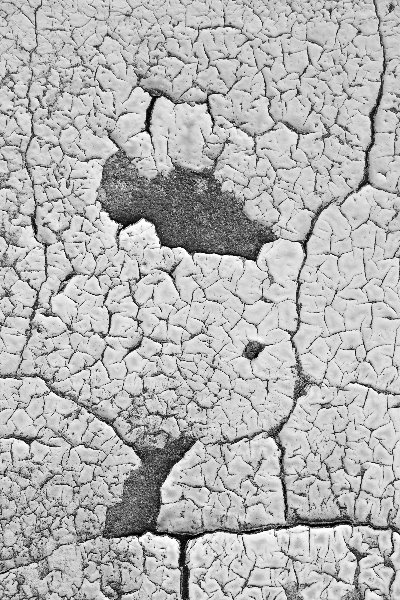
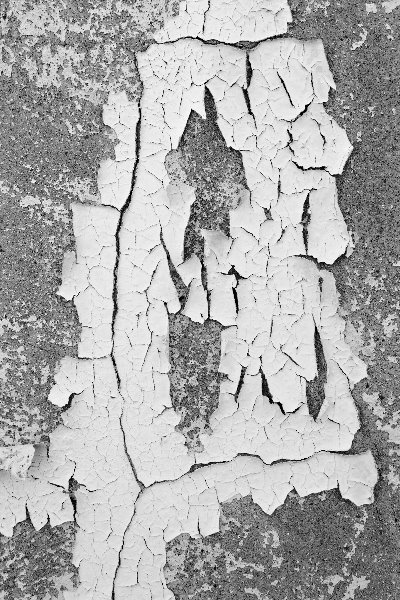
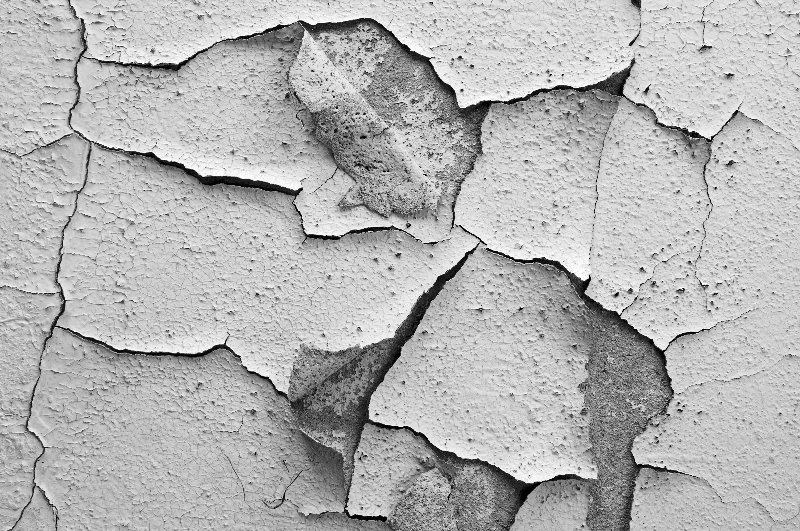
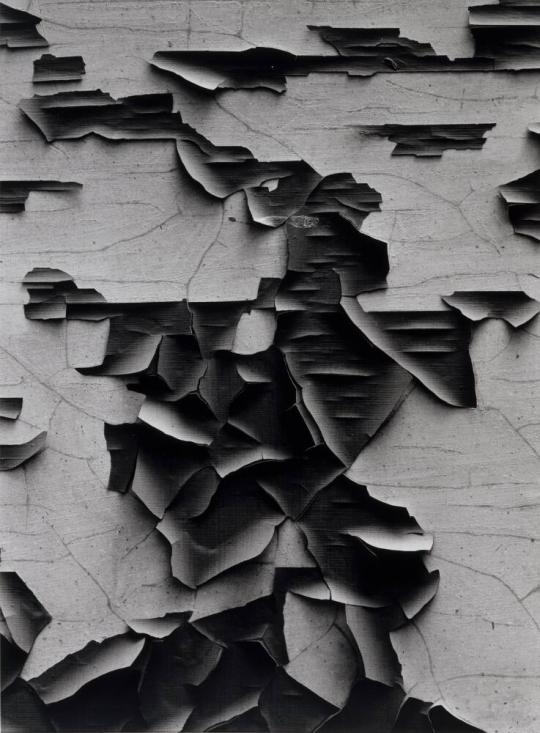
Thus, I present for your viewing pleasure a small selection of unabashedly Siskind-inspired (but distinctly Andy-esque) "peeling paint" abstracts (the one at the top is also mine, as is the one highlighting my last blog entry, Ergodicity & Art)...


Wednesday, March 29, 2006

Ten "Epiphanous" Photographs: #9

The ninth of ten "epiphanous photographs" - a hand-picked series of photographs as defined in an earlier Blog entry - is...

Epiphanous Photograph #9: Aaron Siskind's Jerome (Arizona, 1949)


Aaron Siskind (1903-1991), an American abstract expressionist photographer, began his career on his honeymoon, after receiving a camera as a wedding gift. Originally an English teacher, he later taught photography (with Harry Callahan) at the Institute of Design at the Illinois Institute of Technology in Chicago (from the 1950's into the 1980's). As an artist, he started taking documentary photographs of Harlem in the 1930s when he was a member of the New York Workers' Film and Photo League, but later evolved into a deep abstract impressionist, focusing his attention on cracked walls, peeling paint, fences, and graffiti. His own transition from documentary-style photography, and its strict adherence to the primacy of subject matter, to abstraction, as a conceptual and artistic vehicle for individual expression, marked a general turning point in twentieth-century American photography.

His Jerome, Arizona image is a good example of his unique artistic eye; it is also the very first image by Siskind that I can recall seeing (and being mesmerized by ever since!) While it shares the same basic abstract impressionistic aesthetic space as Weston's Pepper, Minor White's Capitol Reef, and Harry Callahan's Ivy Tentacles on Glass, it (and Siskind's whole general approach) represents a subtle departure from those other photographers.

For Siskind, the flat two-dimensional frame of the picture surface is the sole frame of reference of the photograph. As Siskind describes in an
exhibition catalog
of his work in 1965,...

"...The experience itself may be described as one of total absorption in the object. But the object serves only a personal need and the requirements of the picture. Thus, rocks are sculpted forms; a section of common decorative iron-work, springing rhythmic shapes; fragments of paper sticking to a wall, a conversation piece. And these forms, totems, masks, figures, images must finally take their place in the tonal field of the picture and strictly conform to their space environment. The obejct has entered the picture, in a sense; it has been photographed directly. But it is often unrecognizable; for it has been removed from its usual context, disassociated from its customary neighbors and forced into new relationships."

Weston, White and Callahan all taught (me) that "ordinary things" may be viewed (and understood) as symbols of abstract "otherness" (and, in White's case, of one's "inner state"); Aaron Siskind has taught me that when the last vestiges of all conventional reference frames are removed from a composition - deliberately, so as to force the viewer to rely on a more primitive language of context-less shapes and tones - a even deeper, ineffable beauty emerges. And Siskind's Jerome, Arizona is another reason I love fine-art photography. (More of Siskind's photographs can be seen here (#1) and here (#2).)