Showing posts with label Stieglitz. Show all posts

Tuesday, February 10, 2026

There is Light


 "Wherever there is light, one can photograph.
...
I have a vision of life, and I
try to find equivalents for it in
the form of photographs.
...
In photography there is a reality so subtle
that it becomes more real than reality."

- Alfred Stieglitz (1864 - 1946)

Saturday, March 16, 2013

Yesteryear Versions of Today's Magazines - Part 1

Continuing on with my recently started series of discussing / reviewing photography-related books that are a bit "off the beaten" path (i.e., not necessarily those that one would find on shelves at the neighborhood Barnes and Noble store but which would be of interest to the dedicated photographer), we introduce the first of two anthologies of magazines that are still around but containing articles once published a generation (or more) ago.

The first is Aperture Magazine Anthology: The Minor White Years, 1952-1976, edited by Peter C. Bunnell and published by Aperture (the second will be revealed in my next post). As the title suggests, Aperture was founded in 1952, and counted among its founders such luminaries as Minor White, Ansel Adams, Dorothea Lange, Barbara Morgan, Dody Weston Thompson, Nancy Newhall and Beaumont Newhall. Inspired, at the time, by the memory of Alfred Steiglitz's long defunct Camera Work (published by Stieglitz from 1903 to 1917), the original incarnation of Aperture continued Camera Work's devotion to quality reproductions, and added a generous bounty of thoughtful essays, commentaries, and reviews. Aperture's appearance coincided with an important crossroad at which fine-art photography found itself at that time, which in a sense mirrored a similar crossroad met head-on by Camera Work. Camera Work was conceived as a publishing vehicle to establish - and promote - photography as something more than "just" a mechanical means to mechanical means of reproducing "images out there, in front of a lens" (see Photo Secession); i.e. it sought nothing less than to establish photography as a fine art. Arguably, and in almost all important respects, it succeeded laudably in this goal. 

When Aperture arrived, some 35 years later, the "fine art" of photography had again come under assault. But this time - ironically - not because people did not accept photography as a bona-fide art form (the efforts of Stieglitz, Adams, Weston, and others had made sure of that!), but rather because so many simultaneous channels of expression had arisen in the intervening years - from the social-documentary-style that came into vogue in the 1930s to the new photojournalism introduced by Life in the 1940s to a new breed of photography that is now called "street photography" and honed to early perfection by Henri Cartier-Bresson - that the focus on "fine art" photography, for its own sake, had started to wane. And so, by the time Aperture arrived in 1952, the photographic world was ripe for a renewed discussion of photography as art.

Under White's editorship, all of the important fundamental questions one might expect to be asked of a still nascent "fine art" medium were asked and discussed, at length, by some of that bygone era's greatest masters. What is the creative potential of photography? What is the relationship between photography and art? What is the relationship between text and image? Is fine-art photography something that can be taught, and, if so, what is the best way to do so? What is the role of criticism? And so on.

Included in the 40 reprinted essays (by such masters as Adams, Newhall, Wynn Bullock, Aaron Siskind, Carl Chiarenza, and Frederick Sommer, among others) are 14 essays by White himself, making this an indispensable resource for admirers of Minor White and his philosophy of photography as a spiritually infused creative medium (a group to which I unabashedly admit my membership). The collection also includes a complete index of articles appearing in Aperture magazine from 1952 to 1976. Since (IMHO, and as I've written a few words about before) later versions of Aperture - beginning with perhaps the very first issue published after White's departure (he died in 1976), and including the run through the most recent issues - took the magazine onto a vastly different - dissonant even - path from the one it would have likely followed had it still been under White's leadership, those readers and photographers who - like me - feel a certain revulsion to the "shock element" that characterizes so much of today's "art photography," will cherish the timeless wisdom of a bygone era contained in this book. My only lament is that this anthology is not (yet?) available as an eBook.

Needless to say - but just to be clear - I am not affiliated with Aperture in any way.

Sunday, February 24, 2013

Reconnecting With "Older" Wisdom in a World of eBooks

For years, dating back to the early 90s, a good friend of mine (a co-worker on my "day job," fellow physicist, and part-time artist) and I have enjoyed a weekly lunch followed by a short sojourn to a neighborhood Borders book store (now defunct of course) or one of a few local Barnes and Nobles. Now, unfortunately (at least for us "oldies" who were weaned on the feel and smell of a good book), the writing seems on the wall for Barnes and Nobles to follow Borders' lead: recent reports indicate that the lone remaining brick & mortar national bookstore chain is about to embark on a plan that will close 100s of its stores. 

Though hardly a surprise, with Kindles and Nooks nearly as ubiquitous as smart phones these days, I must admit a profound sadness at the prospect of living in a physical-bookstore-less world. (I can only imagine the tragic depths of melancholy Borges would have been forced to endure in this "new" bookless world, had he lived this long - though, with an inevitable touch of irony, since the great conjurer of the infinite multiverse of libraries  himself possessed only a humble little bookshelf of books). 

Oh, I know all the familiar counterarguments, from, "Mom and Pop bookstores will never die"  to "second-hand bookstores will only grow" as the market for such "relics" inevitably expands (at least for a generation, like mine, that will always need a tactile reminder or two of a bygone era). There is also the happy reality that books - as literal purveyors of information - will truly never cease to be, but be merely transformed into something magical (as is already happening with a proliferation of "Borgesian" interactive hybrids of words, images, and videos). eBooks are a kind of living, self-transforming, digital palimpsests of their older tactile, static, cousins. Still, my innate desire to finger through some old dusty, moldy copy of some first edition will never wane.

Which brings me to how these general laments and musings bear on the subject of photography, and the real subject of this blog entry. To wit: I fear that our new eBook era makes it all too easy for young photographers to at best be ignorant of, and at worst, simply ignore, the "dated and / or irrelevant" photographic wisdom of past masters. Brooks Jensen, editor of Lenswork, recently posted a sad story (sad to me) about how a recent MFA photography graduate had no idea who Edward Weston was! 

Debates aside about whether this loss of awareness is real or illusory, or about how really "important" it is for one to be aware of the history of one's craft, whatever that craft, my perception is that the photography eBooks being published nowadays are rarely reprints of "older classics" (by and /or about past masters). For example, there are no eBook versions - that I am aware of - of any of Ansel Adams' classic texts (The Camera, The Negative, The Print); or of Weston's Daybooks; or even of, say, a relatively modern biography of an old master, such as, say, Alfred Steiglitz (written by Stieglitz's grand-neice, Sue Davidson Lowe).

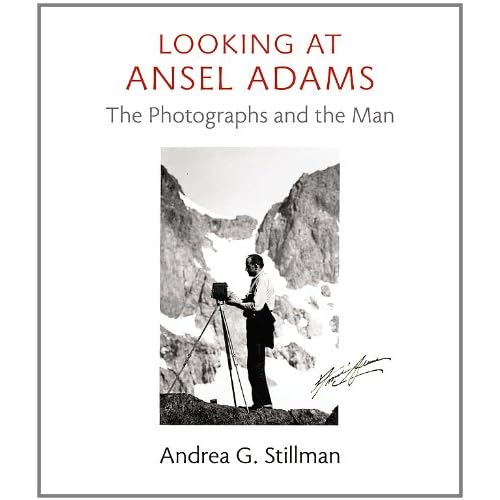
Still, there is hope, and some notable exceptions. One is a magnificent recent book by Andrea Stillman that provides the behind-the-scenes stories of 20 of Adams' most significant images (Stillman was Ansel Adams' assistant in the 1970s): Looking at Ansel Adams: The Photographs and the Man. Although published in hardcover (with great reproductions, including comparisons of how Adams' printing "eye" and aesthetics evolved over the years), Stillman's book is arguably even better in eBook form - available as an iBook for iPads and iPhones. The eBook provides audio, video, and links to additional material that only enhances the readers enjoyment of what is already a fine book. Kudos to Little, Brown and Company (the publishers) for bringing such a wonderful volume on Adams' work into the eBook age.

Another kudos goes to Allworth Press, which published in 2006 a wonderful collection of essays by and about "classic" photographers (already an anachronism for modern-day MFA students;-) called The Education of a Photographer; and who, more recently, released an eBook version of the book for the Kindle. I recommend it highly for students of photography (as well as to established modern photographers who want to discover or reacquaint themselves with the wisdom of past masters).

A third great book (albeit by more of a latter-day-master than a Weston or Adams era master) that now appears in both physical and iBook form is The Art of Photography: An Approach to Personal Expression by Bruce Barnbaum (one of our generation's most gifted photographers and printers). I still have a dogeared version of the book from back when its first or second version  appeared in the 80s. It is a stapled mess (I say that affectionately), contains no pictures, but is filled to the brim with timeless wisdom about the art and craft of photography. Barnbaum's deep insights into photography have now been brought more-or-less up-to-date (including a chapter or two on Photoshop, though these have the feel of "let's tag  this on for analog / darkroom veterans who want to whet their feet just a bit") and are a veritable steal at $12!

As I refocus my attention on my blog over the coming weeks and months (I have been "away" since Dec of last year completing the Russian edition of my dad's biography - multiple copies of which are on their way to the Taganrog museum in Taganrog, Russia as I type, to which my mom and I bequeathed 35 of my dad's works -  and completing my Synesthetic Landscapes portfolio, which I am happy to report will be published in the extended DVD edition of Lenswork #105 in the next month or so), I plan on devoting some time to reviewing / discussing several photography-related books that are a bit "off the beaten" path; i.e., books that are not necessarily something one would find on shelves at the the soon-to-be-closed Barnes and Noble store but which would be of interest to the dedicated photographer. Stay tuned.


Sunday, January 18, 2009

Learning to See from the Blind

Fine-art photography is first-and-foremost a visual language by which otherwise hidden truths and meanings - of the world and self - are revealed by the observer / artist. As such, it is rarely the case that what a photograph shows on its surface is the complete "message" that the photographer wishes to communicate. Indeed, philosophically speaking, one can say that fine-art photographers use images to provide glimpses of a reality that lies behind (and beyond) what the images represent, as things-in-themselves. Just as letters and words provide the basic units of grammar for literary artists to communicate essential truths that have nothing to do with letters and words, so too do light and form provide the visual grammar by which photographers reveal fundamental truths of nature (and our relationship with it) that have nothing to do with light and form. Art transforms the abject banality of sterile rules, internalized through years of rote memorization and practice, into an intimate expression of the ineffable.

So it should come as no great surprise (though, undoubtedly it will) that the blind - yes, the blind (!) - have much to teach those of us who are sighted about what real "sight" means. The image at the top of this blog entry is of the cover of an extraordinary book called Seeing Beyond Sight, lovingly put together by visual artist, Tony Deifell, and published by Chronicle Books in 2007. The book collects the works of visually impaired children during a five-year program of teaching photography to students at Governor Morehead School for the Blind in Raleigh, North Carolina, from 1992 to 1997. The book has a dedicated website; and an interview with the author has recently been posted on YouTube.

Mr. Deifell quickly addresses the most obvious question: "How can you teach photography to the blind?" On a practical level, even though most of the students involved could not see light, all of them were able to feel the heat due to light. Moreover, blindness does not preclude anyone from achieving a technical understanding of how a camera works, nor of learning the rudiments of good imaging technique. The more difficult question to answer - and what the book so beautifully explains by showing - is "How can the blind take pictures?" In a conventional sense, of course, they cannot; but only if by "taking pictures" we mean using the camera to record what they see visually. However, photography, in its purest form, is so much more than that.

Alfred Steiglitz, Henri Cartier-Bresson, and Minor White - among many other great "photographic seers" - teach us that the finest photography occurs when we are able to (recognize and) capture that special sliver of time during which the boundary between inner and outer experiences vanishes. Steiglitz called such photographs equivalents; Cartier-Bresson referred to the sliver of time as the decisive moment; and Minor White talked often of the profound role that spirit plays in photography:
"Be still with yourself until the object of your attention affirms your presence." - Minor White (1908 - 1976)
But whatever one chooses to call it, the underlying process - for the photographer - is always the same: the camera is merely a mechanical device (and certainly not the only such mechanical device, nor even necessarily the best one to use for this purpose!) that serves to focus our attention (to pressing the shutter) at precisely the right moment when our inner and external experiences align.
"I was thinking that it would be sort of hard for a blind person to take pictures, but it's not very hard. You've just got to listen." (John V., student, quoted on page 48 of Seeing Beyond Sight).
When the "feel is right" - when everything is in its place, when all the compositional elements have snapped into their positions, the shadows and forms are just where they all must be, and when, for the blind, the warmth of the sunlight on the wall is just so, the wind has quieted down, and is no longer heard, the reverberations of distant footsteps are no longer felt, and the texture of the floor is just the right mix of smooth and rugged against the palm of the hand, then we hit the shutter.

In truth, the sighted photographer responds no more to purely visual stimuli than does the blind photographer. All photographers, whether they do so consciously or not (and whether they are aware of it or not) depend on all of their senses to reach that wonderful instant when the shutter goes "click." One can argue that blind photographers, precisely because they do not respond directly to visual stimuli, are actually closer to the core truths and realities that lie beyond the light than photographers who must work their way through to truth (by brute force, so to speak).

Anyone can take a picture of a tree; because that is what is in front of the camera. It takes an artist to use the image of the tree to show you something else about the tree, or something else entirely that has nothing do with the tree per se. Since the visually impaired photographer has difficulty seeing the tree as a tree - indeed, the blind photographer does not see a tree at all - other associations and meanings must necessarily arise that, ultimately, result in some inner train of thought / intuition that concludes with the photographer making the camera go click.

Just as I consider color a "distraction" to the purity of forms and tonalities I try to reveal with my black and white photographs, I can see how light itself can be a distraction if what I am really after is illumination of what light reveals to me (but which I cannot take a picture of directly). It is a great irony - paradox even (!) - of photography that it so deeply but mechanically depends on something (i.e., light) that is, in fact, rarely the focus of its intended message. Even if the light itself is the message (as exemplified by, say, Galen Rowell's lifelong artistic pursuits), the photograph can only capture the effect that light has on whatever environment the photographer has selected to take a picture in, not the light in situ.

There is a touching - or, better, an illuminating - story about a blind student named Leuwynda, who captured a series of wonderful "abstract" photos of cracks in the sidewalk; which she clearly "saw" with her walking cane but which most people are oblivious to. She used her photographs as documentary "proof" of the danger that blind students face in what most would consider uneventfully "short walks" to class, and sent her images along with a letter containing a plea for help to the superintendent. Mr. Deifell muses, on behalf of the rest of us "sighted" photographers, about how many "cracks" there are in the world that we are essentially all blind to?
"If the lights are off, I can see what I'm doing." (Dain, student, quoted on page 138 of Seeing Beyond Sight).
Another student, Josh, produced some soulful photographs of dark, blurry stairs that he used to communicate - via metaphor - a dream he had about being lost and wandering aimlessly in a snowstorm. Other students started using their growing collections of photographs as a means to develop otherwise under-developed communication skills. Merlett, for example, was both blind and learning disabled, and found reading and writing akin to torture. Photography provided a new - and joyous - language in which she could express herself and, as it turned out, tell all the stories she had always wanted to tell others but could not do so in a conventional way.

The book contains a short introduction by the author (and teacher), followed by a selection of student photographs organized into five sections: (1) distortion, (2) refraction, (3) reflection, (4) transparence, and (5) illuminance. It concludes with an afterward, a short FAQ, and a summary of where the students who participated in the project are today.
"How do you not cut people's heads off in a photo? Just ask the person where they are." (Frances, student, quoted on page 112 of Seeing Beyond Sight).
For me, the book (and the project on which it is based) is a revelation. Were it not for the context in which the images in this book were captured, and the accompanying stories of how individual images came to be, one would be tempted to "dismiss" many of the photographs as "amateurish" and merit-less as fine-art. And that would be sadly unfortunate; for these images go to the heart of human experience and artistic expression. They show us what lies beyond the light that illuminates what we take pictures of, and what all photographers - with and without the gift of sight - are trying to reveal with their photography.

Anybody with a decent camera can take a picture of a crack in the sidewalk - and have the image met with blank stares and mutterings of "Yeah, it's a crack in the sidewalk., so what?" It takes a blind photographer to so effortlessly use a physical symbol - i.e., a photograph of some "thing" - to represent the deeper, inner experience of how "difficult it is to walk to class" on a campus built by people who can see. By not being able to see things, the blind photographer naturally focuses on using the things that the camera is able to capture to show what else things are. And that is what the very best photography has always been about.

While I have focused mainly on the philosophical end of the spectrum in this short commentary, I would be remiss in not mentioning that I was just as struck about how powerful a general learning tool - about self, about world, about learning (!) - the project was for the students involved. In some ways, though not quite as "obviously" dramatic - the results of the project remind me of Oliver Sacks' Awakenings (though here the "awakenings" are more spiritual than physical).

The blind obviously have much to teach us sighted photographers how to really see. They teach us to pay attention to all of the little "invisible cracks" in the world, and to not rely exclusively on our eyes in doing so. There is no better place to begin the first lesson on this journey of illumination - which takes the form of a gentle admonition to just "close your eyes" - than to savor the examples in this magnificent book, Seeing Beyond Sight. Highly recommended.

Postscript #1: There is recent evidence that suggests that "blindsight" - i.e., the ability "see" even if completely blind to visual stimuli - is real (and is due to previously unknown ancient evolutionary sensory pathways). See Blind Man Navigates Maze.

Postscript #2: A few days after posting my blog entry, I ran across another review of Seeing Beyond Sight very much in the spirit of mine; which is to say, philosophically infused and considerably more about "seeing" than seeing.

Postscript #3: There is a similar, but unrelated, book about photography by visually impaired photographers, called Shooting Blind, published by Aperture. An associated website also contains some extraordinarily haunting photographs.

Wednesday, October 08, 2008

The Allure of Abstraction and the Difficulty of Defining It

"Abstraction allows man to see with his mind what he cannot physically see with his eyes... Abstract art enables the artist to perceive beyond the tangible, to extract the infinite out of the finite. It is the emancipation of the mind. It is an explosion into unknown areas." - Arshile Gorky

I have written about abstraction, at least as it applies to photography, a number of times on my blog. But always more implicitly rather than tackling the subject head-on; musings lurked in the background and served more as highlights and accents to the images rather than the main source of discourse. I've certainly posted more than a fair share of abstract images, since that is what my eye responds to most strongly. Indeed, my last three major projects were all heavily abstract: micro worlds, mystic flame, and glyphs. So abstraction is obviously on (and "in") my mind, quite strongly. But I'm not quite sure whether it's more my inner "I" or my outer "eye(s)" that is responsible for abstraction being such a deep rooted meta-pattern in me. So that's the subject of this post.

So, "What is an abstract photograph?" A simple (but far from complete) answer is that it is any image that does not depict anything that is "obviously" representational. By that I mean, whatever shapes and forms it appears to depict, none (or, at most, only a small subset) of them are obviously something that is recognizable; or, if it is recognizable, it is not uniquely so, as the shapes and forms can be interpreted in multiple self-consistent ways. This loose definition also allows for innately recognizable "objects" to be assembled (or composed) in an otherwise unrecognizable way (or that renders the collective unrecognizable as a whole).

A recent editor's note in Photo Techniques magazine (by Jerry O'Neill, Nov/Dec 2008 issue) revealed that Google is about to embark on a massive image cataloging task, in which it is anticipated that upwards of a trillion images will be parsed and indexed according to their content, rather then (as done now) by label. While the methodology to be employed is naturally left unspecified and proprietary, undoubtedly it will consist of some kind of AI-assisted pattern recognition of specific features and rudimentary scene analysis (such as facial contours, buildings, trees, water, and so on). It will be interesting to see what technique the Google researchers have come up for recognizing and indexing abstract images; i.e., images that do not contain anything "obviously recognizable." Will there be primitive categories of tone, shape, and texture? (Which apply equally well, of course, to non-abstract images!) How will an ostensibly "obvious" head shot of a horse, say, differ in Google's catalog from another one in which the contours are deliberately cropped (focusing, say, only on the mane of hair) and facial features either blurred or photoshopped away, rendering the image all but unrecognizable? At what point will one type of image transition into another? Even more simply, beyond referencing an image as "abstract" (by what measure?), what finer distinctions will be made in that class, and how will they be defined?

Google's laudable objective is to provide users with a way to find images according to what they innately depict, rather relying on someone else's depiction (via external label or reference) of what the images contains; and to do so automatically, by scanning the image itself. The problem, with both practical and philosophical components, is that the more abstract the image, the more difficult it becomes to distill it into a few simple features.

In some ways, this reminds me of an idea in theoretical computer science that has do with how one can tell whether a sequence of numbers, say, is random. The mathematically precise way of distinguishing random from nonrandom sequences, is that nonrandom sequences may always be compressed into something shorter than themselves; a random sequence cannot. Thus an otherwise infinite sequence that starts out and continues ad infinitum as "111011101110..." may be compressed by the much shorter (than infinite) description, "an infinite sequence of the symbol set 1110." In essence, one exploits an inherent pattern or symmetry, and uses that innate feature to compress information; or to more optimally express the information content. But a truly random sequence cannot be compressed into anything shorter. In order to communicate what the sequence is to someone else, one must exhaustively list each symbol that appears, for as long as patience permits.


However, some special random sequences, like the digits of Pi=3.14159..., may yield to a compressed description, such as "sum this infinite series..."; which raises the intriguing question of whether there are "special" abstract images in art and photography that similarly yield to "simpler" distillations? One possibility is that while some abstract images in the sense defined above are "random" (in a mathematical sense) and therefore are generally unyielding to distillations, there are also those that - despite not depicting any obviously recognizable thing - nonetheless evoke (in some quasi universal way that depends on the viewer's cultural background, for example) some obviously recognizable feeling (or a subliminal mood). A long time-exposure of waves in the ocean far from shore may not at all be "obviously long time-exposures of waves" (and thus not easily conducive to simple distillations: I wonder how Google's indexing will handle this case?), but may evoke very similar emotional responses in different people. An aesthetic compression based on evoked emotion rather than on the objective content may be much more useful in such cases. On the other hand, some other abstract, one that is perhaps created very artistically using some clever combination of light and shadow, may neither depict anything "obviously recognizable" nor evoke any universally shared feeling. A multiple exposure of a dozen separate shots, each of which is itself an "abstract" might be an example. I'd also be interested to learn how Google will handle such examples.

As for the philosophical dimension of abstraction, at least for me as a photographer, I tend to use abstraction in the classical (Alfred) Stieglitzian way; i.e., as "equivalents" of my inner emotional or cognitive states. Of course, I fully understand that there is a much greater chance that the viewer will not respond to an image in a way that mirrors my inner state when I created it than that the image conveys to the user what I really felt when I pressed the shutter. There are simply too many variables impossible to account for or control. But it is also often true (at least for me) that it is impossible to convey the feelings I have about a subject or scene without resorting to abstraction. It is certainly not true in all cases (sometimes a red barn is exactly what I need to express the beauty of redness). But as I grow as a photographer, and experiment with new techniques and ideas for projects, I am finding my artistic path moving ever more deeply into the abstract part of the aesthetic forest.

Perhaps, just as there are no "simplifications" of truly random number sequences, the purest form of abstraction is the one for which there is no better distillation than the abstraction itself. Then again, isn't that generally true of all art?

Sunday, September 16, 2007

Concerning the Spiritual in Photography

"The great epoch of the Spiritual which is already beginning, or, in embryonic form ... provides and will provide the soil in which a kind of monumental work of art must come to fashion," so prophesied the great Russian painter, Wassily Kandinsky, in his masterful Concerning the Spiritual in Art, published in 1914. Since then, of course, and to varying degrees, art has been replete with many aspects of the spiritual; indeed, the traditionally religious-centric interpretation of the term has on occasion been considerably expanded by art to include mysticism, ritual and myth, symbolism, the occult, and pure abstraction. A wonderful book - The Spiritual in Art: Abstract Painting 1890-1985 - that chronicles much of the history of spiritual art, and contains many wonderful reproductions of important works, was published in 1985 to highlight an exhibit held at the Los Angeles County Museum of Art. A recent Dover reprint of another classic survey - The Spiritual in Twentieth-Century Art - is also available; though it has only a relatively few black and white examples, the scholarship is first-rate.

The impact of the "spiritual" on photography is less clear, and has - sadly - less of a clear history. To be sure, the spiritual has never been far from photography's best practitioners; though not necessarily in overt form. Alfred Steiglitz's "Equivalents" are nothing if not quiet, soulful expressions of an inner reality, and are obviously infused with spirit in the deepest sense. Ansel Adam's portfolio of ostensibly "grand sweeping vistas" filled with Wagnerian-scale drama, are both creative affirmations of everything that is beautiful "out there," beyond the artist behind the lens, and of the poetic soul yearning desperately for a way to better communicate the transcendent beauty it sees on the inside. Adams' quest was a quintessentially spiritual one, much more so than merely aesthetic; a quest that is, regrettably (and profoundly erroneously, in my view), all-too-quickly dismissed by some latter day photographers as a product of "vision-less" Zone-system technobable and attention to irrelevant minutiae of craft. Many of Minor White's best works can be compared to those of Kandinsky, in the sense that both artists (used their respective media to) point a way toward a radically new grammar for spiritual expression. And Carl Chiarenza's visionary explorations of the "inner landscape" have been available for all to "see" for decades.

Still more recently, I've encountered the works of spiritually inclined artists such as Doug Beasley, Nicholas Hlobeczy, John Daido Loori, Deborah Dewit Marchant, and Jerry Wolfe, who each in their own way, pay homage to the spirit of Steiglitz's equivalents, and use their photography to reveal otherwise invisible realms of the soul. (Not surprisingly, Hlobeczy, Loori, and Wolfe all worked with Minor White.)

But, though there are plenty of other contemporary photographer / artists whose work is very spiritual in nature, there is little evidence to suggest that "spiritual photography" (at least in the sense I mean here) is emerging - or has ever emerged, for that matter! - as a bona-fide movement in photography. Indeed, if books such as reGeneration: 50 Photographers of Tomorrow (published, ironically, by Aperture, a magazine founded by Minor White and Ansel Adams!) are true indicators of the direction in which photography is currently "moving," that direction is visibly leading away from, rather than anywhere near, spirit. Deliberately staged images that shock and pound the senses into a surrealistic (and often numbingly ugly) unreality seem to be the norm; pictures that invite a quiet meditation or that simply, but sincerely, ask, "Is this not beautiful?" are rarely seen today - and when they do appear, are routinely scorned by critics as unimportant "pretty pictures" that convey no lasting meaning. (Christopher Alexander has been lamenting a similar spiritual decline in architecture and urban planning for a quarter century.) I hope I am wrong, for to move away from spiritual expression is, in my opinion, to move away from the most meaningful connection we have to the spiritual world - which is our essential wellspring of existence - as physical beings. Severing this connection, even if only implicitly by focusing our collective artistic / photographic energies onto more "sterile" - and spiritually inert - aspects of the world, means we must face the specter of losing ourselves in (or devolving backwards to) the merely physical.

For me, photography, or any other creative art form for that matter, is first and foremost a language of the transcendent; it represents a way for gifted "seers" - otherwise known as "artists" - to remind the rest of us that none of us are merely creatures of the flesh.

Friday, December 01, 2006

Poetic Light


Every once in a while, a small gem of a book appears on the landscape; that is at once both humble and profound. Deborah Dewit Marchant's Traveling Light: Chasing an Illuminated Life is just such a gem. A small book - but only as measured by its physical size - it contains some of the most beautifully tranquil and ethereal imagery I have seen in a long while; the meditative contemplation of which is nourished by a generous sampling of lovingly poetic musings on the artist's life of yearning and searching for sources of illumination, from both outward sources and those inwardly directed. One of the purest forms of "fine-art" photography - with an emphasis very much on art - appears when "mere images" are used by the artist to convey both personal realities and universal truths. This can only happen when the artist has so mastered the symbolic language of his/her own creation, that the distinction between inner and outer worlds either blurs, or disappears altogether. Images become both figure and ground, are both context for deeper meaning and meaning giving rise to deeper contexts, and simultaneously represent objective "reality" and the most mysterious, deeply subjective, inner experiences. The highest form of "fine-art photography not only pleases us aesthetically (and, maybe, intellectually), but also teaches us something timeless about ourselves. It is a mystery how an image captured by one person can teach some other person something about him/her self; but when it happens it is often magical, and points to hidden realms of shared experiences and realities. By this measure of "fine-art" photography, at least, Marchant's art, as witnessed by the work appearing in her beautiful first book, is masterful indeed! I suspect that many will want to keep this volume by their bedside, if only to be gently reminded at the end of a stressful day that there is great joy and grace in the world, and that more of us would be able to see it, if only we could train our eyes, our hearts and souls to recognize it. Marchant has gone out and captured it for us, and I, for one, wish to thank her for sharing her experience. Anyone who is not moved - at some level - by this stunning book of "illuminated poetry" cannot possibly be alive ;-) ... for such is its spiritual reach. If Alfred Stieglitz were alive today, I am sure he'd proclaim, "Yes, yes, THIS is why photography is art!" You can see some of Marchant's photographs (as well as pastel drawings and oil paintings) on her website.

Wednesday, September 06, 2006

The EightFold Way of an Artist


While on a recent reconnaissance mission for a new image series, I experienced a mini-epiphany with regard to my (embarrassingly slow!) maturation as an artist. Before I expand on this muse, I need to briefly explain what I mean by "reconnaissance " and "image series"...by "reconnaissance" I mean a scouting out of potential photo sites: an excursion to a new park, a farm, a garden, or an out of the way road. Sometimes I go with my camera; sometimes I deliberately choose not to, and instead just walk around a place (with hands clasped behind my back, as my artist dad used to do as though it were genetically prescribed, which in his case it might well have been!) to get the feel of a new place. By "image series" I mean the set of photos that, by design (though chance also plays a vital part), revolve around a single theme: portals, light, reflections, complexity, decay,...

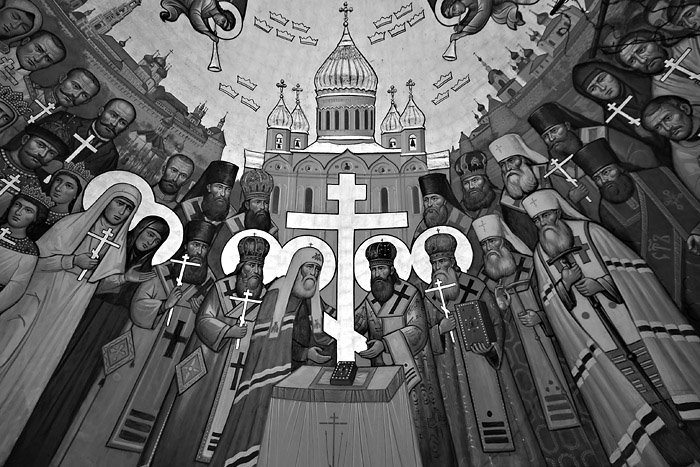
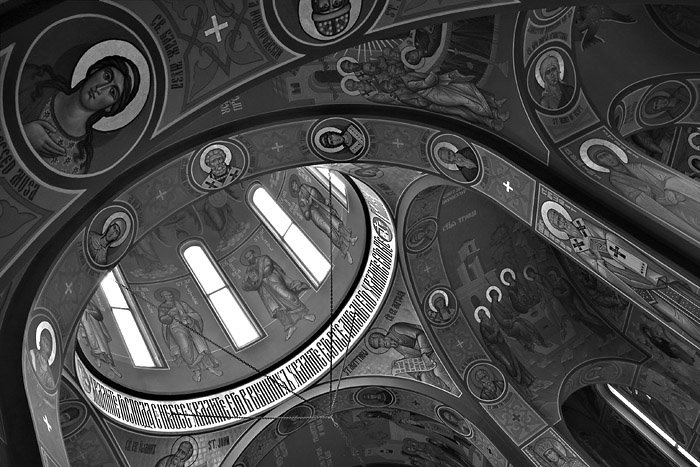
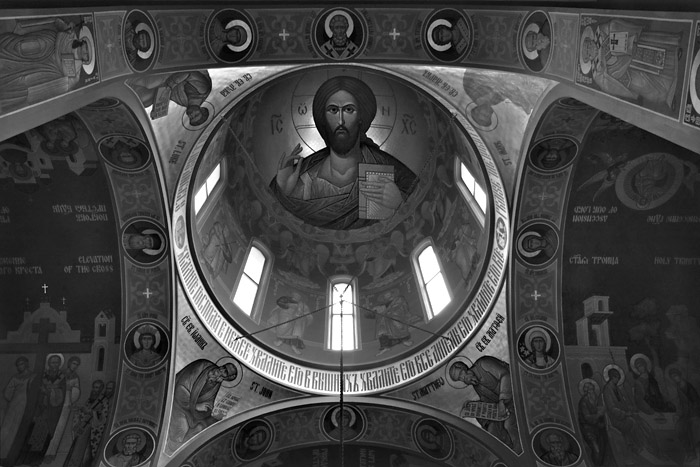
And so, on to my muse...I was on my way this past weekend to reconnoiter a local Russian Orthodox Church for a new image series called Light & Spirit, only to find it locked, with no one around to open it. As I started on my way back home, I noticed that I was not far from an old haunt of mine, a place I took about a dozen trips to while capturing images for a series eventually called "Entropic Melodies" (a few of which wound up in B&W Magazine last year). I have many fond memories of spending many wonderfully creative hours prowling around that place. But, despite having a few unexpected hours at my disposal on the heels of discovering a locked church, I had absolutely no desire to stop by my old haunt to capture a few photographs!


It was upon my honestly asking myself "Why didn't I stop to take some pictures?" (while waiting, ironically, at a stop light) that I had my sudden epiphany. I did not stop because my old haunt is no longer an active part of my creative landscape. I had, in short, moved on. The spark that lights my photography at a given place and time had been ignited - and is burning - but elsewhere. And it is that spark that drives my work.

My photography has, in recent years, slowly evolved from my being content to "shoot away" at will at a beach or park, with no specific artistic "goal" in mind other than to maybe capture a nice image or two, to a point where, if I have not managed to capture a series of strong enough images to convey something (ala Steiglitz or Minor White) of my inner state of mind (soul) while taking them, I am considerably less than satisfied. I yearn to tell a deeper story!

The keys here are:

(1) Recognizing, and being able to communicate, something aesthetically deeper than just the representational "surface layer" of a given image, and

(2) Imagining, and being able to use, a series of images to convey something of my inner experience of a place, as I am shooting it.

Thus, I am no longer content to "merely" capture a mysterious ethereal glow to an otherwise withered old window; I need to use that image, and another, and a third, and perhaps a dozen more like it (or entirely different from it!) to weave a still more mysterious narrative of what I felt (and maybe a bit of what I thought!) as I was transfixed on training my camera on withered old windows.


In trying to place my mini-epiphany-inducing locked-Church experience this weekend into a broader context, it occured to me that all photographers - indeed, perhaps all artists - inevitably go through some version of the following basic stages of what might suggestively be called the Eightfold Way of an artist:

(Stage 1) One learns the technical aspects of his/her craft. In the case of a photographer, this amounts to learning how to use a camera (the meaning of an f-stop, what ASA/ISO means, how to properly meter a scene, and so on), and learning to use a darkroom (analog or digital) to produce prints. The emphasis in this stage is on the formal, mechanical aspects of an art (which is not quite an "art"). The lessons are stored in short-term memory, and must often be practiced to the point of tedium in order to commit them to long term memory that, eventually, renders them automatic.

(Stage 2) Once the mechanical has become second nature, the first hint of real art appears. The basic tools of the craft are first used as tools of the trade, though perhaps still in rudimentary fashion. The camera is used to record the "objects" of the world that are of interest to the budding artist: a person, a flower, a tree, and so on. But little or no attention is given, at this stage, to anything other than a technically correct "capture" of an image; and a representational one at that. It is rare for a budding artist to skip this representational stage and move directly to an expressionist, or even abstract, rendering of the world.

(Stage 3) In the third stage, the emerging artist takes his/her first tentative steps towards using (the, by now, technically well executed) images to express something uniquely of themselves. It is not necessarily "timeless art" in the tradition of an Ansel Adams (since most artists will never even come close to achieving this lofty ideal); but it is "art" in the sense that the artist, having now mastered the tools of his/her trade, now uses them mindfully to convey an artful message. The image of a tree ceases to be merely a representation of a "pretty tree" and becomes, instead, a personal expression of "using the photographic capture of a tree to communicate X", where "X" is a message of the artist's own choosing. Stage three is both an "easy" step to take (at least for those meant to live a life of art); and a profoundly hard one to take naturally (since even the most committed artists often have a hard time disentangling what others expect them to create and what they themselves need to create). No one can make it to Stage 4 (and higher) without stumbling through the Stage 3 roadblock.

(Stage 4) The fourth stage is a deeper imprint of the process started in stage 3. Where stage 3 sees the artist use his/her craft to communicate an artful message, stage four invites the artist to develop a personal language that uses outward forms (captured by the camera) to express inner realities. Thus, stage 4 is where the objective meets the subjective for the first time. A found/created image retains its representational form, but is infused with the first light of transcendence by its conveyance of distinctly non-representational inner meaning. A given image is used to reflect the artist's inner experience of the context for the image at the instant of capture; think of Steiglitz's "equivalents" or Minor White's Zen-like approach to using photography as a probe of his inner self).

(Stage 5) Stage 5 (which is where, if I'm in a particularly happy mood, I allow myself to believe I'm taking a tentative step toward) is where the photographer first turns his/her attention to using a series of images to communicate - and share - a broader, deeper, experience of some meaningful reality in space and time. In short, to use images as an experiential, narrative grammar that may be used to recreate and communicate something of what the photographer felt while being in a place a camera for a time longer than an instant. When a photographer reaches stage 5, a single image no longer seems to suffice, and even a few feel stifling and incomplete. The photographer now actively seeks narratives with his pictures, and tends to use multiple images to communicate deeper experiences.

(Stage 6) As Stage 4 is a deeper imprint of stage 3, all successive stages from stage 5 and higher are essentially deeper imprints of the stages below them. Having mastered (by stage 5) his/her own creative grammar, the artist in stage 6 moves on to develop his/her own artistic language. Multiple series of images are still used, and the "subject matter" remains essentially the same, but the creative product is a subtly more profound, and resonates on many more levels (in the communication between artist and viewer). Paradoxically (though "obviously so" if you've been following the argument thus far), fewer people are able to "appreciate" what the emerging artist is using his new personal language to express; the artist need not fear this stage (though all do!), for this is also a landmark along the path to finding one's art (and soul). We cannot expect everyone to listen to what we have to say; or to hear us when we say it. The fact that fewer do than did before (at this stage) is a sign that both what we are saying and how we are saying it is becoming indelibly fused with who we are, at our core. And we are all different.

(Stage 7) Stage 7 sees the photographer embark on an even broader vision quest to use his/her art to communicate not just inner (and intensely personal) experiences, but universal truths as well. The photograher, at this stage, wishes to use photography (and art in general) to express an (objectively invisible) universe of subjective truth. No longer confined to the space of personal narrative, the artist's creative space encroaches the whole human experience of reality. The focus is now less on physical experiences, and more - often, much more - on spiritual experiences. Light, for example, as the pre-grammatic form of an artist's personal photographic grammar and language, is no longer just a counterpoint to tone and darkness, but is a symbolic pointer to a spiritual realm. The artist, once he/she enters stage 7, leaves the merely physical realm (and its myriad subjective descriptions), and enters the ineffably spiritual universe.

(Stage 8) Stage 8, which few artists encounter, but those that have, have obviously done so (at least to those viewers who still understand their "language"), sees the artist, in the deepest sense possible, come home, full circle...

“Before I had studied Zen for thirty years,
I saw mountains as mountains,
and waters as waters…

When I arrived at a more intimate knowledge,
I came to the point where I saw
that mountains are not mountains,
and waters are not waters.

But now that I have got its very substance
I am at rest.
For it's just that I see mountains
once again as mountains,
and waters once again as waters.”


— Ch'uan Teng Lu, The Way of Zen

...the artist's work is now so evolved, so personally attuned to the cosmos, and universal, that - at least on the best of days - the artist is finally able to convey all that is with, seemingly, hardly any effort, or even artwork (!) at all. A humble little single picture, perhaps not even one of anything recognizably real, or, just as likely, of something most people would think banal, now suffices to communicate (to the best of the artist's gifts and skills) the truths that are usually home only to young children and mystics. All is finally seen as one; and it is up to the viewer to see the one and appreciate, and marvel at, how the artist has rendered it as all.


Postscript: I have no doubt that my dad (about whom, and about whose art, I have written before on this Blog) is among the precious few souls who have attained the rarefied air of Stage 8. Here is his very last painting, created sometime shortly before he died on March 30, 2002. This from a man who amassed a lifetime's worth of skills, who sketched and painted countless landscapes and portraits, and, right up until his death, produced complex, multilayered abstracts the likes of which even Kandinsky would be proud! But his final image (that only those who did not know him would say was "obviously" drawn by a child) is a perfect - perfect! - narrative of my dad's artful journey: a joyous celebration of life and spirit.