Showing posts with label Fish. Show all posts

Friday, September 19, 2025

Ineffable Flow


"Water flows, clouds move,
never stopping or settling down.
When the wind blows, the leaves fall.
Like the fish swimming
or the birds flying,
I walk and walk,
going on and on."

- Santōka Taneda (1882 - 1940)

Saturday, June 17, 2023

Time is a Sea


"Time is all-embracing. Everything is in time. When is four o'clock? In time. When did Socrates live? In time. When will you keep still? In time. How can time hold so much? Time is very big. The fishes are in the water. The ships are in the sea. The stars are in the sky. The birds are in the air. And all things, fishes and water, and birds and air, and stars and sky are in time. Time is immense. Without water fish cannot swim. Without air birds cannot fly. Without sky the stars cannot shine. The water carries the fish, the air carries the birds. The sky carries the stars. Water, air, and sky are buoyant. And water and air and sky are themselves buoyant, buoyed, in buoyantest time. Time is all-embracing, all-embuoyant. And if, now, everything is in time, is time also in all things? Are not all things time-embracing? Mutual love! It is so. Time permeates all things. Lift the tiny scales of little fishes, time is there. Examine the entrails of birds, time is there. Tiresias knew. And in the hottest regions of the stars, time is there. In the drop of water, in the breath of air, in a patch of sky, time is there. Time permeates all things. And now we can also understand the words: 'on which we and all the universe swim.' For as fish swim in the water and birds swim in the air and the stars swim in the sky, so all swimming in the water and all swimming in the air and all swimming in the sky are swimmings in time, the sea, air, sky, of time. Time is a sea, an air, a sky. "

-  O. K. Bouwsma (1898 - 1978)
The Mystery of Time

Monday, March 06, 2023

Cartesian Fallacy


"The universe is wider than our views of it."

Henry David Thoreau (1817 - 1862)

"Logic does not lead us from the fact that we are an integral part of the web of life to certain norms of how we should live. However, if we have the deep ecological experience of being part of the web of life, then we will (as opposed to should) be inclined to care for all of living nature. Indeed, we can scarcely refrain from responding in this way. 

By calling the emerging new vision of reality 'ecological' in the sense of deep ecology, we emphasize that life is at its very center. This is an important issue for science, because in the mechanistic paradigm physics has been the model and source of metaphors for all other sciences. 'All philosophy is like a tree,' wrote Descartes. 'The roots are metaphysics, the trunk is physics, and the branches are all the other sciences.'

The systems view of life has overcome this Cartesian metaphor. Physics, together with chemistry, is essential to understand the behavior of the molecules in living cells, but it is not sufficient to describe their self-organizing patterns and processes. At the level of living systems, physics has thus lost its role as the science providing the most fundamental description of reality. This is still not generally recognized today. Scientists as well as nonscientists frequently retain the popular belief that 'if you really want to know the ultimate explanation, you have to ask a physicist,' which is clearly a Cartesian fallacy. The paradigm shift in science, at its deepest level, involves a perceptual shift from physics to the life sciences."

Fritjof Capra (1939 - ) and Pier Luigi Luisi (1938 - )
The Systems View of Life: A Unifying Vision

"Nature is an infinite sphere
whose center is everywhere and
whose circumference is nowhere."

Blaise Pascal (1623 - 1662)

Sunday, October 09, 2022

Idea Chasing


"Chaos is what we’ve lost touch with. This is why it is given a bad name. It is feared by the dominant archetype of our world, which is Ego, which clenches because its existence is defined in terms of control...The creative act is a letting down of the net of human imagination into the ocean of chaos on which we are suspended, and the attempt to bring out of it ideas.  It is the night sea journey, the lone fisherman on a tropical sea with his nets, and you let these nets down – sometimes, something tears through them that leaves them in shreds and you just row for shore, and put your head under your bed and pray.  At other times what slips through are the minutiae, the minnows of this ichthyological metaphor of idea chasing. But, sometimes, you can actually bring home something that is food, food for the human community that we can sustain ourselves on and go forward."

Terence McKenna (1946 - 2000)

Wednesday, September 28, 2022

Peaceful Moments


"How peaceful it was, with the light evening breeze stirring the small leaves of the grapevine that clustered around the electric bulb, making the shadows move and change on the yellow mat below. For a moment he pushed aside the thought of money. From time to time the dark water beside them rippled audibly, as if a tiny fish had come to the surface for an instant and then darted beneath. It was in peaceful moments such as this, his father had said, that men were given to know just a little of what paradise was like, so that they might yearn for it with all their soul, and strive during their time on earth to be worthy of going there."

- Paul Bowles (1910 - 1999) 
The Spider's House

Tuesday, December 14, 2021

Forget About Words


"A fish-trap is for catching fish;
once you've caught the fish,
you can forget about the trap.
A rabbit-snare is for catching rabbits;
once you've caught the rabbit,
you can forget about the snare.
Words are for catching ideas;
once you've caught the idea,
you can forget about the words.
Where can I find a person who
knows how to forget about words
so that I can have a few
words with them?"

Chuang Tzu (c.369 B.C. - c.286 B.C.)
The Essential Writings

Friday, September 24, 2021

Universal Causation


"But the scientist is possessed by the sense of universal causation. The future, to him, is every whit as necessary and determined as the past. There is nothing divine about morality; it is a purely human affair. His religious feeling takes the form of a rapturous amazement at the harmony of natural law, which reveals an intelligence of such superiority that, compared with it, all the systematic thinking and acting of human beings is an utterly insignificant reflection. This feeling is the guiding principle of his life and work, in so far as he succeeds in keeping himself from the shackles of selfish desire. It is beyond question closely akin to that which has possessed the religious geniuses of all ages."

Albert Einstein (1879 - 1955)

Wednesday, May 20, 2020

Soul and Landscape


"It is one of the perils of our so-called civilized age that we do not yet acknowledge enough, or cherish enough, this connection between soul and landscape - between our own best possibilities, and the view from our own windows. We need the world as much as it needs us, and we need it in privacy, intimacy, and surety. We need the field from which the lark rises - bird that is more than itself, that is the voice of the universe: vigorous, godly job. Without the physical world such hope it: hacked off. Is: dried up. Without wilderness no fish could leap and flash, no deer could bound soft as eternal waters over the field; no bird could open its wings and become buoyant, adventurous, valorous beyond even the plan of nature. Nor could we."

- Mary Oliver (1935 - 2019)

Sunday, April 19, 2020

Other Worlds


"Our universe is what it is simply because we are here.

The situation can be likened to that of a group of intelligent fish who one day begin wondering why their world is completely filled with water.

Many of the fish, the theorists, hope to prove that the cosmos necessarily has to be filled with water. For years, they put their minds to the task but can never quite seem to prove their assertion.

Then a wizened group of fish postulates that maybe they are fooling themselves. Maybe, they suggest, there are many other worlds, some of them completely dry, some wet, and everything in between.”

Alan Lightman (1948 - )

Sunday, October 14, 2018

Precious Stillness


"Do not burn yourselves out. Be as I am - a reluctant enthusiast....a part-time crusader, a half-hearted fanatic. Save the other half of yourselves and your lives for pleasure and adventure. It is not enough to fight for the land; it is even more important to enjoy it. While you can. While it’s still here. So get out there and hunt and fish and mess around with your friends, ramble out yonder and explore the forests, climb the mountains, bag the peaks, run the rivers, breathe deep of that yet sweet and lucid air, sit quietly for a while and contemplate the precious stillness, the lovely, mysterious, and awesome space. Enjoy yourselves, keep your brain in your head and your head firmly attached to the body, the body active and alive, and I promise you this much; I promise you this one sweet victory over our enemies, over those desk-bound men and women with their hearts in a safe deposit box, and their eyes hypnotized by desk calculators. I promise you this; You will outlive the bastards."

- Edward Abbey (1927 - 1989)

Tuesday, September 25, 2018

Ocean of Chaos


"The creative act is a letting down of the net of human imagination into the ocean of chaos on which we are suspended, and the attempt to bring out of it ideas.

It is the night sea journey, the lone fisherman on a tropical sea with his nets, and you let these nets down - sometimes, something tears through them that leaves them in shreds and you just row for shore, and put your head under your bed and pray. 

At other times what slips through are the minutiae, the minnows of this ichthyological metaphor of idea chasing.

But, sometimes, you can actually bring home something that is food, food for the human community that we can sustain ourselves on and go forward."

- Terence McKenna (1946 - 2000)

Tuesday, February 09, 2016

Bildung , Gestalten, and Metamorphosis


“If we look at all these Gestalten, especially the organic ones, we will discover that nothing in them is permanent, nothing at rest or defined—everything is in a flux of continual motion. This is why German frequently and fittingly makes use of the word Bildung [formation] to describe the end product and what is in process of production as well…. When something has acquired a form it metamorphoses immediately into a new one.

...We will see the entire plant world, for example, as a vast sea which is as necessary to the existence of individual insects as the oceans and river are to the existence of individual fish, and we will observe that an enormous number of living creatures are born and nourished in this ocean of plants. Ultimately we will see the whole world of animals as a great element in which one species is created or at least sustained, by and through another. We will no longer think of connections and relationships in terms of purpose and intention; we will progress in knowledge alone through seeing how formative nature expresses itself from all sides and in all directions.

...Among the objects we will find many different forms of existence and modes of change, a variety of relationships livingly interwoven; in ourselves, on the other hand, a potential for infinite growth through constant adaptation of our sensibilities and judgment to new ways of acquiring knowledge and responding with action."

(1749 - 1832)

Sunday, October 30, 2011

Pikes, Minnows, and Parks (and a Lesson, Oh My)


"The hardest thing to see is what is in front of our eyes." - Johann Wolfgang von Goethe

During a visit to see my mom on Long Island the other week, my younger son and I stumbled across a beautiful park - no more than a stone's throw away from the house I grew up in - that I never knew existed! Well, I knew of the place, and of its beauty, but not of the park's presence. And therein lies an important lesson that owes its origin to pikes and minnows.

Years ago, I read of an experiment in which some biologists used cameras to record the actions of a large northern pike inside of an aquarium filled with small minnows. Initially, the pike did exactly what one would expect a pike to do under those circumstances; namely, it enjoyed a feast of a lifetime, since it was surrounded by its favorite food.

But then the researchers placed a glass barrier between the pike and the smaller fish. Each time the pike attempted to grab a minnow, it struck its head on the glass. After many repeated failures, it simply stopped trying altogether. The researchers waited until after the pike was clearly hungry and removed the barrier, thus allowing the minnows to swim toward the pike. What did the pike do? Absolutely nothing! Having "learned" that feeding on the minnows was anything but productive (indeed, even painful), the pike blissfully ignored an aquarium-full of food source. It eventually died from starvation. Despite being immersed in a field of nourishment, it believed none was attainable.

And so we come to our newly "discovered" park... I have known about this place ever since I was about 10 or so (i.e., 41 years ago!). My family and I must have driven past it dozens of times a year. My attention was always drawn to a picturesque little "house" (well, I always thought it was a house, which I now know is an old unused mill, which appears in the image above) overlooking a pond with lovely water lilies. The property itself was on a tiny cliff overlooking a harbor, and surrounded by gorgeous trees.

I very clearly remember wanting to take pictures of the "property" when I started doing photography (when I was around 15), but never got around it; too "embarrassed" (as a youth) to act my resolve to ask the owners for permission. What I did not know - having inadvertently taught myself an incorrect truth (as the pike taught itself that its food was inaccessible) - is that this was a public park! Having gone through so many days in my youth during which I would wake up resolved to "go knock on the door of that house to ask for permission to take pictures," only to wind up empty-handed for whatever reason (laziness, shyness, forgetfulness, ...), my brain eventually defined the house and its property as a private residence, simply because (a) I had never thought of it in any other way, and (b) I never bothered to find out what it really was. The house was on private property, and that was that. And so, years and years would pass, with endless trips up and down the road that house still sits on; periodically, in passing, I would tell my mom, my kids, my wife (anyone in the car with me), "You know, one day..."

On this particular trip, I once again firmly resolved to... going so far as to deliberately pack an extra photography business card to present to the owners. Finally - finally! - I set aside some time to actually walk up to the door and ring the bell. And after 41 years of "knowing," I finally learned that I could have explored this property any time I wanted. Embarassing? Oh yes! And I truly have no explanation why this time proved different. Why did I go now, but not last year, or the year before that? Why not indeed?! Apart from some wonderful pictures (that I ought to have started taking 35 years ago), this experience has also taught me a lesson worth applying to all of my other "learned" truths as well. What am I blind to because I "know" I see it so well?

Thursday, March 03, 2011

Meta-Musings on my B&W Photography Workshop


The graphic illustration you see above is a wonderful visual depiction of some of the key differences between how the left (analytical, logical) and right (creative, artistic) sides of our brain process information (it is part of a Mercedes-Benz advertising campaign). The point of my posting this image is not to engage in a dialectic on what is known, unknown, or merely believed about how the brain functions (though the popular distinctions are largely correct, the functional division is not nearly as "clear cut" as they purport, and much is still shrouded in mystery); rather it is to simply show it (because I think it is a really beautiful visualization) and to use it as a conceptual backdrop to asking myself a "meta" question about my experience of giving the B&W photography lecture this past saturday: "Just what did I actually convey about doing black and white fine-art photography?"

Let me go back a step, and begin again by recalling a chat I had with an artist friend at work (who was unable to attend my talk). When we met on the monday after my lecture, and as we sipped coffee together while viewing the slides I had used, my friend made the kind comment, "Andy, you've done an incredible job at elucidating exactly what's on your mind when you're out taking photos...what you look for, what the best compositions are, how to put feeling into your shots. Just beautifully done!" While his praise means a lot (my friend is a prodigiously gifted artist, and his "eye" is second to none), and I thanked him for his kind words, my immediate reaction - and the origin of this blog entry - was a giggle, followed by outright laughter.

It struck me that, far from elucidating exactly what is on my mind when I take pictures, there is nothing on my slides that speaks about what is really on my mind - on a conscious level (of which there is, in truth, very little) - as I take pictures (which is not to take anything away from the information about photography that the slides provide). Nor, I believe, can anyone expect there to be. This point is both a simple (almost trivial) one, and very subtle (possibly deeply subtle): when I am out with my camera, I am emphatically not thinking about shapes, or tones, or patterns, or textures, or any of the other things I talked about during my talk. Of course, I am mindful of light, of lines, of shadows, of planes of focus, and of a myriad other things that go into the "gestalt" of the process, but am so entirely on an unconscious, preattentive level. I've written about this timeless-state experience before, and of the mystery that surrounds it, psychologically, cognitively, and spiritually. But my talk has made me appreciate another aspect of this experience, and how it may contain certain universal truths about engaging ourselves on any boundary between cognition and artful creation.

In my case, the boundary was cognizing about photography; or, more precisely, attempting to communicate something about what "doing photography" is about by describing what one end result is (namely mine) of having done it. As a speaker, I was allowed (rather, constrained) to use only words, images, and short animations to convey something - i.e., cognize about such concepts as tone, shapes, texture, principles of design, and so on - that describes what "doing photography" is about. Only that's impossible!

The speaker's constraint is rendered inert at best, and self-negating at worst; and - if you think about - assumes this Pythonesque-level absurd form: "You are allowed to use any and all means of expression except those that are equivalent to what you are trying to describe." More succinctly, you can only use left-brain cognitions to convey right-brain creations. Even more simply: "Explain photography by not doing photography." Absurd. DOA.

I cannot "explain" photography using words (or images, or even giving an impromptu "demo" of what it's like for me to go out and take pictures) any more than a chef can "explain" what making a gourmet meal is really like (or what is on her "mind" as she prepares one); or any more than Baryshnikov can explain what is on his mind when he dances, or what "dancing is like" in general. One cannot convey anything meaningful about any process of "doing" via lifeless "symbols of doing," however elegant their form and manner of presentation.

Of course, the Zen masters have known this all along. For that is why they have long "taught" by not teaching. The master can point the student toward the path; he can supply the shoes, the books, the camera and lenses, as it were, even offer hints on where to look, why and how to look, give advise on what do afterwrads when the images are viewed in a darkroom or computer; but no words, no teaching, no "follow these easy steps" tutorials, will ever - ever - convey the essence of what it is like to experience what stirs in your soul as your finger clicks your camera's shutter.

"The purpose of a fishtrap is to catch fish, and when the fish are caught, the trap is forgotten. The purpose of a rabbit snare is to catch rabbits. When the rabbits are caught, the snare is forgotten. The purpose of words is to convey ideas. When the ideas are grasped, the words are forgotten. Where can I find a man who has forgotten words? He is the one I would like to talk to." - Chuang Tzu

You will know that you are "doing photography" precisely when you are out and about with your camera (or just with your I's eye), with nary a thought in your head, or memory of someone pestering you with a bunch of slides about tone, light, gestalt, .... pontificating on how photography is done ;-)

Postscript: My wife reminded me of an incredible (and incredibly apropos) presentation by Jill Bolte Taylor at TED. Taylor is a neuroanatomist, and author of Stroke of Insight, which describes her experience of living through a massive stroke (!)

Sunday, November 15, 2009

A Photographer's Self-Organized Patterns and Categories

In a certain Chinese encyclopedia called the Heavenly Emporium of Benevolent Knowledge - perhaps imagined, perhaps real - Jorge Luis Borges writes that "...animals are divided into (a) those that belong to the emperor; (b) embalmed ones; (c) those that are trained; (d) suckling pigs; (e) mermaids; (f) fabulous ones; (g) stray dogs; (h) those that are included in this classification; (i) those that tremble as if they were mad; (j) innumerable ones; (k) those drawn with a very fine camel's-hair brush; (l) etcetera; (m) those that have just broken the flower vase; (n) those that at a distance resemble flies."

The list is both absurd and profound. It is absurd - or so we think at first glance - because it excludes so many "categories" we (the readers) likely take for granted. Where are the "things that are shaped like spheres or boxes"? Where are the "things that are red"? Where are the things that "make us smile"? (Of course, perhaps these "obvious" categories, and others like them, might also strike you - kind reader - as being equally inept at containing reality).

The list is also profound (though we may come to appreciate it as being so only upon careful reflection) because it reminds us that all categories, however a priori "obvious" and intuitive - are arbitrary, except for the meaning they possess to us as individual observers (and even then, only in the brief instant during which our minds muse on the transient patterns percolating in what the world presents to our senses).

“The division of the perceived universe into parts and wholes is convenient and may be necessary, but no necessity determines how it shall be done.” — Gregory Bateson (1904 - 1980)

The subject of categories, partitions, and patterns has recently come up as I look forward to the opening reception of a three-artist exhibit entitled Worlds Within Worlds at the American Center for Physics (One Physics Ellipse, College Park, MD, 20740). The reception will be held monday, November 16, 2009, between 5:30 - 7:30, with a gallery talk and short presentations scheduled for 6:00pm.

"The painting rises from the brushstrokes as a poem rises from the words. The meaning comes later." - Joan Miro (1893 - 1983)

As I wrote in an earlier blog entry, this exhibit consists of hand-picked works by all three artists (a sculptor, a traditional artist, and yours truly - ostensibly a "photographer") that are all someway related to science; physics in particular. All three artists were selected (by curator Sarah Tanguy) with an eye toward either the artist or his/her work having some connection to physics. In the case of Julian Voss-Andreae, who is both a physicist and artist/sculptor by training, both his background and art are obviously appropriate for the exhibit. He is not only a card-carrying physicist (having earned a Masters degree at the University of Edinburgh), but creates works that are directly inspired by the principles and laws of physics. The artist Cynthia Padgett, while not a scientist by training, has works on display that are also inspired by science; in her case via the exposure she has to astronomy and astronomic images through her son's study of physics.

But what of my own oeuvre, both the small cross-section on display at this exhibit, and my still growing body of work as a photographer? Yes, I too am a card-carrying physicst (having earned my Ph.D. at the University of Stony Brook, NY in 1988). But, unlike Julian Voss-Andreae, my work rarely has any direct connection to physics. To be sure, many - perhaps all (?) - of my works on display may be interpreted in the context of my being a physicist: my "Entropic Melody" series, for example, is clearly labeled by a term - "entropy" - used by physicists to denote disorder; similarly, the title of my "Whirls, Whorls, and Tendrils" series is an homage to terms often used in the study of nonlinear dynamical systems to describe certain self-organized patterns. Being a physicist, I cannot help but "see the world as a physicist"; though I honestly do not know what that means other than "seeing the world as a physicist." And my pictures are the best - and only - evidence of what "seeing the world as a physicist" really means.

What of the works themselves (sans titles)? They are, after all, simply pictures of things: windows, rocks, water, flame, ice, etc. Consider a single image (not a part of the exhibit, but a part of "Entropic Melodies"):
Objectively speaking, this "abstract" is nothing but a shot of a window (you can see the latch at bottom center), where a small pane of glass remains in the lower left corner, a torn piece of fabric adorns the upper right, and the "foreground" is really the corrugated sheet-metal pattern of a building about 30 feet away from where I am standing inside an old barn. What does this have to do with physics? Nothing, and everything (though one would be hard-pressed to explain why either response is appropriate without knowing a bit more about who I am, as a human being, and my body of work, both as a photographer and as a physicist.) I took this picture for a reason, but one which I can neither articulate to others (any better than simply showing them the picture), nor fully understand myself (on a conscious level). It is as though the picture is but one "word" of an unknown language, expressed in some foggy half-formed grammar (parts of which may be of my own choosing and/or creation, and parts of which are wholly alien to me). Paraphrasing an old cliche, it is as though the act of capturing an image pushes me one step closer to understanding why I bother capturing images at all. And how this process unfolds, from picture to picture, is as much a function of "who I am as an artist" as it is of the "parts of the world" I decide to focus my - and my camera's - attention on.

"Physical concepts are free creations of the human mind, and are not, however it may seem, uniquely determined by the external world." - Albert Einstein

Of course, anyone could have taken this picture, were they standing on this spot, and if they had a more or less similar set of aesthetic predilections to mine (independent of how those predilections may have come to be: physicists may be drawn, as I, to the entropic "feel" of the window; artists to the simplicity of the uncluttered composition; and farmers to an unconventional view of a place they spend much of their time immersed in an otherwise very conventional way. The same is true, I would argue, of any other single image. Anyone can, and has, taken more or less the same picture of a tree, or a leaf, or a waterfall, or a dog, ...

But where things start getting interesting is when we focus our attention on a larger body of work, beyond just a few images of this and that. To be sure, individual images in any larger body of work will always still be just that, individual images (the tree, the leaf, the waterfall, and so on). But a body of work tells a deeper, richer story; indeed it tells multiple, and multiply interwoven, stories. A body of work simultaneously serves as diary (of places, events, and aesthetic predilections, among other things), as narrative (explaining how one set of "places, events,..." evolves into others), and - most importantly - as an evolving database of categories that provide an amorphous glimpse of a photographer's self-organized patterns of selection.

"A man sets out to draw the world. As the years go by, he peoples a space with images of provinces, kingdoms, mountains, bays, ships, islands, fishes, rooms, instruments, stars, horses, and individuals. A short time before he dies, he discovers that the patient labyrinth of lines traces the lineaments of his own face." - Jorge Luis Borges, Afterword to El hacedor, 1960

The more extensive the body of work, the deeper an artist immerses herself into the theme (or themes) that define it, and the more "sincere" (i.e., ego-less) the attention the artist gives to its creation, the more indistinguishable the artist's soul becomes from her work; and more meaningful become the aesthetic patterns and categories that otherwise, more typically, lie dormant, in latent form, waiting to be discovered by some discerning eye (not, necessarily, that of the artist!). In the purest sense - as Borges reminds us in one of my all-time favorite quotes from him above - we are what we devote our attention and lives to. For an artist, this can only be described - at least, by someone other than the artist herself (whose only way of "understanding herself" must come from doing and not reflecting on what she has done) - by the body of life's work produced by the artist. Every photographer, from Fox Talbot to an as-yet unknown "latter-day Ansel Adams" (that may born sometime, somewhere, tomorrow) has taken a picture of a "tree." But the pictures of trees that belong to Fox Talbot's body of work as a photographer are, and cannot be anything other than, uniquely his; as are the trees captured by Henri Cartier-Bresson, Galen Rowell, or scores of other famous and "unknown" photographers. We all weave an invisible, fantastically complicated trail of images in a vast multidimensional aesthetic landscape. While short trails can be expected to overlap with many other trails, both long and short, and are unable to define a unique presence - the longer the trail (i.e., the richer the body of work), and, more importantly, the more sincere the effort of the artist as she forges it - the less important becomes the distinction between the artist and the patterns and aesthetic categories of the body of work the artist has produced. In the end, they are one and the same.

"To create one's own world in any of the arts takes courage." - Georgia O'keefe

So, what patterns and categories of my work, as a physicist / photographer, are on display at the "World Within Worlds" exhibit at the American Center for Physics in College Park, MD? What qualities are inherent in these images that reflect my training as a physicist? What "excursions" do they represent on the trail I'm still in the process of forging in some multidimensional aesthetic space? All I can say for sure, is the images displayed at this exhibit represent what one particular physicist - who happens to also be a photographer - has focused his eye/I on during a short, two-year thick "slice" of time in his life; a very small slice indeed! There are 18 pictures in all, 3 each in 6 "arbitrary" categories. Hardly a sampling that qualifies as even the tiniest of tiny points in my "aesthetic landscape." Could others have created the same set of images? Other photographers, not trained in physics? To an extent, of course, though all would also probably be "different" in ways both meaningful and not. Truthfully, it is as much of a mystery to me what any of these images say or do not say about "how I understand the world" and/or "how I understand myself" as it must surely be to those viewing my work for the first time. But somewhere, embedded within the microscopic strands of an invisible aesthetic fabric, are clues to the self-organized patterns and categories that will, in time, inevitably define the soul that is still weaving them together.

"I would like my pictures to look as if a human being had passed between them, like a snail leaving its trail of the human presence... as a snail leaves its slime." - Francis Bacon (1909 - 1992)

Postscript #1: There is an interesting new book called Photography in 100 Words. It is a sampling of 50 photographers' works, along with a short four word summary of their "style." The author carefully selects four words that - in his opinion - best describe a given artist's oeuvre, viewed as a gestalt. The words are selected from a "master list" of 100 words (that are provided at the end of the book). The book may therefore be viewed as a zeroth-order approximation (as physicists like to say;-) of self-organized meta-patterns in a multidimensional aesthetic space. It would be an interesting thought-experiment to apply this "four word" distillation to one's own body of work; and compare it to how others perceive what we've created. (I did a similar thing in one of my self-published books - Sudden Stillness - using 10 words, out of a total of 100, to describe each of the images in the book.)
Postscript #2: The "information field" at the top of this blog - where keywords provide links to associated blog entries, and the size of the font of a given keyword denotes the number of entries that are associated with it - is also a crude form of visualizing the emerging aesthetic space.

Monday, June 09, 2008

The Eightfold Path Toward Self-Discovery Through Photography

A while back, I posted an entry called The Eightfold Way of the Artist, in which I describe the basic "steps" by which most artists - and most photographers (not that there is any meaningful difference between the two;-) - typically develop an aesthetic language over a lifetime's worth of "seeing" and "expressing" their own unique vision. That earlier discussion, however, was fairly abstract; and emphasized how the evolution of one's personal art may be used to reveal, over time, the artist "behind" the emergent work. I'd like to revisit this idea, but from a slightly more practical (but no less philosophically deep) point of view: namely, how the nature of the expressed art form itself changes over time, and what we - as artists - can learn from the forms of change.
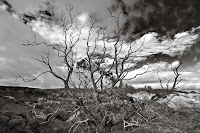
In keeping with this entry's more prosaic tone (though, as I glance ahead to what I wrote below, I'm not sure how much "philosophy" I've actually stripped from my earlier post; I'll leave that up to the patient reader to decide;-), I should note that it was prompted by a disarmingly simple and straightforward question my mom asked me a few weeks ago (well, it was straightforward, but only before I realized that answering it - in a meaningful way - would prove anything but). Having just seen my Micro Worlds portfolio, my mom asked: "Andy, these are lovely, but why do you take so many pictures of the same thing? You used to show me such a variety of subjects; why the change?"

My immediate reply was accurate but shallow. I said that I no longer find individual images adequate to fully express what I want to communicate about what I'm seeing and feeling. My mom - who is not used to shallow answers about art, having lived with a rather deep artist (namely, my dad) for as long as I can remember - called me on my flippant reply, and probed for something deeper. I tried again: "I don't think in terms of individual images anymore; and when I see a subject that interests me, I want to explore it more, with multiple exposures and viewpoints." In some ways, of course, that was worse than my first answer...my mom countered with: "Andy, you've restated my question quite nicely. Now, how about explaining why you don't think in terms of individual images anymore?"What follows is a summary of the deeper answer I gave my mom after I took a few hours to ponder her probing question. I concluded that my mom very perceptively discerned a genuine meta-pattern shift in the gestalt of my photography; and that the essence of that meta-pattern shift provides an important clue as to what stage I'm in, in my natural (and still very much ongoing) evolution as an artist. I also thought that it might be a worthwhile exercise to think through, and describe, the various stages that I suspect most (if not all) photographers gradually move through as they mature as artists. While my notes contain the germs of ideas for "stages of artistic evolution" whose numbers range from a only a few to more than a dozen, I eventually settled on eight stages (perhaps an unconscious homage to Buddha's Eightfold Path).
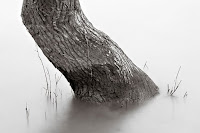
Let me begin by stating up front that my description of the "8-fold path toward self-discovery" in no way implies that I have any special insight into the deepest strata of art or photography; it is offered simply, and humbly, "as is" and is to be read - and understood - purely as an expression of but one point of view (which the reader is entirely free to disagree with; indeed, I hope does disagree, with at least parts of it, so as to foster a dialectic by which we can all collectively probe the meaning of art and photographer even deeper).

"A man's work is nothing but
this slow trek to discover,

through the detours of art, these two or three
great and simple images in whose
presence his heart first opened."
- ALBERT CAMUS

Stage 1: Joyful snapshots of anything and everything. What is the first thing anyone who gets a new" toy" (or serious tool) wants to do? Play with it, of course; see what it can do, learn how to use it - mechanically, at least - and just have some fun with it. The beginning photographer - such as I remember myself being when I was barely 10 and my parents had given me a Polaroid instamatic camera for Christmas - doesn't really care much about anything other than taking pictures of whatever strikes their fancy. And that's precisely what they get: pictures of their dog or cat, their room, mom and dad, their own reflection, snapshots of their friends, a tree, a shoe, a baseball game, an apple, whatever. Everyone begins somewhere; and that "somewhere" for photographers is a joyful - but otherwise essentially indiscriminant - expression of a new found tool that takes pictures. And pictures they will take; all kinds of pictures, with hardly any rhyme or reason. In a basic sense, anyone who is alive and is the least bit curious about the world - and is given a camera, or any other artistic tool - instantly becomes a stage-1 artist.

Stage 2: A passive stirring of aesthetic value. As the photographer evolves from stage one to stage two, she still takes images of anything and everything that strikes her fancy but now finds that certain objects draw a deeper attention than others. Her gaze still falls on most everything that surrounds her, but her embryonic photographer's "eye" begins to discern that aesthetic value is not homogeneously distributed; certain scenes, and certain things, draw her eye more than others. For the first time, though perhaps weakly, some aspect of the environment draws the artist's attention. But the second stage artist is mostly passive, reacting to aesthetic stimuli as they appear and are recognized, but still largely undiscerning as to their relative merit and eager to "take in as much as possible." The stage-2 artist creates pictures in which others recognize that certain things are given more or less visual weight than others; but - because the stage-2 artist is still only a "beginner" - the pictures themselves are not necessarily as aesthetically pleasing as they could be.
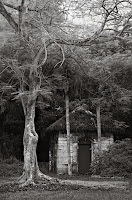
Stage 3: Willful engagement of the aesthetic environment. The transition from stage two to stage three is both difficult to see "from the outside" (for observers of the artist's inner journey) and dramatic (as experienced directly by the artist). The transition occurs when the artist finds herself discontent with the merely passive capture of objects, and instead actively seeks objects she deems "interesting." She has started to categorize the world according to her own unique measure(s) of lesser and greater aesthetic value. Objects (or places, or people, or situations, ...) that the stage-three artist holds in high regard become beacons in the environment that both immediately draw the artist's attention, and are "attractors" toward which the artist actively makes her way. If the artist finds trees of particular interest, for example, she is no longer content with leaving a park with a "few stray shots of trees," but now deliberately goes to different parks (and other places that has lots of trees) to "see" as many different tree as possible. The stage-three artist begins to learn what she values most, and then goes out to find it. She also learns to better express what she "sees" and is better able to create aesthetically pleasing images. "Objects" of attention in the stage-3 artist's picture repertoire are no longer appreciated by others merely as objects that clearly "stand out" from the background, but as bona-fide "aesthetic elements" assembled by the artist's growing creative powers of expression.
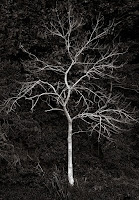
Stage 4: Recognition of the power of expression. The transition between stage three and stage four is marked by a gradual recognition of the power of using photography - traditionally, a print - to express not the object itself, but what draws the artist's attention to the object. In practical terms, this means that the stage four artist is concerned less with depicting trees merely as objects of interest (in keeping with our "tree" example) - being quite happy to display a set of "shots of pretty trees" that are otherwise unremarkable in any way - and more with finding the one shot (and the one resulting print) that best expresses to others why the artist loves to photograph trees. This subtle (and not so easy) transition represents a very significant worldview shift; as well as a shift in artistic sensibility. Indeed, many artists (myself included) find themselves "stuck" at the boundary between stages 3 and 4 for years, as they patiently develop and explore ways to express meaning, and not just being. Making matters even more difficult is that the stage 3->4 transition involves a gradual recognition of - and increased attention to - two different worlds of reality and expression: (1) attention to using a print to isolate the tree as it "appears" to us, as an otherwise embedded feature of the external environment, and (2) attention to using post-capture tools (either in a traditional or digital "darkroom") to properly express the most "important" features of the tree as captured in a photograph. Again, this distinction is both subtle and deep. It is meaningful only insofar as the stage-4 photographer realizes there is an important aesthetic difference between using tools to render differences between trees and their environment (in order to "make them stand out" better from the surrounding clutter), and using tools to selectively render the inner parts of a given photograph (the first inkling to dodge, burn, and make other tonal "changes" to an image), so that the viewer can better "see" what the photographer is trying to express. The slow and careful learning, nurturing, and refining of these skills can (and often does) take years, if not decades, to develop fully.
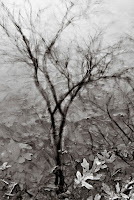
Stage 5: One picture is not enough. Sooner or later, but only after comfortably settling into stage 4, every artist yearns to go beyond the "image" - to go beyond just showing a single picture, or at most a few individual prints, of a subject the artist holds dear. More effort and more care are put into every single capture (and its attendant post-capture processing); and more and more finished prints are deemed "worthy to show others" by the artist. But the stage-5 artist also grows increasingly dissatisfied over what she is beginning to perceive as "too shallow" an expression of an inner vision that is slowly trying to make its own voice heard. "I like this tree," she finds herself thinking to herself more and more often, "but it doesn't - can't ! - by itself express why I've been taking pictures of trees for as long as I have." She continues, "Each of my trees is lovely, and I'm proud to show them to others, but I'm somehow missing the bigger picture here. It is as though each of my pictures is a chapter in a book yet to be assembled." The artist may not yet quite know what this nascent "book" is, what form it will eventually take, or what it will "say," but her aesthetic eye has measurably raised its line-of-sight to higher levels. The stage-5 artist no longer thinks (or "sees") in terms of individual pictures. Rather, the world is seen as a patchwork; a tapestry of overlapping images. Or, simply, in terms of groups - or portfolios - of pictures.

Stage 6: Telling a story. Inevitably, the artist becomes interested in not just putting together a set of assorted - but only marginally related - prints (as in collections of "best of" shots), but in carefully crafting and sequencing the images in a portfolio of prints to tell a specific story. If the original interest was (and remains) trees, for example, the artist now wishes to move beyond her ever growing collection of "individual trees," to a new form of expression designed to reveal both how "sets of trees" are related, and a bit of the process by which the artist's perception and expression of her general "love of trees" has itself evolved over time. The stage-6 artist thus naturally steps away from a focus on prints as prints (even if they are otherwise a part of a larger collection) and moves toward an increased focus on portfolios of interrelated images. It is no longer enough to just find that one "good" or "best" image - even if it is one for the ages (though any artist is always happy to find it! ;-) - the artist now first thinks in terms of mutually related groups of images. Ideally, each image both stands on its own and compliments and/or enhances all of the others. In more practical terms, the artist now wishes to express not so much her love of "trees" per se, as represented in the "best possible way" by a single image, but a deeper aesthetic experience of trees in general; as exemplified perhaps by a selection of personally meaningful images captured in a favorite park, or accrued over several weeks or months (or years) even as the artist explores other subjects and themes. The stage-6 artist's attention has moved from "pictures" to projects that culminate in portfolios of interrelated images; all motivated by a growing desire to use sets of images to tell a story about what the artist's eye (and heart) is drawn to, and why..

Stage 7: Portfolios of Portfolios. The penultimate stage typically appears only when an artist has attained a certain level of "aesthetic maturity"; by which time a meaningful body of work - consisting mostly of portfolios (though "individually meaningful" images still pop up from time to time) - has naturally emerged. Each and every portfolio has both a story to tell, and is an element of an as-yet unrevealed and unrealized deeper story; a story about which the stage-7 artist hears the first faint murmurs of. A story concerning the truths of the world "out there" as revealed to the photographer through her lifetime's worth of aesthetic judgements as to what to shoot, what to keep, how to express, what to show, and what to sequence into portfolios. The artist realizes that her art has not only captured an aesthetic impression of the world - an aesthetic that is uniquely hers, though the details may overlap with that of other artists - but is a manifest imprint of a deeper aesthetic order of the external world. The artist begins to understand and appreciate certain universal objective truths by examining the subjective aesthetic order that she herself has "imposed" on the world. By studying her own portfolio of portfolios - as though her life's work was itself a "world" open to capture with an aesthetic eye and camera - the artist discovers universal truths about the world itself. In my own case (though I suspect I am far from moving into stage-5, much less stage-7), I can glimpse some of the feelings associated with a stage-7 worldview by looking inward to my motivation for creating my recent "portoflio of portfolios" called Sudden Stillness. Sudden Stillness consists of four fundamentally interwoven portfolios called Chaos, Order, Complexity, and Entropy. The subtitle of the book conveys the deeper meaning behind (and reason for the particular sequencing of images in) the book: visual echoes of timeless rhythms. Collectively, the four portfolios weave a "story" about the fundamental rhythmic patterns that regulate our world (from this one photographer's point of view, of course). In short, the stage-7 artist uses her own work - consisting now mostly of portfolios of portfolios - to transcend art and begin addressing deeper and universal themes and issues regarding the order of the world around her. Art is no longer concerned solely with the here and now - for its own sake, and regarding limited sets of objects, themes, and contexts - but assumes an added dimension of seeking a transcendent truth about the nature of the world itself. And part of that truth is revealed - to the artist - by the artists own body of work.

Stage 8: Self-discovery. Stage-8 is not all that different from stage-7, at least outwardly, and if measured objectively in terms of the artist's physical output (in terms of images and prints). The stage-8 artist still typically produces portfolios of portfolios, still diligently practices her artform, relentlessly striving toward perfection, and delights with each every "beautiful print" as though it was her first, just as she has always done and will always do; but the artist shows no outward sign of doing anything different from the stage-7 artist. Indeed, paradoxically, the stage-8 artist may even appear to others as being stuck on a plateau (albeit an aesthetically very high one), and no longer willing, or able, to "evolve" artistically. But something fundamental has changed - and in a dramatic way, but one invisible to anyone but the artist at first - in the way the artist understands and interprets her own work. Of course, all of the technical components of image capture and mechanical procedures of post-capture processing have long ago been turned into virtually reflex action on the artist's part. Without this being true - something that requires years and years of dedicated and full immersion in art - no artist can progress to stage-8 (this - namely, the need for total immersion - also appears to be universally true of any creative field, if the practitioner wishes to attain the highest levels of "creative accomplishment"). And what is the fundamental change that occurs? In the same way as we indicated that the stage-7 artist uses her art to uncover truths about the world, the stage-8 artist discovers truths about her own soul. The world, and the artist's own work, have both come full circle: the world revealed through an artist's vision; and the artist's expression of the world uncovering the depths of the artist herself. Seer and seen become one; and the seen brings the seer back to self.

“A man sets out to draw the world.
As the years go by, he peoples a space
with images of provinces,
kingdoms, mountains, bays, ships,
islands, fishes, rooms, instruments,
stars, horses, and individuals.
A short time before he dies,
he discovers that the patient labyrinth
of lines traces the lineaments
of his own face.”
- JORGE LUIS BORGES

Sunday, August 26, 2007

A Few Basic Lessons of Fine-Art Photography

A young photographer recently asked me one of those "deceptively difficult" questions one encounters from time to time. While not quite in the unanswerable category that questions such as "So, what is life all about?" fall into, I was nonetheless hard pressed to give a quick respond to this question: "What are the most important lessons you've learned on your way to becoming a fine-art photographer?"

Leaving aside the temptation to reply either that "I'm not quite sure I'm a fine-art photographer yet, so..." or, perhaps, "I have no idea, but when you get a good answer from someone, please come back to share it with me!"...after some sober reflection, I decided that if I have anything of value to impart at all, after 35 or so years of struggling to find my own "eye/I" in photography, the basic lessons are these:

1. Never stop taking pictures. Always take pictures, constantly, even when you dont have a camera with you. Always pretend you have an imaginary lens in front of your eyes, and let them dart back and forth wherever you are; looking, seeing, composing, relating one part of a scene to another, imagining what it may look like with one filter or another, that lens instead of this one, and so forth. Don't let a day go by without at least the mental exercise of picture taking; better yet, wander around with a camera for an hour or two every day and take pictures. Photography is at least as much a lifestyle as it is a craft! If you are passionate about photography, you will photograph; you have to, it's who you are. Whether an interest in photography (or any creative endeavor for that matter) is a passing fancy or a deep passion can easily be determined by noting the extent to which you miss it when circumstances prevent you from practicing it. If the passion is real, you will begin (sometimes very creatively;-) sculpting your time to make sure you always have time for your art. The passion lives to the extent that you provide it with the one thing it needs: taking pictures, always taking pictures.

2. Forget about things and concentrate on feelings. Photography - especially fine-art photography - is the art of using the objective reality that sits squarely before you and your eye, and whatever means are at your disposal (beginning with your choice of where to look and what to leave out of a composition), to try to communicate to someone days, weeks, years later the feeling that came over you the instant you paused and said, to yourself, "Ah, I must take a picture!" This is something that is both very, very hard to explain how to do (indeed, I'm not even attempting to do that here), and will eventually become something that is very, very obvious to you about what you are really "doing" as a fine-art photographer (even if, as in my case, you fail at it much more often than you succeed).

"I do not photograph nature. I photograph my vision." - Man Ray

One day you will look at your own images, or better, look at someone else looking at your pictures, and you'll understand that you've become a photographer, not a snapshooter. You will realize that some image of yours actually made someone else feel pretty much what you felt while taking it. This is the essential core truth of all meaningful art, and is the first real step toward defining yourself as an artist.

3. Do not internalize (or take too seriously) what others tell you about your pictures; take the pictures that are important to you. Use your images as a way of going inward, into your own soul. Photography is first and foremost a process of self-discovery, not an exercise in literal capture of something "out there". Photojournalism aside (since my focus is on fine-art photography), the most timeless images of all are those that somehow capture a few notes of a deep universal rhythm; you know you're close when you see a part of yourself looking back.

“A man sets out to draw the world. As the years go by, he peoples a space with images of provinces, kingdoms, mountains, bays, ships, islands, fishes, rooms, instruments, stars, horses, and individuals. A short time before he dies, he discovers that the patient labyrinth of lines traces the lineaments of his own face.”Jorge Luis Borges, Afterword to El Hacedor (aka Dreamtigers), 1960

The paradox is that it is only by looking inward, at who we are, and communicating to the world what we see and feel, that we stand the best chance of capturing a truth (and beauty) that others will recognize as their own. The least promising way to go about this is to take pictures that satisfy someone else's vision. While one may still manage to take technically well executed photographs, chances are slim that they will be infused with any deep meaning.

4. Learn the basics of technique, so that "technique" never again requires your conscious attention. While it's certainly important to develop the necessary skills of any craft, and photography is no exception, learn them well and internalize them, but then quickly move on to the art. It is far easier for a creative spark to emerge out of a sincere (but perhaps technically deficient) soul, than it is for art of any kind to arise in an atmosphere where the technical aspects reign supreme.

"Technique is what you fall back on when you are out of inspiration." - Rudolf Nureyev

If you put a homemade pinhole camera into the hands of a master photographer who has never used one, after a bit of fiddling, he or she is likely to produce the same fine-art caliber of imagery - with exactly the same depth of feeling - that he or she naturally creates. But put a world-class $15,000 Hasselblad in the hands of someone with "a photography degree", who perhaps knows more about what each button and dial does than the designers of the camera, but has little real passion for the art, and all you're likely to get is a snapshot taken with a $15,000 Hasselblad. The focus must always be on the art, and what you're trying to communicate with it; the technical side is there only to support you, and will take care of itself.

5. Never stop learning from the masters, and their photographs. Look at their work, and then again, and again; never stop looking at what other photographers you admire (and don't admire!) have done. I have never known a fine-art photographer that does not have a veritable library of books by other photographers (and I will share some of those in my collection in a later post). These are our teachers. They inspire us, they educate us, they provide us with ideas and stepping stones for us to forge our own path toward self-discovery. Second hand bookstores are a great treasure, as people tend to throw away the "old" uninteresting stuff. What a goldmine of inspiration I say! Keep looking, keep flipping though art books, and don't confine yourself to photography by the way. Art is art, whatever the medium. Everything I learned about composition, tone, form and texture - and, ultimately, about photography itself - I learned simply though watching my dad, who (though not a photographer) was a remarkable artist.

6. Forge your own path (strong form of lesson #3). The most difficult lesson of all, certainly the most difficult to follow, is to know that we will ultimately achieve little of lasting value if our work does not bear the fruit of our own uniqueness. How do you know you're on the right path? As Joseph Campbell wisely reminds us, "If the path before you is clear, you're probably on someone else's." This does not mean that your work cannot be "derivative" (or be labeled as such by others); it does not mean it cannot come "easily" (though only a lucky few ever experience it as such); and it does not mean you must always be "lost in the jungle" to stay away from every well-trodden path you see in the distance. It means only that whatever form your art assumes, that it arises naturally, from within, and sincerely expresses your unique vision. Ineffably, you cannot ask for it. You cannot choose it. You cannot guess it. You cannot will it. You cannot blindly hope it comes to you. But have faith in the humble truth that - if you are an artist, and your soul is pure and true to itself - your "vision" will find you, and when it appears, you will have found yourself.


"Art...comes inevitably as the tree from the root, the branch from the trunk, the blossom from the twig. None of these forget the present in looking backward or forward. They are occupied wholly with the fulfillment of their own existence. The branch does not boast of the relation it bears to its great ancestor the trunk ...because it is engaged in the full play of its own existence, because it is full in its own growth, its fruit is inevitable." - Robert Henri, The Art Spirit