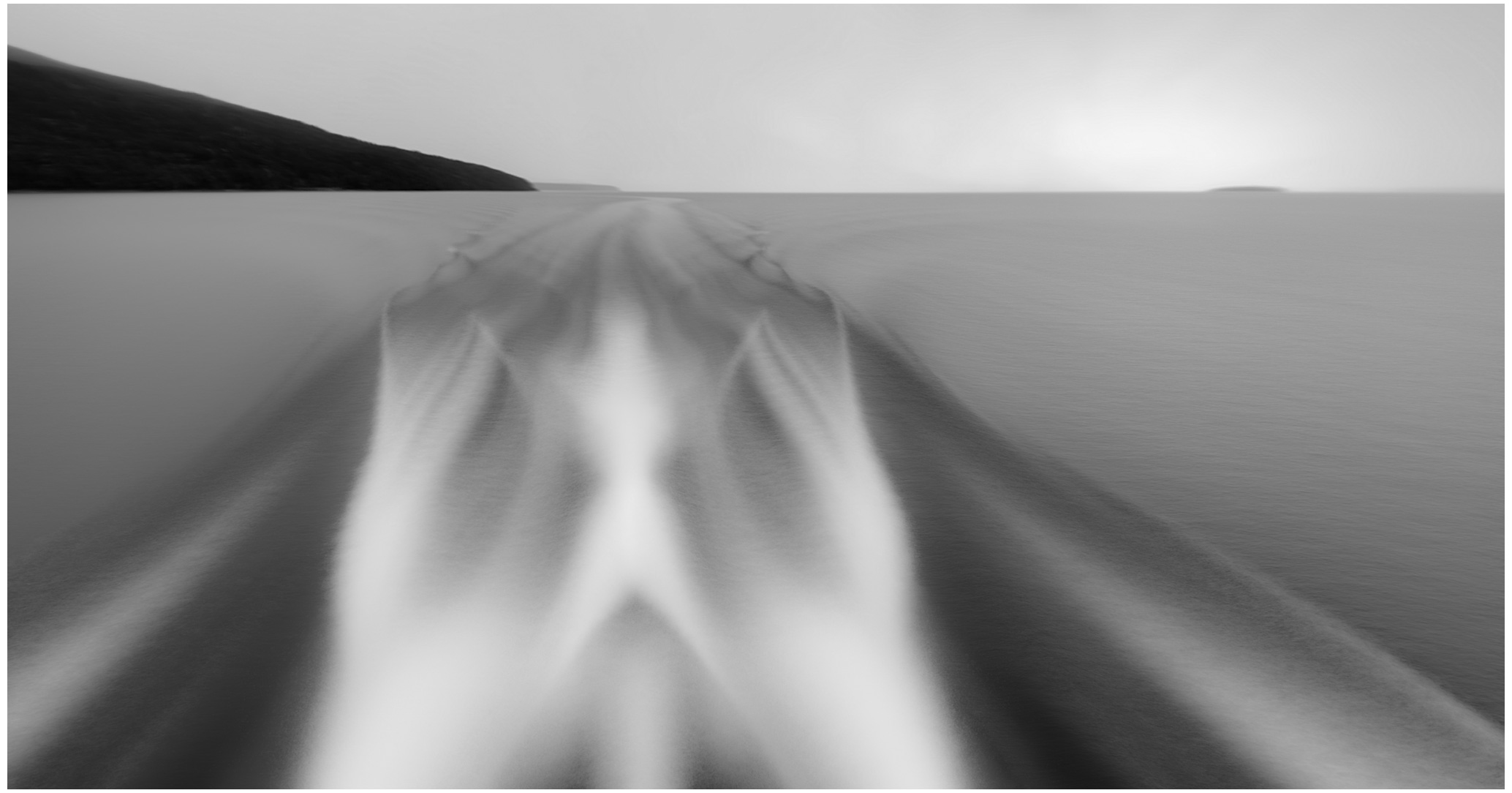
Showing posts with label Plato. Show all posts

Thursday, December 04, 2025

Allegory of Light


"Picture the following in your mind. Imagine human beings living in an underground cave-like residence. Its entrance opens up to the light and reaches all along the cave. They have been there since their childhood, their ankles and necks chained, unable to move or turn their heads, forced to look ahead. The light from a fire blazing at a distance comes from above and behind them. Between the fire and the prisoners there is a raised walkway. Imagine also a low wall built along the way, similar to the screen that divides puppeteers from the audience and allows them to show puppets over it.
...
Now imagine that people walk behind the wall and carry various artifacts that extend above the wall. These artifacts include carvings of humans and other animals made of stone, wood, and other materials. Some of the people carrying these object are talking, while others are silent. ...They are like ourselves. Now do you think they see anything else except their own shadows, or the shadows of one another, which light from the fire casts on to the opposite wall of the cave? 
...
Now imagine what would happen naturally if the prisoners were released from their shackles and cured of their ignorance. Right after they are released and suddenly forced to stand up, turn their necks around, walk, and look towards the light, these activities will cause them pain; because of the bright glare they would be unable to see those things which they previously had seen only as shadows. Now what do you think they would say if one were to tell them that what they saw before was fooling them, but that now, when they are closer to what really exists and when they face that which more truly exists, they see more clearly, in a straightforward manner? What if that person pointed to the objects as they passed and asked the former prisoners to tell him what they were? Don’t you think they would be baffled and think that the shadows they formerly saw were truer than the objects that are now being pointed out to them? "

- Plato (c.424 - 348 BC)
"The Allegory of the Cave" (Republic, Book Seven) 

Friday, November 14, 2025

Morphic Resonance


"The sudden appearance of all the Laws of Nature is as untestable as Platonic metaphysics or theology. Why should we assume that all the Laws of Nature were already present at the instant of the Big Bang, like a cosmic Napoleonic code? Perhaps some of them, such as those that govern protein crystals, or brains, came into being when protein crystals or brains first arose. The preexistence of these laws cannot possibly be tested before the emergence of the phenomena they govern."

Rupert Sheldrake (1942 - )
Morphic Resonance

Thursday, May 22, 2025

Photographs-Otherwise-Not-Taken, Taken

Inside of Library, University of Otago, Dunedin, New Zealand

"Nows within this now, rather like snapshots in an album. Each Now is separate and a world unto itself, but the richly structured Nows 'know' about one another because they literally contain one another in certain essential respects. As consciousness surveys many things at once in one Now, it is simultaneously present, at least in part, in other Nows. This awareness of many things in one could well exist in a much more pronounced form in other places in Platonia."

- Julian  Barbour (1937 - )
 The End of Time

Note. The admittedly busy title of this blog post obviously begs an explanation. I'll start by saying that it is inspired by a short email exchange I recently had with a photo buddy of mine (the Zen-master, Paul Cotter). In reply to Paul's kind comments about my recent "travelogue images," I countered with the suggestion that my favorite images from the trip are/may-be those I took with my iPhone and not my 21L-sling-bag's-worth of "pro" gear (the details of which hardly matter)! While I am not (entirely) convinced of the veracity of my claim (and others may differ), I have zero doubt that my iPhone gifted me many images that I will cherish in the years to come precisely because these are photographs I would otherwise have not taken! Some examples - click to see full-size:

View of a wall while waiting to be seated at a restaurant

Footprints on a beach in front of another restaurant


A view from inside the Novotel Auckland Airport
while my wife was busy getting us checked in

Frosted window inside restroom at the
Aoraki/Mount Cook National Park Visitor Centre

View inside a restaurant while being led to our table

Upside down view of one of the ceilings at the
Nadi International Airport in Fiji

Another (upside down) view from inside the library at
the 
University of OtagoDunedin, New Zealand
 
A snapshot view of urban geometry while waiting
for my wife to pay the parking meter


A 5 sec exposure of a part of our boat ride to Milford Sound,
stabilized by my iPhone's computational photography algorithms

I have dozens more of these "Photographs-Otherwise-Not-Taken, Taken" images, all of which share this one salient pattern: had I not used my iPhone to capture them (embarrassingly easily by, literally, framing and tapping, and without any of what my wife describes as "glacier-paced compositional machinations"), they would all have been but fleeting moments doomed to be lost in the mists of memory and time.

Monday, September 11, 2023

Fox-like Hedgehogian Photography


"We are what we are, and live in a given situation which has the characteristics – physical, psychological, social – that it has; what we think, feel, do is conditioned by it, including our capacity for conceiving possible alternatives, whether in the present or future or past. Our imagination and ability to calculate, our power of conceiving, let us say, what might have been, if the past had, in this or that particular, been otherwise, soon reaches its natural limits, limits created both by the weakness of our capacity for calculating alternatives – ‘might have beens’ – and even more by the fact that our thoughts, the terms in which they occur, the symbols themselves, are what they are, are themselves determined by the actual structure of our world. Our images and powers of conception are limited by the fact that our world possesses certain characteristics and not others: a world too different is (empirically) not conceivable at all; some minds are more imaginative than others, but all stop somewhere."

- Isaiah Berlin (1909 - 1997)
The Hedgehog and the Fox

Whenever I am on "vacation" - such as when my family and I recently visited Iceland - I instinctively recall Isaiah Berlin's well-known essay, "The Hedgehog and the Fox." The essay - a set of musings about Leo Tolstoy, history and human psychology - is woven around an aphorism attributed to Archilochus: "The fox knows many things, but the hedgehog knows one big thing." Berlin divides the world into two different kinds of thinkers. Some, like Aristotle and Shakespeare, are pluralists - or "foxes" - and cast a wide net to get to know as many things as possible; others, like Plato and Dostoyevsky, are monists - or "hedgehogs" - and strive to know one thing as deeply as they can. 

So, what does this have to do with photography? Substitute "style (or manner) of composition" for "mode of thinking" to get an inkling of the admittedly imprecise analogy I will now leverage to illustrate the inevitable image-making process I seem to  follow during "family vacations." Soon after I arrive at a destination (but excluding the first few days, during which - as a rule - I seem utterly incapable of capturing anything more meaningful than instantly forgettable "touristy" snapshots of something that simply catches my eye), I am drawn exclusively to the "big picture," literally scanning the horizon for sweeping views and landscapes. In other words, I typically approach an "unknown land" like a fox, running from place to place, aware of my larger surroundings, but constantly sniffing, looking, anticipating other places to visit; never resting too long in any one spot. This initial stage of my creative process consists not just of having a loose penchant to search for "Wagnerian landscapes," but is indicative of a deeply entrenched - myopic - focus on "big picture" scenery during which I seem strangely incapable of even seeing anything else. Of course, and for obvious reasons, this "creative insight" is hardly surprising. Iceland's mountains, volcanoes, and glaciers all beckon - demand - your attention even before your plane lands!

But something interesting inevitably happens after a few days go by in a new place. I transform into a "fox-like" hedgehog. While I still scurry around from place to place like a fox (remember, these are vacations I am writing about, so there are usually plenty of sights to see 😊, my eye and camera become deeply drawn to smaller, quieter, vistas that speak more of universal moods and feelings than capturing documentarian-like images of "objects" in a given place. Concomitantly, my compositions transition from images that superficially depict obviously Icelandic scenery (i.e., images that explicitly encode and/or communicate the states-of-being of "multitudinous things" as my eyes saw them "out there" in Iceland), to photographs that implicitly communicate my own state-of-mind (i.e., images that reveal how "big picture" Icelandic vistas transform my inner "I"). 

Sometimes, rarely, I manage to do both, as in the diptych above. The left big-picture image "obviously" depicts uniquely Icelandic rocky forms (which may be easily confirmed by spending a few moments with Google maps), while the one on the right is at least plausibly Icelandic, given its volcanic appearance, but could have been captured anywhere as I scurried to-and-fro in fox-like fashion. Taken as a whole, the diptych also perfectly conveys my Zen state, as I was lost in, and mesmerized by, Iceland's gentle moods and rhythms. Notably (and not unexpectedly), after looking over my archive of raw files when we got back home, images like these did not emerge until I was into the second week of our trip.

Monday, December 19, 2022

Bewilderments of the Eyes


"To them, I said, the truth
would be literally nothing but
the shadows of the images.
...
Anyone who has common sense will remember that the bewilderments of the eyes are of two kinds, and arise from two causes, either from coming out of the light or from going into the light, which is true of the mind's eye, quite as much as of the bodily eye; and he who remembers this when he sees any one whose vision is perplexed and weak, will not be too ready to laugh; he will first ask whether that soul of man has come out of the brighter light, and is unable to see because unaccustomed to the dark, or having turned from darkness to the day is dazzled by excess of light. And he will count the one happy in his condition and state of being, and he will pity the other; or, if he has a mind to laugh at the soul which comes from below into the light, there will be more reason in this than in the laugh which greets him who returns from above out of the light into the den."

- Plato (c.424 - 348 BC)
Republic, "The Allegory of the Cave" 

Tuesday, July 19, 2022

Higher Dialectic


"The efficient or motive principle, which is not merely the analysis but the production of the several elements of the universal, I call dialectic. Dialectic is not that process in which an object or proposition, presented, to feeling or the direct consciousness, is analysed, entangled, taken hither and thither, until at last its contrary is derived. Such a merely negative method appears frequently in Plato. It may fix the opposite of any notion, or reveal the contradiction contained in it, as did the ancient scepticism, or it may in a feeble way consider an approximation to truth, or modern half-and-half attainment of it, as its goal. But the higher dialectic of the conception does not merely apprehend any phase as a limit and opposite, but produces out of this negative a positive content and result. Only by such a course is there development and inherent progress. Hence this dialectic is not the external agency of subjective thinking, but the private soul of the content, which unfolds its branches and fruit organically. Thought regards this development of the idea and of the peculiar activity of the reason of the idea as only subjective, but is on its side unable to make any addition. To consider anything rationally is not to bring reason to it from the outside, and work it up in this way, but to count it as itself reasonable. Here it is spirit in its freedom, the summit of selfconscious reason, which gives itself actuality, and produces itself as the existing world. The business of science is simply to bring the specific work of the reason, which is in the thing, to consciousness."

- Georg Wilhelm Friedrich Hegel (1770 - 1831)
Science of Logic

Wednesday, October 02, 2019

Geometry


"Euclid's Elements has been for nearly twenty-two centuries the encouragement and guide of that scientific thought which is one thing with the progress of man from a worse to a better state. The encouragement; for it contained a body of knowledge that was really known and could be relied on, and that moreover was growing in extent and application. For even at the time this book was written—shortly after the foundation of the Alexandrian Museum—Mathematics was no longer the merely ideal science of the Platonic school, but had started on her career of conquest over the whole world of Phenomena. The guide; for the aim of every scientific student of every subject was to bring his knowledge of that subject into a form as perfect as that which geometry had attained. Far up on the great mountain of Truth, which all the sciences hope to scale, the foremost of that sacred sisterhood was seen, beckoning for the rest to follow her"

- William Kingdon Clifford (1845 - 1879)

Wednesday, February 08, 2012

Transcendental Mirrors


"Bodies of still water are
themselves like minds;
transcendental mirrors, 
Platonic cameras
to catch and hold 
the phenomenological long enough 
for the onlooker to grasp its reality,
the eternal thing behind it."

- David Mason Greene

"There is, one knows not what sweet mystery about his sea, whose gently awful stirrings seem to speak of some hidden soul beneath; like those fabled undulations of the Ephesian sod over the buried Evangelist St. John. And meet it is, that over these sea-pastures, wide rolling watery prairies and Potters’ Fields of all four continents, the waves should rise and fall, and ebb and flow unceasingly; for here, millions of mixed shades and shadows, drowned dreams, dreaming still; tossing like slumberers in their beds; the ever-rolling waves but made so by their restlessness."

"The Pacific," Moby Dick

Saturday, January 29, 2011

Reflections and Illusions

"You have heard much of this world
yet what you seen of this world?
What is its form and substance?...
You are asleep and your vision is a dream;
all you are seeing is a mirage.
When you awake up on the morn of the last day
you will know all this to be fancy and illusion;
When you have ceased to see double,
Heaven and Earth will become transformed;
when the real sun unveils his face to ou,
the moon, the stars,and Venus will disappear;
if a ray shines on the hard rock
like wool of many colors, it drops to pieces."
-Mahmud Shabistari
Sufi Poet
(1288 - 1340)

"Reflect: is not the dreamer, sleeping or waking, one who likens dissimilar things, who puts the copy in the place of the real object?

I should certainly say that such a one was dreaming.

But take the case of the other, who recognizes the existence of absolute beauty and is able to distinguish the idea from the objects which participate in the idea, neither putting the objects in the place of the idea nor the idea in the place of the objects-- is he a dreamer, or is he awake?"