Showing posts with label Architecture. Show all posts

Thursday, May 22, 2025

Photographs-Otherwise-Not-Taken, Taken

Inside of Library, University of Otago, Dunedin, New Zealand

"Nows within this now, rather like snapshots in an album. Each Now is separate and a world unto itself, but the richly structured Nows 'know' about one another because they literally contain one another in certain essential respects. As consciousness surveys many things at once in one Now, it is simultaneously present, at least in part, in other Nows. This awareness of many things in one could well exist in a much more pronounced form in other places in Platonia."

- Julian  Barbour (1937 - )
 The End of Time

Note. The admittedly busy title of this blog post obviously begs an explanation. I'll start by saying that it is inspired by a short email exchange I recently had with a photo buddy of mine (the Zen-master, Paul Cotter). In reply to Paul's kind comments about my recent "travelogue images," I countered with the suggestion that my favorite images from the trip are/may-be those I took with my iPhone and not my 21L-sling-bag's-worth of "pro" gear (the details of which hardly matter)! While I am not (entirely) convinced of the veracity of my claim (and others may differ), I have zero doubt that my iPhone gifted me many images that I will cherish in the years to come precisely because these are photographs I would otherwise have not taken! Some examples - click to see full-size:

View of a wall while waiting to be seated at a restaurant

Footprints on a beach in front of another restaurant


A view from inside the Novotel Auckland Airport
while my wife was busy getting us checked in

Frosted window inside restroom at the
Aoraki/Mount Cook National Park Visitor Centre

View inside a restaurant while being led to our table

Upside down view of one of the ceilings at the
Nadi International Airport in Fiji

Another (upside down) view from inside the library at
the 
University of OtagoDunedin, New Zealand
 
A snapshot view of urban geometry while waiting
for my wife to pay the parking meter


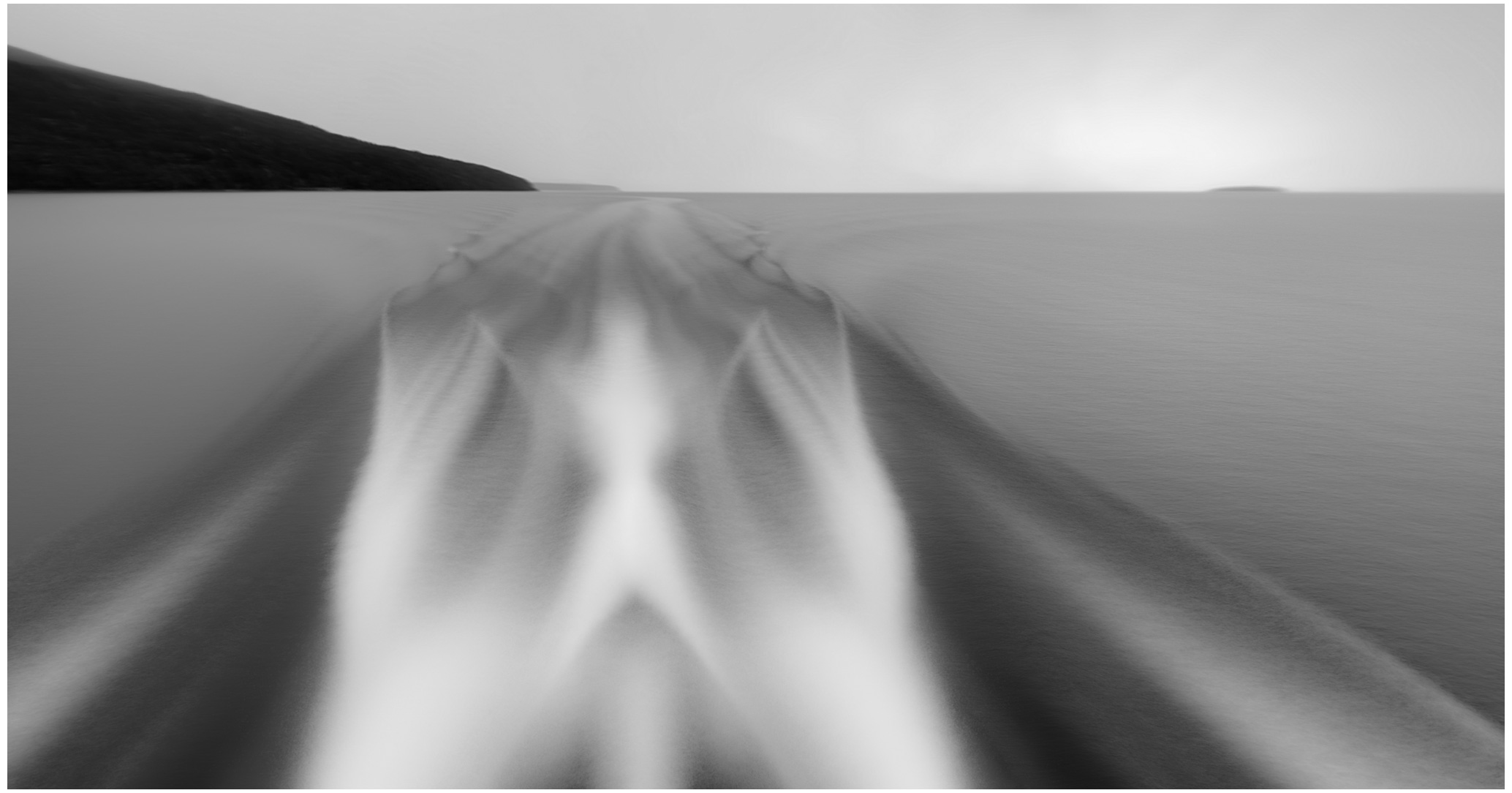
A 5 sec exposure of a part of our boat ride to Milford Sound,
stabilized by my iPhone's computational photography algorithms

I have dozens more of these "Photographs-Otherwise-Not-Taken, Taken" images, all of which share this one salient pattern: had I not used my iPhone to capture them (embarrassingly easily by, literally, framing and tapping, and without any of what my wife describes as "glacier-paced compositional machinations"), they would all have been but fleeting moments doomed to be lost in the mists of memory and time.

Thursday, December 05, 2024

Euclidean Dimensions


"There have been and still are geometricians and philosophers, and even some of the most distinguished, who doubt whether the whole universe, or to speak more widely the whole of existence, was only created in Euclid's geometry; they even dare to dream that two parallel lines, which according to Euclid can never meet on earth, may meet somewhere in infinity. I have come to the conclusion that, since I can't understand even that, I can't expect to understand about God. I acknowledge humbly that I have no faculty for settling such questions, I have a Euclidean earthly mind, and how could I solve problems that are not of this world? And I advise you never to think about it either, my dear Alyosha, especially about God, whether He exists or not. All such questions are utterly inappropriate for a mind created with an idea of only three dimensions."

Fyodor Dostoyevsky (1821 - 1881)
Brothers Karamazov

Tuesday, September 24, 2024

Perceived Geometries #1


"It is well known that geometry presupposes not only the concept of space but also the first fundamental notions for constructions in space as given in advance. It only gives nominal definitions for them, while the essential means of determining them appear in the form of axioms. The relationship of these presumptions is left in the dark; one sees neither whether and in how far their connection is necessary, nor a priori whether it is possible. From Euclid to Legendre, to name the most renowned of modern writers on geometry, this darkness has been lifted neither by the mathematicians nor the philosophers who have labored upon it."

- Bernhard Riemann (1826 - 1866)

"The division of the perceived universe
into parts and wholes is convenient
and may be necessary,
but no necessity determines
how it shall be done.""

Gregory Bateson (1904 - 1980)

Monday, September 25, 2023

Icelandic Geometry


"To say that space is just physical
or geometrical is the same thing
as saying that the human being simple.
And both statements are false.
...
The imaginary is not formed in
opposition to the real, it is
not opposed to common sense,
it is not situated on another plane,
it is situated simultaneously on
all the planes of the real.

The real is always in movement,
it is always changing, always
becoming different-from itself.

Man is separated from the great
whole only because he consists of the
same substance as the whole,
which guarantees the union, a
substance which is doubtless more
substantial for being more rare."

- Gaston Bachelard (1884 - 1962)

Tuesday, June 20, 2023

de Chirico's Dreams


"To become truly immortal,
a work of art must escape all human limits:
logic and common sense will only interfere.
But once these barriers are broken,
it will enter the realms of
childhood visions and dreams.
...
There are more puzzles in the
shadow of a man walking under
the sun than in all past,
present, and future religions."

Giorgio de Chirico (1888 - 1978)

Note. This was a "quick grab" I took with my iPhone a few months ago when my wife and I were wandering around underground at the Smithsonian in Washington, D.C.; specifically, the S. Dillon Ripley Center, the entrance to which is easy to miss (at least for folks that don't live near D.C.), since it's topside view is remarkably unobtrusive and does not present itself as "anything special." After you enter the domed structure and go down a few levels, you may be amazed to find a massive space that contains conference centers, art studios, offices, and galleries. (The only reason I know of its existence is that I was invited to give a presentation in one of underground spaces about 20 years ago.) The football-field-sized room on the bottom level also provides an underground pathway to both the African Art Museum and the Sackler Gallery of the National Museum of Asian Art. The iPhone picture shows a part of the south side of the central staircase/elevator column that we took to descend (and looking up from where the escalator ends on the lower level). The geometry and lighting reminded me of de Chirico's works. The picture can also serve as a reminder to photographers (young/old, beginner/seasoned,...) that interesting images can be discovered literally everywhere.

Monday, October 17, 2022

Serendipitous Geometry


"The artist is a collector of things imaginary or real. He accumulates things with the same enthusiasm that a little boy stuffs his pockets. The scrap heap and the museum are embraced with equal curiosity. He takes snapshots, makes notes and records impressions on tablecloths or newspapers, on backs of envelopes or matchbooks. Why one thing and not another is part of the mystery, but he is omnivorous."

- Paul Rand (1914 - 1996)
Paul Rand: A Designer's Art

Postscript. It has been said that the lifeblood of photography is serendipity. While none of the images that make up the triptych above are particularly praiseworthy (beyond, I hope, simply being "interesting" to look at for a a few seconds), the fact that they exist at all is serendipitous. As seems to happen so often, what I planned to photograph and what I found myself photographing this past Sunday are unrelated except that the latter followed naturally - if unpredictably - from the former. Waking up to see a completely overcast sky I rushed to the kitchen to pour a bit of coffee into my commuter cup and took off in my car to go to one of my favorite "cloudy day" parks (Great Falls park in northern VA), about an hour from home. The closer I got to the park, the more "blue sky" was elbowing the clouds away, until, finally, literally as I arrived, the sky had become crystal clear and a strong sun was beating down overhead; far from the quiet diffused light I expected and was rushing over to compose in. Nothing to do but turn around and head back home. Which is what I did, but not before listening to my muse and stopping by the parking lot my wife and I leave our car at when we go to the farmer's market held nearby on Saturdays. Since it was Sunday, the parking lot was deserted, and I had plenty of time to commiserate over a failed trip to Great Falls, rekindle the quiet joy of just being "mindfully in the moment," and rediscover the simple pleasure of looking for "geometric designs" with my camera. As I said, nothing spectacular or noteworthy, and a far cry from what I originally planned to do, but a thoroughly delightful outing nonetheless 😊

Saturday, October 15, 2022

Light, Shadow, and Geometry


"The phenomenon which I have now briefly mentioned appears to me to partake of the character of the marvelous, almost as much as any fact which physical investigation has yet brought to our knowledge. The most transitory of things, a shadow, the proverbial emblem of all that is fleeting and momentary, may be fettered by the spells of our "natural magic," and may be fixed for ever in the position which it seemed only destined for a single instant to occupy.

This remarkable phenomenon, of whatever value it may turn out in its application to the arts, will at least be accepted as a new proof of the value of the inductive methods of modern science, which by noticing the occurrence of unusual circumstances (which accident perhaps first manifests in some small degree), and by following them up with experiments, and varying the conditions of these until the true law of nature which they express is apprehended, conducts us at length to consequences altogether unexpected, remote from usual experience, and contrary to almost universal belief. Such is the fact, that we may receive on paper the fleeting shadow, arrest it there, and in the space of a single minute fix it there so firmly as to be no more capable of change, even if thrown back into the sunbeam from which it derived its origin."

- Henry Fox Talbot (1800 - 1877)
Some Account of the Art of Photogenic Drawing 

Sunday, April 25, 2021

Geometry and Space


"It is well known that geometry presupposes not only the concept of space but also the first fundamental notions for constructions in space as given in advance. It only gives nominal definitions for them, while the essential means of determining them appear in the form of axioms. The relationship of these presumptions is left in the dark; one sees neither whether and in how far their connection is necessary, nor a priori whether it is possible. From Euclid to Legendre, to name the most renowned of modern writers on geometry, this darkness has been lifted neither by the mathematicians nor the philosophers who have laboured upon it."

- Bernhard Riemann (1826 - 1866)

Saturday, February 15, 2020

Visible Delineations


"You see what the eye does teach; and yet it would never of itself have afforded this insight, without something that looks through the eyes and uses the data of the senses as mere guides to penetrate from the apparent to the unseen. It is needless to add the methods of geometry that lead us step by step through visible delineations to truths that lie out of sight, and countless other instances which all prove that apprehension is the work of an intellectual essence deeply seated in our nature, acting through the operation of our bodily senses."

- St. Gregory of Nyssa (335 – 395)

Sunday, March 13, 2016

What is Order?


“What is order? 

We know that everything in
the world around us is governed
by an immense orderliness. 

We experience order
every time we take a walk.
The grass, the sky,
the leaves on the trees,
the flowing water in the river,
the windows in the houses along the street,
all of it is immensely orderly. 

It is this order which makes
us gasp when we take our walk.
It is the changing
arrangement of the sky,
the clouds, the flowers, leaves,
the faces round about
us, the order, the dazzling
geometrical coherence, together
with its meaning in our minds. 

But this geometry which means
so much, which makes us feel
the presence of order so clearly,
we do not have a language for it.”   

(1936 - )

Sunday, July 20, 2008

Color vs. B&W...a "Heisenberg Uncertainty"-like Relation?


In my last post, and immediately on the heels of returning from a trip my wife and I took to Greece, I noted that Santorini = geometry + color + shadow; emphasizing color, in particular, and brazenly declaring that Santorini is glorious, breathing, living, and sometimes blindingly bright color.

While I do not back down from those words - indeed, as I look over my growing portfolio of finished images and a selection of draft prints, I am, if anything, even more enamored of the "full color" results - an interesting thing happened as I went back (a second time) to process a few images in black and white: they reminded me of how awestruck I was when I first gazed onto the strange Escher-like Santorini architecture.

To be sure, what struck my eye first (or so I remember) was Santorini's blazing color; and my first emotion was pure joy - joy at being on a long awaited and much needed vacation with my lovely wife, joy at finally arriving at such a magnificently beautiful place, and joy at looking forward to discovering yet-unseen but sure to be wondrous sites. Consequently, when we got back home and I started processing my images in my usual style, I was struck by how much of my raw joy was missing from the black and white images. However, the color images instantly evoked many of the same feelings. My earlier blog entry thus followed naturally.

So what happened afterwards, and what is the point of this new entry? The answer is both "simple" and subtle...and, for me, a source of an important lesson I ought to have learned long ago. After working on over a 100 or so color images, and taking a few days "off" (while working on other, much older images having nothing to do with Santorini or Greece), I went back for a second look at my Greece files. I must emphasize that as I managed my usual black and white workflow, I did nothing objectively different from what I had originally done upon our arrival home from Greece (and what had originally resulted in my decidedly negative reaction, compelling me to work in color). But this time, even after completing only the first few files, I was struck by how powerfully the black and white images reminded me of the unbridled awe I felt at simply being in Santorini and finding myself amidst its magnificent architecture. This awe was not, strictly speaking, an emotional awe; it was much more akin an intellectual awe. My experience of witnessing Santorini's architectural splendor unfolding before me reminds me of the first time I gazed at an Escher print (which eventually resulted in a lifelong pursuit of math and physics). The point is that I had (at least) two layers of experience with Santorini landscapes; and that both cannot be simultaneously expressed equally as strongly in a single type of image. While the color images most strongly evoke the purely emotional side of my experience, the black and white images most strongly evoke the purely intellectual and cognitive side of my experience. Interestingly, neither type of image - alone - suffices to express the full depth of my experience. (This vaguely reminds me of Heisenberg's uncertainty relation between complementary variables, such as position and momentum, on the atomic scale).

Why had I not noticed this the first time around? I think it is because my emotion - or, rather, my strong desire to express my emotion of being in Santorini - was so overwhelming, that the secondary component of my experience in Santorini (a somewhat more detached intellectual "awe" of its geometry) was lost in the process. Yes, the color images vivdly convey the blazing light and glorious color of the island; but they also leave little room for any reaction other than a joyful exhuberance. The focus on color in my color images is necessarily so strong, and so dominant, that even the photographer's own eye is unable to discern the other - equally as important - dimensions of the original experience. In a sense, going back to the original files and "revisioning" them in black and white (although, truth be told, that is how I originally "saw" them while I was composing; I chose to retain the color afterwards only because the color reminded me of what I felt in Santorini, not because that is how I previsualized the images taken there) is my answer to Minor White's well-known admonition to use photography to tell the viewer something about what else the subject matter is. My color images show you what Santorini is; my black and white images tell you what else it is.

By stripping away the color, by focusing exclusively on only two of the three dimensions - geometry and shadow - I can more easily express the emotionally less charged component of my experience. Since color is absent, it is no longer the "distraction" it is in the color versions of the same images. The viewer is forced to interpret an image in terms of form and tone alone; and, hence, in Santorini's case, in terms of geometry and shadow.

And as for my lesson...? The lesson - I warn you it is a "trivial" one, but one I obviously needed to "relearn" at best - is that a single image can be used to express markedly different emotions; the "emotion" being a function of how the original captured (or raw) image is processed. Indeed, since my experience of Santorini (as of any place I visit, including places I know as well as my own backyard) is obviously multidimensional and is far deeper than "mere" joy and awe, I suspect that I will slowly discover multiple versions of the same underlying "raw" image captured by the camera. Collectively, and over time, these "expressions" will tell an increasingly more refined (but forever incomplete) story of my experience in Santorini. And I will continue to search for ways to bring out (and discover!) certain aspects of my original experience; undoubtedly focusing on one particular dimension at a time, at the expense of another, complimentary one (perhaps best expressed by some other expression; or "performance", as Ansel Adams likened a print to a negative). But, of course, that is precisely what photography is supposed to be all about :-) (Shows how much I have left to learn!)

Monday, July 14, 2008

Santorini (Greece) = Geometry + Color + Shadow

Regular readers of my blog, and those that have seen my work in Lenswork , Focus, and Black & White magazine, know that I am primarily (indeed, almost exclusively!) a black and white photographer. While I have dabbled with color in the past, and print in color on occasion (the last time involving images taken in Hawaii, with an "explanation" provided by this 2006 blog entry), almost everything I do "seriously" (and seriously try to sell) is in black and white. O'Reilly publishing also published a "color portfolio" (of sorts) of some flowers, but these were considerably older than the "2005" byline date would suggest, and - moreover - were never meant to be part of a larger body of work. Generally speaking, and without apology, color is simply "not my thing."

So, it came as somewhat of a shock to my system to learn that Santorini, Greece - a veritable paradise of color, geometry and shadow that my wife and I were fortunate enough to visit for a few days earlier this month - effectively makes a mockery of everything I held sacred about black and white ;-) Trying to render Santorini in black and white, even if duo- or tri-toned, would be like trying to convey to someone who had never heard of George Carlin what his "seven words you can't say on television" are without uttering what those words are, and doing so in a PG manner. Simply not possible.

While I tend to "see" the world in tones, not colors (a habit I think I first picked up when my eyesight started going bad when I was five; since - without glasses - the world is made up mostly of featureless, colorless splotches in my visual field), I recognize that when color is the primary - or otherwise important - focus of my aesthetic attention and therefore needs to be expressed, it behooves me to render the scene in color. But color is by no means my primary focus. And to the extent that my (mostly B&W tonal) aesthetics dictates how I perceive a photographic environment, and what grabs my attention in the photographic environment, it is simply a fact that I have seldomly produced a body of work consisting of color images. However, Santorini renders all such musings and intellectualizations absurdly moot. Aside from its intricate labyrinth of criss-crossed and interlocked walkways (that passerbys must occasionally share with mules), Santorini is nothing but color; glorious, breathing, living, and sometimes blindingly bright color!

I am convinced that color is somehow born and nurtured here, before being unleashed in muted tones elsewhere in this world. A result partly of the eternally bright midday summer sun and partly of the bright local hues and saturation, Santorini is ablaze with color. This is somewhat of a paradox, as most of the buildings are painted a bright white, and are devoid of any color; of course, this accentuates the omnipresent colors that much more and renders them, if anything, more intense.

Since we were there for only a few days, I regret not having the time to "attune" myself to the fantastic - and phantasmagoric - Escher-like architectonic forms. I was more in "point and shoot" mode, trying to capture as much of the colorful geometry as I could in the time we had, than in my more usual slow, deliberate, and contemplative frame of mind (which, had I followed, would have resulted in far fewer shots; perhaps none at all (!). As it turned out, I did manage to find several wonderful scenes that show some of Santorini's unique charm (though I'll let kind readers judge for themselves).

On a physical side, what I will always remember about Santorini is the steps; endless steps, ups and downs, and more endless steps ;-) My wife and I needed about 80 steps or so to get down to our hotel room from the main desk (which is itself about 75 steps removed from the "top" of Fira, the town we stayed in), then another 50 to arrive at the hotel's restaurant for dinner. It is the first place either of us has stayed in with the amusing (and slightly surrealistic) property that, if - after locking your hotel room and before arriving at the hotel's restaurant - you suddenly remember that you have forgotten something absolutely vital for the rest of the day, you will pause, in mid-step, for considerably more than a few minutes (partly to catch your breath and partly to just think), reflecting on the pros and cons of going back to the room for the item; and, 9 times of of ten simply decide to forget it. This place is just hard on the legs and lungs! Though we were both immediately winded less than half-way up the first series of steps the first day there, we soon acclimated to the mini-climbs and were hardly out of breath by the last day. Just in time to prepare for our hike down Samaria Gorge on Crete, our next stop; but that's another story. (We also both found our thighs had expanded two or three inches in girth with pure muscle after we got back home.)

I have posted a mini "point and shoot" portfolio of Santorini's Geometry, Color, and Shadow - (no B&W to be found anywhere ;-) - here.