Monday, March 13, 2006

Ten "Epiphanous" Photographs: #5

The fifth of ten "epiphanous photographs" - a hand-picked series of photographs as defined in an earlier Blog entry - is...

Epiphanous Photograph #5: André Kertész's Mondrian’s Glasses and Pipe, Paris, 1926


André Kertész (1894 - 1985) captured his first photograph while working as a clerk at the Budapest stock exchange in 1912. A member of the Austro-Hungarian Army during WWI, Kertész photographed his experiences of the war until he was wounded in battle in 1915. Unfortunately, many of the images he captured during this time were lost during the Hungarian Revolution of 1918.

Thereafter, this preturnatually gifted poetic soul traveled to Paris (in 1925), where he worked as a freelance photographer and published three books of his images; and on to New York (in 1936), where one of the 20th Century's most gifted photographers was effectively cold-shouldered by the photographic "establishment" and relegated to taking pictures of architecture and home interiors for House and Garden. In what must be one of the most egregious oversights in photographic history, not a single one of his images was selected for Steichen's famous The Family of Man exhibition in 1956! It was only after Kertész retired from commercial work (in 1962) that he was again able to devote his considerable powers of observation and feeling to the same "simple" everyday subjects of his "amateurish" youth. Kertész left behind a legacy of beautiful, meloncholic tonal poems for all future generations of aspiring photographers to marvel at; and to marvel at the breadth and depth of his feeling for the human condition.

I have selected Kertész's Mondrian’s Glasses and Pipe as my epiphanous image #5 for two reasons: (1) it is a wonderful example of his visual poetry, with the gentle perfection of the geometry of the composition (that slightly evokes the "Decisive Moment" component of Henri Cartier-Bresson's approach, though with a decidedly less-fast-paced subject!), and (2) it is also an example of how subtly Kertész is able to fuse the everyday with the abstract. On one level, the photograph is about nothing more than glasses (and a pipe); on another level, it is an "abstract" in the spirit of Minor White (in the way it uses the objective image to reflect the inner meloncholy of the photographer).

However, Kertész's fusion of the everyday and abstract features an important additional dimension (as does much of his life's work); a dimension that makes this one photograph so memorable to me (and places it firmly on my list of personally epiphanous photographs): the tonal forms of the photograph are used not just as a symbolic language of the inner emotions of the photographer, but as a language that speaks directly about how the photographer relates to humanity.

Where Minor White deliberately used essentially unrecognizable abstract forms to communicate inner states, Kertész instead used immediately recognizable shapes and symbols to convey the nature - and feeling - of his connection (or, more often than not, dis-connection) to the world around him. The fragile interconnected bond between artist and humanity was the real "subject" of Kertész's poetic gaze; and we can all feel it, as we look upon the shapes and tones of Mondrian's glasses and pipe. His work is less about the traditional subjects of photographs (people, places and things), even as the traditional subjects populate his portfolio, and more - much more - about his feelings about his relationships with the traditional subjects that came within view of this gentle artistic soul.

"The moment always dictates in my work. What I feel, I do. This is the most important thing for me. Everybody can look, but they don't necessarily see. I never calculate or consider; I see a situation and I know that it's right, even if I have to go back to "get the proper lighting." - André Kertész.

Kertész's work in general, and this one picture in particular, made me appreciate the fundamental role the capture of one's raw, emotional attachment to the human condition plays in shaping the communicative power of photography. It also intensified - immeasurably! - my love of fine art photography.

Sunday, March 12, 2006

Ten "Epiphanous" Photographs: #4

The fourth of ten "epiphanous photographs" - a hand-picked series of photographs as defined in an earlier Blog entry - is...

Epiphanous Photograph #4: Edward Weston's Pepper No. 30, 1930


Edward Weston (1886-1958), was one of the masters of 20th century photography. Working primarily with large-format cameras and natural light, Weston elevated the photography of "common objects" such as rocks, sea shells, and vegetables to an artform. Through impeccable composition, masterful attention to tone and design, and consummate printing skills, everyday things became works of art. Ansel Adams wrote that "Weston is, in the real sense, one of the few creative artists of today. He has recreated the matter-forms and forces of nature; he has made these forms eloquent of the fundamental unity of the world. His work illuminates man's inner journey toward perfection of the spirit."

Weston's Pepper, No. 30, is a perfect example of Weston's artful perfection and unique eye. It is, in fact, a "mere" pepper; a "thing" we have all seen countless times, mostly without ever really looking at any given pepper's unique, and uniquely beautiful, curves and tones. But the world had to wait for Weston to show us how magnificent a humble pepper really is; and by so doing, to also show us all how all things, if seen - and displayed - with the proper eye/I, possess a resplendent inner glow.

The existence of Weston's Pepper, No. 30, has made it impossible for me to look at anything -however outwardly and objectively "ordinary" it may at first appear - as devoid of photographic opportunity and potential latent beauty. In short, this one photograph (which I first saw when I was about nine or ten) instantly transformed the banal landscape of the "everyday" into something wondrous, mysterious and beautiful. It is also another reason why I love fine art photography!

Saturday, March 11, 2006

Ten "Epiphanous" Photographs: #3

The third of ten "epiphanous photographs" - a hand-picked series of photographs as defined in an earlier Blog entry - is...

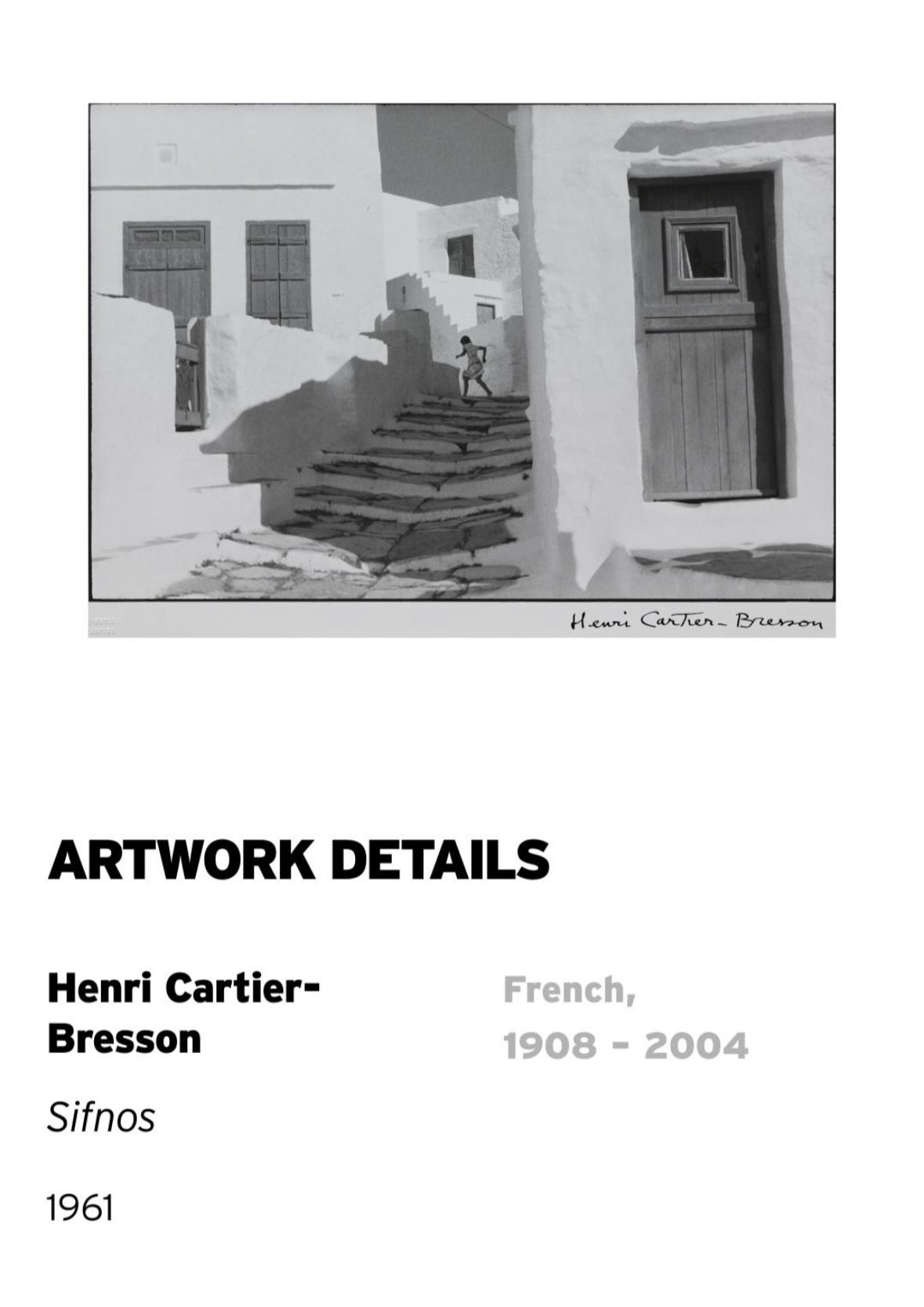
Epiphanous Photograph #3: Henri Cartier-Bresson's Siphnos, Greece, 1961


Though definitive statements of the following form, particularly in an aesthetic medium, are as a rule at best controversial and at worst meaningless, one could nonetheless well argue that Henri Cartier-Bresson (1908-2004) was the most prodigiously gifted photojournalist ever to use a camera.

Paraphrasing what the mathematician Mark Kac once said of Richard Feynman (the great 20th Century physicist), one can say of Cartier-Bresson that "there are two kinds of geniuses: the 'ordinary' and the 'magicians'. An ordinary genius is a fellow whom you and I would be just as good as, if we were only many times better. There is no mystery as to how his mind works. Once we understand what they've done, we feel certain that we, too, could have done it. It is different with the magicians. Even after we understand what they have done it is completely dark. [Henri Cartier-Bresson] is a magician of the highest calibre." (see Wikiquote entry on Feynman for original quote).

Cartier-Bresson is most famous for introducing the idea of the "Decisive Moment" into the photographer's lexicon, which he described in his celebrated book of the same name in 1952 as "...the simultaneous recognition, in a fraction of a second, of the significance of an event as well as of a precise organization of forms which give that event its proper expression."

One can see the "Decisive Moment" at play in virtually all of Cartier-Bresson's photographs; there is no "one best" representative of it, and which images illustrate the idea better than others depends more on context, mood and the temperament of the observer than innate quality. The first Cartier-Bresson image that I can remember having a profound influence on me was his Siphnos, Greece shot reproduced above.

I was struck (when I first saw it as a young photographer, and even more so now, after trying, mostly unsuccessfully, at capturing that stubbornly elusive "Decisive Moment" for a few decades!) by the perfectly seamless (and, seemingly effortless) blend of geometry, time, and dynamics.

The geometry is exquisite in its "imperfect" precision; the buildings are old and withered, the road is well traveled and decaying, but together there is a deep harmony. The harmony is only enhanced by the deep contrast, with the shadows - falling just so, at this precise moment - adding an almost surreal virtual dimension to the physical architectonic shapes. As if all of that were not enough to yield a magnificent moment, the girl racing up the stairs is positioned in exactly the right spot to give life to the entire picture, and with a body posture whose geometry exactly matches that of the surrounding forms and shadows. Masterful, is not the word! You can feel her energy; you feel her heart racing as she makes her way up the stairs; the coolness on her skin as she is momentarily embraced by the precise shadow. And then, as a final reward, as the eye slowly pans around the scene, small details to savor are revealed: the texture of the road, the detail on the door on the right, the architectural "accent" on the otherwise featureless wall at the upper left. The ineffable transience of space, time, geometry, dynamics, and the natural flow of human life, is captured at the Decisive Moment. And then, Poof!, the girl is gone, the shadows pass, a cloud moves in overhead, and the moment is gone, forever.

I have been chasing decisive moments ever since; and it is the third reason I have always been passionate about fine art photography.

Friday, March 10, 2006

Ten "Epiphanous" Photographs: #2

The second of ten "epiphanous photographs" - a hand-picked series of photographs as defined in an earlier Blog entry - is...

Epiphanous Photograph #2: Ansel Adam's Monolith, The Face of Half Dome, Yosemite National Park, 1927


Apart from its aesthetic appeal, what makes this photograph so special to me, is what I learned a few months after I first saw it a book (when I was still in my teens) about how Adams made it. I subsequently learned that Monolith was the image that taught Adams the art of previsualization; that is, the ability to previsualize, in one's mind, what you want the print to look like, and to then use whatever filters (in Adams' case, a deep red filter to properly render the sky deep black) and exposure are required by the previsualized print. Adams had to work fast, and, as I recall, had only a single plate of film left to expose (after a long day of photography).

This particular image, and most importantly the way this image was conceived, previsualized and printed, marks a cornerstone in my own photography in two ways: (1) I have never approached a subject since without first previsualizing what it is I want the final print to reveal about the subject, and (2) it was the first time that I truly appreciated that a photograph need not exactly recreate a scene (as might be observed by a passive "viewer" at the scene); rather, it can - sometimes must - depict the scene in a way that best communicates what the photographer saw and felt.

In the case of the Monolith, Adams' epiphany (and thereby the epiphany for all succeeding generations of fine art photographers!) was that a filter was needed to convey how awe struck he was, as observer/as photographer, by the Monolith's shear magnificence. I, in turn, was awe struck, by the resulting print's power to communicate Adams' moving experience (just as he was sure it would when he previsualized in his mind's eye how a red filter would render this scene). And it is another important reason why I am so passionate about fine art photography!

Wednesday, March 08, 2006

Ten "Epiphanous" Photographs: #1

In Lenswork Issue #63 (March-April, 2006), editor Brooks Jensen has a wonderful essay that begins with the question: "If you were going to demonstrate to a non-photographer the nature of fine art photography and why you are so passionate about it, which ten photographs would you show them?"

What a provocative (and deceptively difficult) question! Naturally, it prompted me to reflect on what my own choices might be at this time and stage of creative life. Of course, I realize that what my 45 year self currently believes are the "epiphanous" photographs that have helped form and shape my photographic I/eye's evolution are likely representative of neither what my I/eye most deeply cherished ten or twenty years ago (though the overlap is large) nor what I may cite as my first inspirational visual stepping stones 20 or 30 years from now.

Having done away with this obvious, but important, caveat, I offer the first of ten photographs that were - each in their own way - epiphanous to me, as an ever-evolving photographer, and my best "explanation" (as per Brooks Jensen's question) to others why I am passionate about fine art photography...

Epiphanous Photograph #1: Minor White's, Capitol Reef, Utah (1962):


Minor White (1908-76), who taught at MIT from 1965 until his death and was one of the founders of Aperture Magazine (in 1952), was arguably one of the most gifted "spiritual" photographers of the 20th century. By that I mean that White's lifelong approach to photography was predicated on the notion that a photograph - in particular, a fine art photograph - must transcend its merely physically manifest form and capture something of the timeless inner presence that defines the soul "taking" it.

White's Capitol Reef (the exact date of my first viewing of which I cannot recall) is the very first photograph I remember seeing that absolutely stunned me, rendering me virtually speechless; all I kept saying for days afterward was "Wow!".

The reason for my reaction was (and still is) how subtly it enfolds objective and subjective realities. What at first site appears to be nothing more than a "mere" beautiful pattern of stone, quietly, almost imperceptively, shifts into an unrecognizable, and - almost paradoxically, even more beautiful - subjective pattern of shapes, textures and tones. Reality, in short, has simply dissapeared, and has been replaced - by what? - anything the viewer's eye/I happens to see at the moment of viewing.

Outer objective reality blended, and enfolded, into subjective, inner truth and vision; and a "mere" representational photograph transformed into a glimpse of a transcendent dynamic reality. It is also the photograph that made me fall in love with fine art photography.

Tuesday, March 07, 2006

God is at Eye Level


I saw this wonderful book at a local bookstore and was very moved by its sincerety, elegance, and depth (not to mention its fine photography!).

The book is a sublime gem that anyone who is interested in what photography is really all about, what life is all about, and what their soul is all about, owes it to themselves to keep it by their side! It will enhance and broaden your sense of the world, and deepen your interconnection with it.

The author/photographer, Jan Philips, is a rare creature who is equally well proficient (indeed, gifted), in being able to both effortlessly capture the timeless beauty and spirit of nature in her photos and provide an eloquent written context for those images to help others find the sacred in the ordinary. Spending time with even just a few pages leaves one with feelings of peace and tranquility; reading over the entire book, a few times perhaps, depending on mood and temperament, cannot fail to leave even the most downtroden of souls feeling joyful at simply being alive and having the privilege at marveling at life's beauty. The book, in short, is all about how everything that one looks at - and most of all the inner "I" that is always lurking somewhere in the mysterious depths of our souls looking outward through our "eyes" - is nothing but God looking in.

Phillips book is a small treasure of a book that is now on the short list of books I will never part with. Highly recommended. (Readers for whom this short description is enough to arouse their interest, should also look up Nicholas Hlobeczy's A Presence Behind the Lens: Photography And Reflections and Volume IV of Christopher Alexander's four volume opus, Nature of Order).

Readers are also strongly encouraged to visit Jan Phillips' website, which has information about her many other books, music CDs and workshops schedules.

Monday, March 06, 2006

Kwanon (the original Canon Camera)


I have been a devoted Canon Camera user ever since my purchase of the venerable AE-1 35mm SLR when it first came out in 1976. For fellow Canon afficionados, here is a great site that chronicles the entire history of the camera company.

The company was founded by Saburo Uchida (1899 - 1982) and Takeo Maeda (1909 - 1975), who called their prototype camera the Kwanon (after the Buddhist Goddess of Mercy). The prototype was never marketed, however, and the name "Kwanon" was soon changed to "Canon," which means "standard for judgement or biblical scriptures." The first official camera release by the new company, the Hansa Canon, was released in 1935.

Here is the announcement, as it appeared in the October 1935 issue of the Asahi Camera: "Hansa Canon camera… Canon is a Leica imitation made in Japan. Although some influence of Contax is found, the majority of its features are modeled after the Leica. The dimensions of the camera are 13.5cm x 6.8cm x 4.5cm, while its weight is approximately 650g. It uses a special magazine and the lens is Nippon Kogaku’s Nikkor 50mm f/3.5. The lens is removable… The viewfinder is a box-type, and is designed to pop up to a specified position by pressing a button on the back. 275 yen with a snapshooting case included."

Highlights of this impressive sight include separate histories of film cameras, digital cameras, and an overview of the entire design process. Here is the Museum Site Map.

Appearance vs. Reality


The checkershadow illusion is one of the more remarkable "illusions" I've encountered, that goes to the heart of how we (as visual information processors) interpret and categorize the world; it also goes to the heart of the question, "Are you really sure of what you are looking at?"

Believe it or not, the squares marked A and B are exactly the same shade of gray! If you do not immediately believe your senses (as I suspect you won't!), just copy/save the image to a jpeg file and use any image processing program to sample the actual luminosity of each square...truly amazing!).

The "explanation" is that our visual systems require more than just luminosity to assess the shade of grey to be assigned; it also needs such features as local contrast and boundary effects. A complete explanation is provided here.

The checkshadow illusion was devised by Edward H. Adelson, Professor of Vision Science in the Dept. of Brain and Cognitive Sciences, Massachusetts Institute of Technology. His site includes many other startling illusions that explore the nature of perception and interpretation of reality (see his Illusions and Demos), as well as technical papers explaining his theories and findings. Adelson's site is a must-see for all photographers who "believe" they know all there is to know about appearance, reality, and the true nature of tonal gradations.

Additional references (and illusions) appear on the
Perceptual Sciences Group
homepage.

Friday, March 03, 2006

Cymatics: Revealing Nature's Hidden Patterns


Cymatics (from the Greek kyma, meaning "wave" and ta kymatica, meaning "matters pertaining to waves"), is the study of wave phenomena, pioneered by Swiss medical doctor and natural scientist Hans Jenny (1904-1972). Over the course of more than ten years, Jenny conducted landmark experiments pumping energy into, and animating, otherwise inert powders and liquids into life-like, flowing forms that mimic patterns found throughout nature, art and architecture. All of these patterns are a direct physical manifestation of pure tone vibration: dynamic form induced by material vibration.

Jenny's work builds upon much earlier work by Ernst Chladni who, in 1787, published "Discoveries Concerning the Theory of Music." This work introduced the basic physics of acoustics (the science of "sound"). One of Chladni's many practical (and aesthetic) discoveries was a way to make sound waves visible . By using a violin bow, stretched perpendicularly across the edge of flat plates covered with sand, he produced the patterns and shapes that today go by the term Chladni figures.

Jenny's work also overlaps a bit with the work of mathematician Nathaniel Bowditch, who was among the first to study the patterns generated by parametric sinusoidal waves called Bowditch curves, but are more often called Lissajous figures.

Apart from the incredible innate beauty of Jenny's patterns, there lies perhaps an even deeper, and deeply mysterious, "beauty" that has to do with the underlying patterns of nature. As Cathie E. Guzetta puts it so eloquently in "Music Therapy: Nursing the Music of the Soul"..."The forms of snowflakes and faces of flowers may take on their shape because they are responding to some sound in nature. Likewise, it is possible that crystals, plants, and human beings may be, in some way, music that has taken on visible form." You can read more in the article Cymatics: The Science of the Future.

More recently, work on oscillons has revealed many of the same mysterious features, including that of effective atomic and crytaline structures. The physics of "small" granular media (sand, powder, BBs from a toy shotgun,...) that sit between the microscopic (atomic) and macroscopic (and cosmic) is in its infancy. A great technical survey on oscillons: Patterns and Collective Behavior in Granular Media.

Wednesday, March 01, 2006

Camera Obscura


The camera obscura (Lat. dark chamber), the basic principles of which have been known since antiquity, is essentially just a box (which may be room sized: see discussion below) with a small hole on one side. Light passes through the hole and forms an image on the opposite wall (the sharpness of which depends on the size of the hole, and with very small holes leading to problems stemming from diffraction; as the hole becomes smaller, light sensitivity also naturally decreases).

The camera obscura has long been a favorite of artists because the artist can use the projected image as the base on which to draw; since the image is in perfect perspective, the realism of the rendered image is thus hightened. Pinhole cameras are camera obscuras with light-sensitive film.

Now we come to the reason for this Blog entry: to highlight the work of a master photographer - Cuban-born Abelardo Morell - who uses a room-size camera obscura to record wall-size images of Manhattan, New York, San Francisco, CA, and the cityscape of Havana, Cuba (among many other locations). Interested viewers are encouraged to explore Morell's complete Camera Obscura gallery.

His full (and extensive) on-line gallery of photographs (including some of his early work) can be viewed here. His most recent publications include Camera Obscura, and A Book of Books. See also Abelardo Morell (by Richard B. Woodward).