Sunday, March 04, 2012

What Else a Thing Is


Since the beginning of the year, I have posted about a dozen and a half images from a (still evolving) portfolio with the tentative title Synesthetic Landscapes. The concept for this portfolio actually dates back to Thanksgiving 2009 (which my family and I celebrated in my in-laws' home in Coral Gables, Florida, and which I can date so precisely because it is the time my eye was first drawn to color-infused reflections in my mother-in-law's Nambe-like metal salt and pepper shakers). So the portfolio by now contains many more images than those I have had time to post. Indeed, I will likely self-publish a selection using Blurb. What I wish to explore a bit in this post, however, is - if you, kind reader, will indulge my usual predilection for philosophical musings and/or ramblings - is what my experience of capturing images for this portfolio reveals about the fundamental nature of "what a thing is, is-not, and may-be."

Let me start with this beautiful image of a print by Hanabusa Itchō (1652–1724):


It depicts a story that has many variants and reaches back into Jain, Buddhist, Sufi and Hindu stories. The poet John Godfrey Saxe immortalized the core idea for the western world in his poem "The Blind Men and the Elephant," that starts out...

It was six men of Indostan
To learning much inclined,
Who went to see the Elephant
(Though all of them were blind),
That each by observation
Might satisfy his mind

...and (eventually) has the men "see" the elephant as a wall, snake, spear, tree, fan or rope, depending on what part of the elephant's body they touch and probe...

And so these men of Indostan
Disputed loud and long,
Each in his own opinion
Exceeding stiff and strong,
Though each was partly in the right,
And all were in the wrong!

A wikipedia article highlights some of the many uses this story (in all its myriad forms) has had as a metaphor in physics, biology, and religion. I view it as a provocative stepping stone for asking (for the moment, in the context of photography, but ultimately probing something rather deeper): "What is a 'thing' really?", or - better - "How fundamental an understanding of 'reality' does our privileged 'view' of it provide us with?"


Suppose you are asked to take a picture of a water glass (say, from the kitchen). What would you do? The simplest, most obvious, approach is to point your camera in its general direction and go "click." The result is a photograph of a glass, but - like the blind men groping at the elephant - the glass will have been captured from a single vantage point, using a fixed aperture and exposure time, with perhaps a filter sandwiched between the glass and our lens (maybe a polarizer to "cut out" some of the glare). Assuming the photograph is technically well executed, it can certainty serve as an adequate representation of  the glass, and others may use your image as a "symbol" to denote the "real" glass. But what - and how much - of the "glass" (and everything it "means" as an object in this universe) have you actually captured in your photograph? Your image is less an "image of the glass" than it is an "image of the glass taken by [substitute your name] taken on date D under conditions C using camera X with setting S." Your image - any image - is but one possible image of essentially an uncountable number of possible images that could have been taken of the glass.


Which image 'best' represents the glass? None, all, and one, depending on one's point of view and ontological predilections. The answer is none, because "privileged observers" are an anathema (at least to physics). There can be no "best" observer, or "best" image. Images may contain more or less useful information (for a certain goal), but - absent such an externally imposed constraint; i.e., an external aesthetic - no one image is "better" or "worse" than any other. The answer is all, because if an objective measure of "better" or "worse" cannot be defined, each image must be treated equally, and the set of all possible images - collectively - objectively defines (the visual representation of) the colored glass. And the answer is one, because there is always at least one aesthetic at play, namely that of the photographer. The photographer is a de facto privileged observer, and the "best" image is the one that best reflects the photographer's aesthetic. 


The caveat is that the resulting picture is not necessarily a picture of a "glass" (since the photographer may wish her image to convey something entirely different). Rather, it is a "picture of a glass taken by photographer X (at time t) for purpose P." This ontological distinction is often overlooked. Because an image is itself a physical thing and conveys information about another physical thing, we tend to interpret what we see in pictures literally: "this image shows a glass, and now, having seen it, I 'know' what this glass looks like and therefore what it is." And yet, this is so obviously not so. Taking a cue from the blind men and their elephant, we ask: What other "views" of this glass could we have, under what conditions (of the glass and our own inner thoughts and feelings), such that we gain a fuller, more complete, understanding of what the glass really is? 

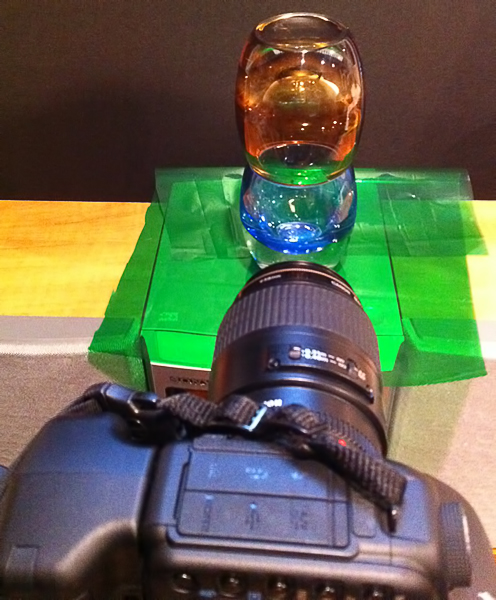
What does all of this have to do with images on this page and kitchen glasses? These images, along with the last 16 or so Synesthetic Landscape images that I've posted on my blog in the last few months, are all "privileged views" of colored water glasses borrowed from my family's kitchen (captured using either Canon's EF/100mm or extraordinary MPE/65mm macro lenses, and using only naturally reflected, transmitted, and refracted light, no "Photoshopping"). Yet none of them depict a "glass" as such (indeed, I hope that for most viewers this will come as an unexpected revelation of what the images "really" are ;-) They are all attempts to pay homage to Minor White's well-known credo to take pictures of "what else" a thing is. Pictures of colored water glasses they all may be, but they are also each fleeting glimpses of other-wordly realms, of wild aurora borealis, arctic seascapes, sunsets, spring and summer meadows, and deserts. And, as well, they are - collectively - all snapshots of my ongoing efforts to grope my way toward understanding what a "water glass in my family's kitchen" really is.

I also imagine that somewhere in these synesthetic sunsets and meadows there is an image of the very same water glass that got me started on my aesthetic journey. And deeper still lies an image - only an image? - of my own eyes staring back at me. What is "more" or "less" real: the glass, the meadow, or the photographer? And are there - really - truly meaningful distinctions to be drawn among the three? Or is the universe but a vast, ineffable, self-created, ouroborian broth of nested self-perceptions? A recursive loop of void and substance? The elephant groping for its own meaning? A cosmos observing itself observing?

Monday, February 27, 2012

Symbolic Omniscience


"The basic characteristic of any artistic expression is the ordering of a visual impression into a coherent, complete, living form. The difference between a mere expression, however intense and revealing, and an artistic image of that expression, lies in the range and structure of its form. This structure is specific. The colors, lines, and shapes corresponding to our sense impressions are organized into a balance, a harmony, or rhythm that is is in an analogous correspondence with feelings; and these feelings are, in turn, analogues of thoughts and ideas. An artistic image, therefore, is more that a graph of emotions. It has meaning in depth, and, at each level, there is a corresponding level of human response to the world. In this way, an artistic form is a symbolic form grasped directly by the senses but reaching beyond them and connecting all the strata of our inner world of sense, feeling, and thought. The intensity of the sensory pattern strengthens the emotional and intellectual pattern; conversely, our intellect illuminates such a sensory pattern, investing it with symbolic power. This essential unity of primary sense experience and intellectual evaluation makes the artistic form unique in human experience and therefore in human culture. Our closest human experience is love, where again sensation, feeling, and idea live in a vital unity."


“For some time there was a widely held notion (zealously fostered by the daily press) to the effect that the 'thinking ocean' of Solaris was a gigantic brain, prodigiously well-developed and several million years in advance of our own civilization, a sort of 'cosmic yogi', a sage, a symbol of omniscience, which had long ago understood the vanity of all action and for this reason had retreated into an unbreakable silence.” 

Sunday, February 26, 2012

Poetics of Space


"House, patch of meadow, oh evening light
Suddenly you acquire an almost human face
You are very near us,
embracing and embraced."


"Our house is our corner of the universe... it is our universe, a real cosmos in every sense of the word. If we look at it intimately, the humblest dwelling has beauty... The house, like fire and water...[recalls]... flashes of daydreams that illuminate the synthesis of immemorial and recollected... Through dreams, the various dwelling-places in our lives co-penetrate and retain the treasure of former days... We comfort ourselves by reliving memories of protection... The house shelters daydreaming, the house protects the dreamer, the house allows one to dream in peace... The places in which we have experienced daydreaming reconstitute themselves in a new daydream, and it is because our memories of former dwelling-places are relived as daydreams that these dwelling-places of the past remain in us for all time."

- GASTON BACHELARD

Saturday, February 11, 2012

Transcendent Order


"When we say that order is transcendent, we mean to say that somehow, the order makes contact with some other reality, or some other 'something,' which lies outside of and beyond our normal experience. We need a word for this something. It is hard  to find a suitable word, since, by definition, the something is beyond normal experience - and presumably, therefore, outside the range of things which have ordinary names... I use the word 'ground'  to refer to this something.

The ground is imagined to be a pure reality. It is a state of reality, or substance, which is in the universe, but not accessible to normal perception and normal awareness. It is, however, not assumed to be distant. It is generally assumed to be here where we are, and even more real, more authentic, than the reality we normally experience. It is thus supposed to be a state of matter, or state of things, or state of existence, which is more fundamental - and of which one might say that 'the universe is really made of this stuff.' All this is 'the ground.' It is the ground beneath our feet, the ultimate ground of substance on which all things stand.

Color not only establishes wholeness as a single quality, a oneness beyond structure.It begins to establish a connection with this ground. The inner light we experience in the cases of great color seems to penetrate beyond normal experience, reaching through to this ground, showing us this ground, making us feel the ground... the experience of inner light reveals an ultimate world of existence as it really is, perhaps, and shows us a glimpse of a reality which is more profound, more beautiful, than the one we experience every day...[it is the] first direct experience of the I."


Wednesday, February 08, 2012

Transcendental Mirrors


"Bodies of still water are
themselves like minds;
transcendental mirrors, 
Platonic cameras
to catch and hold 
the phenomenological long enough 
for the onlooker to grasp its reality,
the eternal thing behind it."

- David Mason Greene

"There is, one knows not what sweet mystery about his sea, whose gently awful stirrings seem to speak of some hidden soul beneath; like those fabled undulations of the Ephesian sod over the buried Evangelist St. John. And meet it is, that over these sea-pastures, wide rolling watery prairies and Potters’ Fields of all four continents, the waves should rise and fall, and ebb and flow unceasingly; for here, millions of mixed shades and shadows, drowned dreams, dreaming still; tossing like slumberers in their beds; the ever-rolling waves but made so by their restlessness."

"The Pacific," Moby Dick

Tuesday, February 07, 2012

On Seeing


"The child has to learn how to separate out the images which assail the newly-opened retina... a whole series of 'senses' are necessary... 

A sense of spatial immensity, in its greatness and in its smallness, disarticulating and spacing out, within a sphere of indefinite radius, the orbits of objects which press around us; 

A sense of depth, pushing back laboriously through the endless chain of events and measureless distances of time which a sort of sluggishness of mind tends continually to condense for us in a thin layer of the past; 

A sense of number, discovering and grasping unflinchingly the bewildering multitude of material or living elements involved in the slightest change in the universe;

A sense of proportion, realizing as best we can the difference of physical scale which separates, both it rhythm and dimension, the atom from the nebula, the infinitesimal from the immense;

A sense of quality, or of novelty, enabling us to distinguish in nature certain absolute stages of perfection and growth without upsetting the physical unity of the world; 

A sense of movement, capable of perceiving the irresistible developments hidden in extremely slow development - extreme agitation concealed beneath a veil of immobility - the entirely new insinuating itself into the heart of the monotonous repetition of the same things; 

A sense, lastly, of the organic, discovering physical links and structural unity under the superfical juxtaposition of successions and collectivities.

...we have only to rid our vision of the threefold illusion of smallness, plurality, and immobility for man effortlessly to take the central position... the momentary summit of an anthropogenesis which is itself the crown of a cosmogenesis. No longer will man be able to see himself entirely unrelated to mankind, neither will he be able to see mankind unrelated to life, not life unrelated to the universe."

Monday, February 06, 2012

Music of the Eyes


"What prohibits me from treating my perception as an intellectual act is that an intellectual act would grasp the object either as possible or as necessary. But in perception it is 'real'; it is given as the infinite sum of an indefinite series of perspectival views in each of which the object is given but in none of which is it given exhaustively."

(1908 - 1961)

"Perhaps art is just taking out
what you don't like
and putting in what you do.
There is no such thing 
as Abstraction. 
It is extraction, 
gravitation toward a 
certain direction... 
It is nearer to music, 
not the music of the ears, 
just the music of the eyes."

(1880 - 1946)

Sunday, February 05, 2012

Celestial Melodies


"...above all, I perceive in me with joy, a new tone, sounded by a violin within my innermost being. Its strings are tensed or relaxed through simple differences of temperature and illumination from without. Yet from deep with our being (an instrument that the conformity of habit has condemned to silence), there appears a song - out of those derivations, out of those vibrations -  from which all music arises. The weather, on specific days, leads us perchance from one sound to another. We rediscover the lost melody, which - as we might have guessed - appears with mathematical necessity, and which we, without knowing it, sang from the first moment on. Only these inner modifications - inner, despite the fact that they came from the outside - renew the outer world for me."

"It was while gliding through these latter waters that one serene and moonlit night, when all waves rolled by like scrolls of silver, and, by their soft, suffusing seethings, made what seemed a silvery silence, not a solitude: on such a silent night a silvery jet was seen far in advance of the white bubbles at the brow. Lit up by the moon, it looked celestial; seemed some plumed and glittering god uprising from the sea."

Saturday, February 04, 2012

Illumination and Purification


"The outcome is this...the whole conscious being is open to spiritual experiences of every kind. It turns toward spiritual truth in thought, feeling, perception, and action; it is adjusted to respond rightly... The second thing is the free influx of all kinds of spiritual experience, experience of self, experience of God and of the divine creative power, experience of the cosmic consciousness, a direct contact with cosmic forces and with the hidden movements of universal Nature, a psychic sympathy, union, inner communication and various kinds of reciprocal relationship with other beings and with Nature as a whole, illumination of the heart through love and devotion, through spiritual joy and ecstasy, illumination of the senses and of the body through higher experiences, illumination of dynamic action in truth and love, purification of mind and spirit, heart, and soul."

(1893 - 1963)

"Complete consciousness is present to us at all times, every moment, but we reject it in order to maintain our prejudices, our ideas. But sooner or later we will relinquish our ideas in favor of response... Life is consciousness of life itself."

(1912 - 2004)

Friday, February 03, 2012

Hermeneutic Mysteries


"I see photography as an extraordinary means to undertake an exegesis of the Real, prompted by the first and literal level: the image of the evident objects. Any subsequent new meanings are discovered and rendered manifest through a hermeneutic process unfolding from the limited surface of the photograph; new interpretation will spring from the depth of the apparently flat surface of its image.
...
As with the sacred texts, all levels of meaning of a photograph are contained within its boundaries, simultaneously present to be discovered and revealed. Through a photograph we may see and transcend the object, moving further from its literal sense.
...
We are the interpreters of a great mystery: we belong entirely to reality and are part of this mystery.
...
In a 1995 presentation that Michelangelo Antonioni made of Beyond the Clouds, the film that proved to be the last one of his life, he said:

...we know that beneath the image revealed there is another one more faithful to reality, and that beneath this image there is another one, and again a new one under this last one, up to the true image of the absolute and mysterious reality that no one will ever see..."

"Photography and Torah"
(quoted from The Edge of Vision, by Lyle Rexer,  p. 281)