Showing posts with label Andre Kertesz. Show all posts

Saturday, March 23, 2013

Yesteryear Versions of Today's Magazines - Part 2

In my last post, I recommended a recently published book that collects some early articles and portfolios that appeared in Aperture Magazine while under the editorship of Minor White. All the articles appearing in the new book were first published between the years 1952 and 1976, and - as explained in the previous post - are very different in subject and content from what typically appears between the covers in the current incarnation of the magazine.  

I promised to introduce the second of two anthologies I've recently enjoyed of this type, to which we turn to now. The difference this time is that both the reprinted articles and the book itself are "old," the articles dating back to its inception through 1977 and the first (only, so far as I know) edition of book itself to 1979! The magazine is Popular Photography, and has been around since 1937. The anthology I'm recommending is called The Best of Popular Photography, edited by Harvey V. Fondiller, and available from Amazon in used form (which is the form I bought mine in) for as little as $0.85; new ones starting at $9. Barnes and Noble also lists "new" versions, but they seem needlessly expensive (running from $24 up to $130.00).

To say it has been a long time since I've done much else than inattentively flip through the heavily-laden-with-advertisements modern variant of this once-wonderful magazine at Barnes & Noble is an understatement. Rarely offering more than a few paragraphs that contain general musings (if you can find them in the thicket of adds!) - about how "one should not forget to take a tripod on a trip," or "here is yet another lens you absolutely need (that reads like the review of last month's lens-of-the-month, which reads like..," to "you too can become an Ansel Adams with a few easy steps " - the magazine IMHO contains effectively nothing of use to anyone even remotely interested in the art of photography.

But, alas, this was not always the case, as in the early decades of this once fine magazine some very memorable prose, reviews, insights - and even art! - found their way into its pages. The anthology contains 392 thick semi-gloss pages - which is good because a thick stock generally ensures that used copies will likely have stood the test of time and use (mine is old, but in very good condition) - is broken into 8 sections (that range from retrospectives, to personalities, to techniques (most of which are just as applicable to today's digital world as they are to the analog world they were spawned in), to photojournalism, to careers, to history. There are also short but interesting color and black&white portfolios.

There are articles by Margaret Bourke-White, Ansel Adams, W. Eugene Smith (on Dorothea Lange), and Beaumont Newhall; essays on Andre Kertesz, Edward Steichen, Paul Strand, Edward Weston, Robert Capa, Arnold Newman, Henri Cartier-Bresson, and Weegee (among a host of others); retrospectives on the early years of photojournalism; early "debates" on the differences between snapshots and "real" images, and speculations on "what makes a good photograph?" (that are typically deeper and more probing than many of today's sound-bit bits of "wisdom"); and essays on emerging technologies like holography (one article had the prescient audacity to ask, by its title, "Holography - Is It Art? ;-). To give you an idea of the loving detail most essays provide (in stark contrast to the "we'll give you all you need to know in a moment or less of your time" approach followed by most of today's glossy-magazine editors), an essay on Arnold Newman (first published in November 1973) runs 8 pages and contains 6 images (including a wonderful full-page reproduction of his famous portrait of Picasso); the essays on Alfreed Stieglitz (published in September 1946) and Cartier-Bresson (published in May 1967) run 8 pages each and contain 7 and 3 reproductions, respectively; and the one on Paul Strand that appeared in April 1972 runs a full 12 pages (with small type!) and contains 7 reproductions. A mini-course on portrait lighting - again, just as relevant today as in 1973 when first published - runs 11 pages and contains more useful information that most of today's magazines seem to publish collectively over the course of year.

An added bonus in this anthology is a sprinkling of pages in which yesteryear products and advertisements appear. You can read about what the Polaroid Land Camera cost in 1949 ($87.75), the "new Leningrad" SLR from Russia in 1958,  and the Polaroid SX-70 (introduced in 1972). The book concludes with a useful index of all authors and pages on which discussions about a particular photographer appear. Pages 91-103 contain the results of a 1958 international poll  (of 243 critics, teachers, editors, art directors, consultants, and photographers) on the world's "10 greatest photographers." I'd give away the results of this poll, but that would be spoil the fun;-)

This anthology is highly recommended, for reference, for consultation, or simple joy of reading with a warm drink in hand in your favorite easy chair on a cozy rainy Sunday afternoon.

Monday, January 17, 2011

How Many Unknown / Undiscovered Artists Walk Among Us?

History is replete with lists of names and memorable biographies of the many gifted and talented artists that have graced our world. Indeed, these lists are so long and voluminous (and only growing ever more so), we may sometimes wonder if there are perhaps too many names already on them! But, of course, though not every artist is a Picasso, and not every photographer a Cartier-Bresson, each of us has our own story to tell. Still, very few of us who have - publically at least - accomplished "little" - will ever get mentioned on learned lists that include such names as Picasso and Cartier-Bresson. But what of the "Picassos" that share in Picasso's pool of talent but who no one knows by name, because the output of their creative life was / is confined but to a handful of family and friends? What of the prodigiously talented but utterly unrecognized Uber-geniuses that walk among us? As history also attests, the only real difference between "known" and "unknown" is luck.

I recently ran across a remarkable story about a nanny - and prodigiously talented but utterly unrecognized (until very recently) street photographer from the 1950s - named Vivian Maier. In 2007, real estate agent John Maloof bought a box of 30,000 of Maier's negatives for $400. Having soon realized what a "find" that box was, he has, by now, acquired over 100,000 of Maier's photographs! (only a thousand or so of which have so far been made public; see here and here for a sampling of her images). An exhibit of her work opened at the Chicago Cultural Center earlier this month. Sadly, Vivian Maier did not live to see her day; she died at age 83 in 2009.

It is hard to do justice to the quiet, soulful, graceful, and poignant (and sometimes spontaneous, funny) images that flowed from Maier's eye (and "I"). Using a Rolleiflex camera, Maier would head out into the Chicago streets on her days off as a nanny for rich North Shore clients. What she captured was nothing short of extraordinary! Her best work - IMHO (after sampling the images from the links I gave above) - approaches that of some of the "best known" street photographers of the 20th century. Her images (and overall approach) remind me of (in no particular order) Lisette Model, Walker Evans, Harry Callahan, Dorothea Lange, Robert Doisneau, Andre Kertesz, and - the more humorous ones, at least - Elliott Erwitt. I should emphasize that its not just that her images remind me of the best works by these great photographers; it's that her best work is just as good as theirs!

One image (of two boys standing side-by-side on a cobble-stone road) could arguably be inserted into a Diane Arbus portfolio with no one being the wiser. Another, of a vagabond curled up on a street, is a surrealistic fusion of human pathos and Weston's famous Pepper #30. Another (one of many!) exudes a Cartier-Bresson-like "decisive moment" feel. Still another echoes Kertesz's geometric meloncholy. One could go on and on, comparing this image to that, and illustrating how certain parts of her portfolio are similar to this photographer or that (Jacques Philippe has posted an interesting analysis of Maier's work); in the end, Maier's work is uniquely hers, and hers alone, and it is astounding in its breadth, depth, and meaning! The photo-history books, I suspect, are already being appended - and amended - with Vivian Maier's story!

I wonder, just how many other gifted artists are quietly walking - and creating extraordinary works of art - among us, unknown to all but a few lucky friends and family members?

Postscript: Click here for info about a feature-length documentary film about Vivian Maier that is in the works (for a 2012 release); the producers - John Maloof, Anthony Rydzon, and award-winning Danish documentary film maker, Lars Mortensen - are asking for pledges on Kickstarter.

Friday, March 31, 2006

Ten "Epiphanous" Photographs: #10

The tenth (and last) "epiphanous photograph" - in a hand-picked series of photographs as defined in an earlier Blog entry - is...

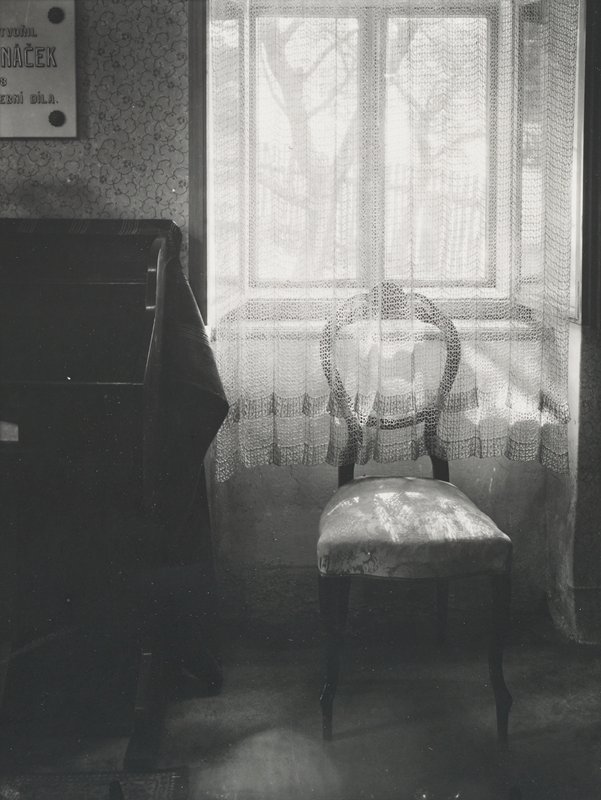
Epiphanous Photograph #10: Josef Sudek's At the Janaceks (1948)


Josef Sudek (1896-1976) was one of the great photographers of the 20th century, and perhaps the best-known Czechoslovakian photographer. Sudek was already an accomplished amateur photographer when he was called up for combat in WWI, and continued to photograph during his military service. Having lost an arm in the war, Sudek was able to get a free scholarhip for a photography course, from which point his life's course was essentially set.

Like Andre Kertesz, Sudek's photography is subtle, and intensely poetic. Though the works of both artists reflect a deep inner meloncholy, where Kertesz focuses (though not exclusively) on daylight scenes and subject matter than spans his travels, Sudek's images are confined mostly to Prague (indeed, to his own studio!) and are often dark and charged with a palpable mystery; few, if any, of Sudek's images would appear out of place as "illustrations" of a Kafka novel!

Consider my tenth, and final, selection as an "Epiphanous Photograph," Sudek's At the Janaceks. Using the simplest of aesthetic primitives - a chair, a window, light and shadow, and diffused light - it simultaneously evokes mystery (of undefined, hidden, meaning) and intensity (in the tangibly psychological presence of the "life" that pervades this room); a seeming paradox of clarity and ambiguity!

It is precisely because of the ambiguity of visual cues and delicate nature of the image - the hint of a yard and fence outside the window, the subtle suggestion of either a candle or small light bulb as an additional source of room light, the small, but otherwise distinctive "peeks" of furniture and a picture (?) in the corners - that the image is able (as so many of Sudek's photographs are!) to strike such powerful emotional chords in the viewer. In Sudek's hands, the camera (with help from Sudek's artistic eye!), becomes a magical tool to capture, probe, and ask what are ultimately unanswerable questions of the meaning and purpose of everyday life.

Sudek once said of his own work, that...


"...everything around us, dead or alive, in the eyes of a crazy photographer mysteriously takes on many variations, so that a seemingly dead object comes to life through light or by its surroundings....To capture some of this - I suppose that's lyricism."


To which I can only add that - if one spends even one afternoon gently immersed in Sudek's work - one can only conclude that in the eyes of a crazy but preturnaturally gifted artist, no part of the world is ever devoid of life and inner radiance. Although this is surely a basic lesson that all photographers, to one degree or another, teach, an examination of any of Sudek's best works makes this "lesson" almost obvious. I am humbled to know that on those rare days on which I dare call myself a "photographer" I at least share a common vision (if not divine gift of expression) with a true genius by the name of Josef Sudek. There is no question that in the right hands, photography is art.

Indeed, perhaps the shortest answer I can give to the original question that led to my soul-searching selection of ten personally "Epiphanous Photographs" - rephrased to read "How can you demonstrate to a non-photographer the nature of fine art photography and why you are so passionate about it?" - just look at any of the photographs by Josef Sudek! (More of Sudek's work can be seen here (#1) and here (#2).)

Saturday, February 18, 2006

Fine Art Photography Portfolios


Here is a real treat for aficionados of fine-art photography, in the classical tradition: an exquisite set of on-line portfolios of some of true masters of fine-art photography, including those of Ansel Adams (19 photos), Brassai (17 photos), Edward Burtynsky (20 photos), Harry Callahan (17 photos), Andre Kertesz (20 photos), Josef Sudek (12 photos), and Edward Weston (46 photos); among many others. The reproductions are relatively small, of course, but a delicious treat to the eyes and soul nonetheless.