Showing posts with label J.M.W. Turner. Show all posts

Tuesday, August 04, 2026

Amber Apparition


"White in prismatic order is the union or compound light, while the [...] mixture of our material colors becomes the opposite; that is, the destruction of all, or in other words - darkness. Light is therefore color and shadow the privation of it by the removal of those rays of color, or subductions of power; and there are to be found throughout nature [...] the ruling principles of diurnal variations, the grey dawn, the yellow morning sun rise and red departing ray, in ever changing combination; these are the pure combinations of Aerial colors.
...
The ark stood firm on Ararat: th’ returning sun
Exhaled earth’s humid bubbles, and, emulous of light,
Reflected her lost forms, each in prismatic guise,
Hope’s harbinger, ephemeral as the summer fly,
Which rises, flits, expands, and dies."

- J.M.W. Turner (1775 - 1851)

Sunday, May 28, 2023

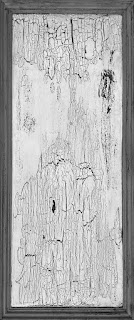
Doors and Landscapes


"With an emphasis on a conceptual rather than visual manifestation of nature, ancient shanshui aims to convey an experience of ‘being in nature’ rather than ‘seeing nature’. This being in nature is not about any singular experience of when and where man encounters nature, but a perpetual truth experienced by man in/with nature, namely, the wholeness and universality of the cosmic, laws and cycles in nature, and the integrative harmony between man and things. This can be best explained by comparing the sense of vastness in nature found in both Western landscape and ancient shanshui . In Western art, the cosmic sense in nature often evokes a sense of might, and even the destructive power, of nature. A moment prior to a thunderstorm, as described earlier in Ruisdael’s work, Turner’s images of snowstorm and shipwrecks, as well as Friedrich’s depiction of graveyards and the Sea of Ice, are all about the omnipotent power of nature, so much so that it can be lethal. In contrast to landscape painters of the West, ancient shanshui painters were not attracted to the unrelenting power of nature. This explains why images of natural disasters cannot be found in ancient shanshui . To ancient shanshui painters, their images visualize not the unusual but the common and perpetual sense of nature. They convey a message of a transcendental experience of being in/with nature."


Note. Like the image in yesterday's post (and perhaps like a few more to come) this one is a "quick grab" with my iPhone during a trip my wife and I recently took to Monterey, CA. "Objectively speaking," the image shows the central panel of an old dilapidated door that guards the entrance to a property on Ocean Avenue, Carmel, about a half mile or so from the beach. But, in my mind's eye, it is "really" an even more withered palimpsest of an ancient Chinese landscape. I have always been drawn to how Chinese landscapes lead you to gently experience the painting as a whole, rather than (as is more typical of Western art) to make you "see a subject." Apart from the academic paper I quoted from above, a wonderful book that explores the artistic and philosophical implications of this point of view is called The Great Image has no Form (by Francois Jullien, University of Chicago Press).

Thursday, December 01, 2016

Living Light


"There is the motion, the actual wave and radiation of the darted beam: not the dull universal daylight, which falls on the landscape without life, or direction, or speculation, equal on all things and dead on all things; but the breathing, animated, exulting light, which feels, and receives, and rejoices, and acts — which chooses one thing, and rejects another — which seeks, and finds, and loses again — leaping from rock to rock, from leaf to leaf, from wave to wave — glowing, or flashing, or scintillating, according to what it strikes; or, in its holier moods, absorbing and enfolding all things in the deep fullness of its repose, and then again losing itself in bewilderment, and doubt, and dimness ... It is the living light, which breathes in its deepest, most entranced rest, which sleeps, but never dies."

- John Ruskin (1819 - 1900)

Postscript: Ruskin's quote was inspired by his devotion to J. M. W. Turner's art (as is my Synesthetic Landscape that appears above it). I have been thinking of Turner lately because I've started reading what is turning out to be a magnificent new biography: The Extraordinary Life and Momentous Times of J.M.W. Turner, by Franny Moyle (Penguin Press, Oct 2016).