Showing posts with label Paul Cotter. Show all posts

Monday, June 22, 2026

Paul's Reflections

"At the core of it all, there's something more.
Something luminous, something shimmering."

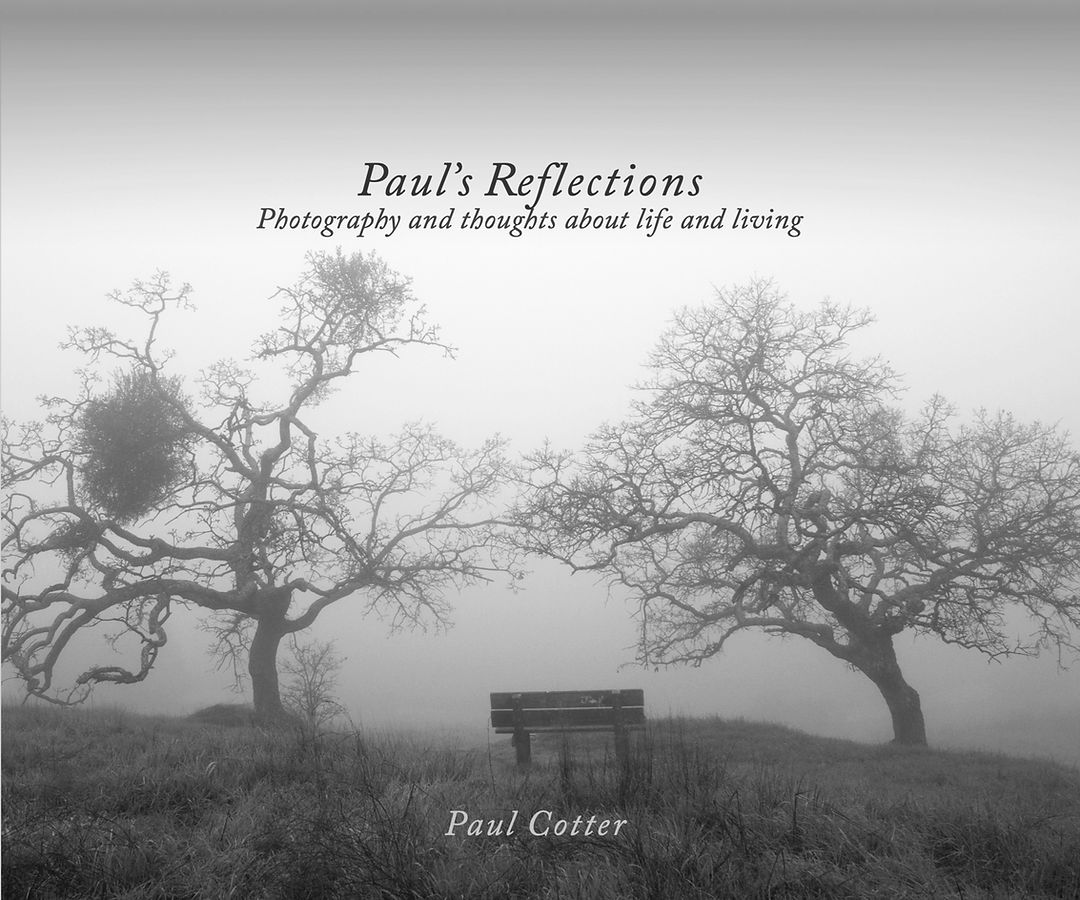
Long-time readers of my blog will have seen book reviews appear every now and then, but I haven't posted as many as one might expect (given my general penchant for books). By my count, I have about 20 (depending on the minimal length and depth that defines a "review" and excluding a post in which I summarize the book my mom and I wrote about my dad's life and art); just click on "Book Reviews" in the Themes and Places section in the left sidebar to see the full list. That's 20 reviews out of a total of 1660 total posts since 2004, or less than 1 per year! The main reason is that I only post reviews of books that have made a strong - a strong positive - impression on me. I can further distill this already select group to a set of exactly four books that made me blurt out "Wow!" and which altered my perceptions of the creative potential of photography as an art form: (1) Bruce Barnbaum's Visual Symphony (in the 1970s), (2) Fay Godwin's Land  (middle 1980s), and (3) John Sexton's Recollections (in 2006), and (4) Wynn Bullock's Color Light Abstractions (in 2010). To this short list I must now add a fifth - Paul Cotter's Paul's Reflections: Photography and thoughts about life and living - mostly because of how brilliantly it combines "verbal and visual" aesthetic - even spiritual - spaces, an observation made also by Barbara Bullock-Wilson in the foreword she wrote for Paul's book.

Full disclosure: (1) Despite never having met in person (though we both look forward to the day this is no longer true), Paul and I have "known" each other for about 10 years, and connected over an essay Paul had published on Wynn Bullock in 2016 (which I found by following a link I'd seen on Barbara Bullock Wilson's Facebook page). And, as dedicated readers of my own blog know, Barbara serendipitously become a treasured friend of mine soon after we first corresponded in 2012 via email about my "discovery" of her father's color abstractions; (2) I purchased Paul's book online as soon as I learned of its existence. Does my knowing Paul make the "review" you are about to read biased? Objectively, perhaps. But you'll have to take my word (on faith, of course) that I never recommend a book (about photography or any other subject) unless I believe it is special. Which brings us to my review.

The softcover book (this is the only version available) consists of 53 of Paul's favorite essays and accompanying photographs that have appeared on his blog between March 2023 and early 2026 (you can read more about the book and place your order here). Apart from the foreword and introduction, it follows an elegantly simple two-page format: a title introduces a short essay and a quote/callout (that highlights salient text) on the right, and an accompanying photograph appears on the left (a few sample pages are here and here). 

While the photographs reveal Paul's gift for simplicity and reflect an inner calm honed from years of studying Buddhism (Paul has been featured in National Geographic magazine, gallery exhibitions, and international photography annuals), the essays - each a perfect companion to the image it is paired with (as explained below) - are a world unto-themselves. Each essay is anchored on a single idea or observation (or, as you'll find on page 29, "thoughts about thoughts"). What sets these essays apart from those by most other photographer-authors is the Zen-like spark of illumination they ignite in the reader; Paul is as gifted an author as he is a photographer! Indeed, as I've emailed him privately several times after reading his blog posts, I am in awe at how few words - often no more than a few spare, poetic-like paragraphs - Paul needs to convey ideas that will take root and linger in your memory long after you've closed his book. I tend to think of them as sacred clippings drawn from the life of a wise and gentle sage. Though they are all short and can be finished in a minute or two, I recommend that you savor these essays by reading them slowly, thoughtfully, letting your mind wander and muse on whatever related themes and ideas you will no doubt find percolating inside you. 

You will find - and grow to appreciate after spending quality time with Paul's book - that each image-essay pair is subtly interlocked and self-reinforcing. When you turn to a page, your eye will first be drawn to the photograph on the left (since we are fundamentally visual creatures). After you've absorbed the first layer of meaning (there are other, typically many other layers you'll discover as you revisit the image), you'll shift your gaze to the accompanying essay on the right. This will also quickly draw you in, and you will momentarily "ignore" the image because you will have become consumed with the story that's taken you along for a ride. At some point, as you are reading the essay, your eyes will suddenly dance back to the image to pick out a detail you somehow missed before but which some words you've just read reminded you (or your mind's eye) was there to be discovered all along. You smile ("Of course, I should have seen that!") and turn your attention back to the essay. You smile again ("Paul's describing a world the photograph is showing me just a small part of!"). The essay seems somehow even richer than before; and you see textures and rhythms only hinted at by the words themselves. You glance back at the image and suddenly see that it doesn't just mirror some explicit part of the essay (what probably originally caught your eye), but includes deeper latent layers of meaning; the image is somehow transformed into something more ("I want to just keep looking at it, I don't want to leave."). Then back to the essay ("I wish it would go on. I'm not ready to leave this world. I never saw the world this way!). Back and forth you'll go, until distinctions between image and essay start blurring, and eventually disappear altogether. You'll "see" a world that the Zen-master's boat (i.e., which I'll colloquially refer to as "Paul's image-essay pair") has gently guided you across the stream to see. You smile again, relishing the anticipation of revisiting this stream before turning the page to step into another boat. 

While Paul's book is not meant to make you a better photographer or writer (though there are lessons galore for those who aspire to refine their skills at either), it will undoubtedly enhance your appreciation of - and ability to see, to really see - the "everyday miracles that are all around us." As for me, I look forward to dipping into its pages for inspiration for years to come. Highly recommended!

Thursday, May 22, 2025

Photographs-Otherwise-Not-Taken, Taken

Inside of Library, University of Otago, Dunedin, New Zealand

"Nows within this now, rather like snapshots in an album. Each Now is separate and a world unto itself, but the richly structured Nows 'know' about one another because they literally contain one another in certain essential respects. As consciousness surveys many things at once in one Now, it is simultaneously present, at least in part, in other Nows. This awareness of many things in one could well exist in a much more pronounced form in other places in Platonia."

- Julian  Barbour (1937 - )
 The End of Time

Note. The admittedly busy title of this blog post obviously begs an explanation. I'll start by saying that it is inspired by a short email exchange I recently had with a photo buddy of mine (the Zen-master, Paul Cotter). In reply to Paul's kind comments about my recent "travelogue images," I countered with the suggestion that my favorite images from the trip are/may-be those I took with my iPhone and not my 21L-sling-bag's-worth of "pro" gear (the details of which hardly matter)! While I am not (entirely) convinced of the veracity of my claim (and others may differ), I have zero doubt that my iPhone gifted me many images that I will cherish in the years to come precisely because these are photographs I would otherwise have not taken! Some examples - click to see full-size:

View of a wall while waiting to be seated at a restaurant

Footprints on a beach in front of another restaurant


A view from inside the Novotel Auckland Airport
while my wife was busy getting us checked in

Frosted window inside restroom at the
Aoraki/Mount Cook National Park Visitor Centre

View inside a restaurant while being led to our table

Upside down view of one of the ceilings at the
Nadi International Airport in Fiji

Another (upside down) view from inside the library at
the 
University of OtagoDunedin, New Zealand
 
A snapshot view of urban geometry while waiting
for my wife to pay the parking meter


A 5 sec exposure of a part of our boat ride to Milford Sound,
stabilized by my iPhone's computational photography algorithms

I have dozens more of these "Photographs-Otherwise-Not-Taken, Taken" images, all of which share this one salient pattern: had I not used my iPhone to capture them (embarrassingly easily by, literally, framing and tapping, and without any of what my wife describes as "glacier-paced compositional machinations"), they would all have been but fleeting moments doomed to be lost in the mists of memory and time.

Thursday, September 28, 2023

Silver Water Plummets


"Our land of lakes forever fair below blue mountain summits,
of swans, of salmon leaping where the silver water plummets,
of glaciers swelling broad and bare above earth’s fiery sinews—
the Lord pour out his largess there as long as earth continues!"

Jónas Hallgrímsson (1807 - 1845)

A kind note about the waterfall I featured in my last post (from a photography friend, Paul Cotter, whose exquisite portfolio and blog should be on the short list of anyone reading this - check out my links page to see what I think of Paul's work!), enticed me to ponder how differently I view my own images, depending on whether they were "easy" or "hard" to get — sometimes very hard, as when I tried capturing a view of the Selvallafoss waterfall. While it is easily accessible from a parking lot on the northern part of route 56 (on the eastern/inland part of Iceland's Snaefellsnes peninsula), I suspect that many tourists just take a quick look around (the parking area provides a gorgeous view of the volcanic lake, Selvallavatn), and get right back into their cars, oblivious to the beautiful falls that are hidden from view. 

I found it "difficult" to get this particular shot not because I needed to do any strenuous hiking (while there is a short walk involved along a mud-strewn and partly inclined path, the falls are almost within a stone's throw from the parking lot), but because my son (Josh, the next generation photographer/artist in our family) and I struggled with the ambient elements: (1) bitingly hard pelting rain, and - as if that wasn't enough - (2) unrelenting fierce mini-hurricane-strength "sentient" wind (that mysteriously swirled around us, seemingly without direction, trying to find a way to keep us an unbalanced as possible). In short, this was a beastly hard shot to get! - certainly by comparison to the image in my last post.

So, what does this have to do with the kind note from Paul Cotter? My kneejerk reaction was, "Many thanks, but now I'm embarrassed!" - where my "embarrassment comes not from being unable to take a compliment, but from the fact that I know that the earlier photograph was ridiculously easy to get: park car, walk 1000 feet to a bridge overlooking falls, set up tripod with a wide angle lens, screw on a 3-stop neutral density filter, and click. That's it! How can I possibly take any real credit (or be "rewarded" with a compliment) beyond simply asserting, "Well, I was there, saw an incredible scene in front of me, and went click"?

Objectively, I know (or ought to know) that "how good an image is" - regardless of what measure of "goodness" one uses - is not correlated with, or defined by, how hard (the photographer remembers) it was to capture. One can just as easily stumble across a timelessly "good" image as work furiously for days, even weeks, to capture a meh-level photograph. Yet, instinctively, my knee-jerk reaction is still always the same; I feel "embarrassed" when complimented on (what I know was) an easy-to-get image 😳 ... which the image above was assuredly not!

Saturday, March 21, 2020

I Am a Leaf


"Like bubbles in a spring, 
the phrase floated effortlessly
to the surface of
my consciousness.
I am a Leaf."

Back in September, while on a trip to the Pacific Northwest with my family, I wrote of an "unexpected kindness" that flowed my way in the form of an email from a recent "follower" of my blog, whose note politely inquired about when I'd next post a new picture. As I wrote at the time, the impersonal sterility of our modern world makes it easy to forget that what connects us all are simple, gentle, human gestures, like one photographer reaching out to another over the technological ether to ask, "I enjoy seeing your pictures; you haven't stopped posting have you?" It is in this same spirit of a deep interconnectedness among all living beings, that I offer in this post not a picture (none would do justice to the impact that the story - and its accompanying photographs - I am about to reveal had on me), but rather a link to an extraordinary - and extraordinarily uplifting and visionary - essay ("I Am a Leaf") that was recently posted by photographer Paul Cotter on the website, Gratefulness.org.

It is curious how I came upon Paul's essay (which I had not seen posted on his own site), for it too is evidence of the "interconnectedness" of things. While Paul and I have never met in person (I look forward to the day we do, for our aesthetic travels appear to have much in common), we have exchanged many emails ever since connecting over an essay Paul had published on Wynn Bullock in 2016. I got to Paul's post by following a link I'd seen on Barbara Bullock Wilson's Facebook page; as dedicated readers of my own blog know, Barbara serendipitously become a treasured "virtual" friend of mine soon after the first email she sent me after reading of my "discovery" of her father's color abstractions back in 2012). But back to Paul, interconnectedness, and his remarkable "I am a Leaf." Paul sent me a link to his essay after reading two of my recent posts (“Branches” and “Part of Something Larger”). Both of these posts, in turns out, had resonated strongly with Paul. After you read his essay, you will immediately see why.

Without spoiling your pleasure of reading Paul's own words, here is part of the email I sent Paul soon after I read his essay for the first time (I have read it multiple times since, and will not soon forget it's message): "Paul, thank you so much for sharing your story. I felt a deep chill reading it, though not in an 'ego-centric' manner, rather in a way profoundly devoid of any 'I' whatsoever. Your experience, and the transformative (dare I say, transcendent) quality of embracing being a  'Part of Something Larger', literally (frank admission) brought a tear to my eye. For a moment, just a fleeting moment, through your words and the images accompanying them, I remember losing my sense of self and reveling in pure being." 

Now, gentle reader, if you have not done so already, please go here and read what Paul has to say about life, vulnerability, self, reality, impermanence, interconnectedness, and - yes - why we are all, "just" leaves. The accompanying images are also nothing short of breathtaking; luminescent, spiritually infused, and all preternaturally soulful. In short, fine-art photography at its very best. 

Please share Paul's message with as many people you believe may benefit from his story. And then stay tuned for things to follow, as Paul has admitted to some long-term plans he has in mind. Thank you, Paul, for sharing your experience!