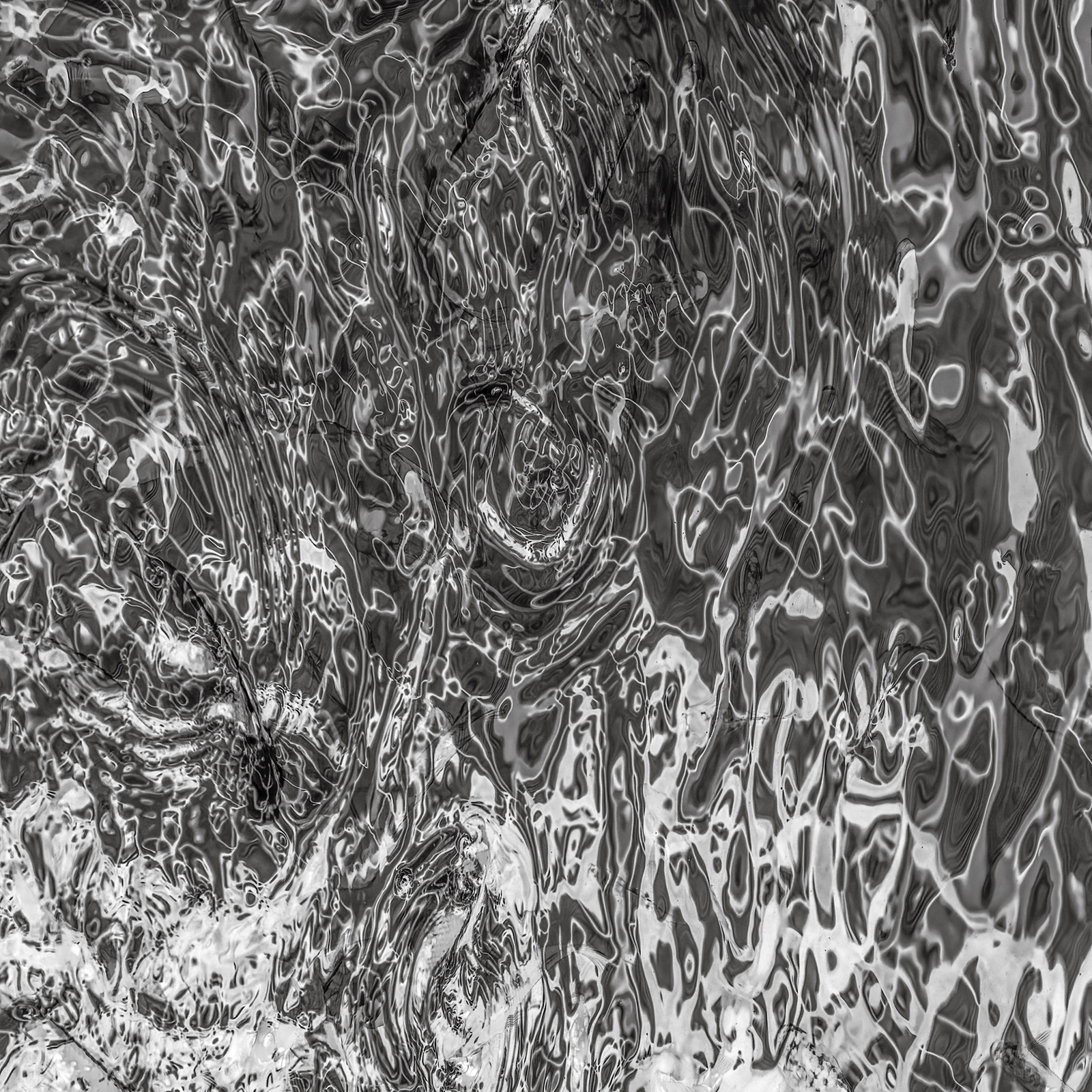
"The vibration of Spirit is at such an infinite rate of intensity and rapidity that it is practically at rest — just as a rapidly moving wheel seems to be motionless. And at the other end of the scale, there are gross forms of matter whose vibrations are so low as to seem at rest. Between these poles, there are millions upon millions of varying degrees of vibration. From corpuscle and electron, atom and molecule, to worlds and universes, everything is in vibratory motion. This is also true on the planes of energy and force (which are but varying degrees of vibration); and also on the mental planes (whose states depend upon vibrations); and even on to the spiritual planes. An understanding of this Principle, with the appropriate formulas, enables Hermetic students to control their own mental vibrations as well as those of others. The Masters also apply this Principle to the conquering of Natural phenomena, in various ways. 'He who understands the Principle of Vibration, has grasped the sceptre of Power,' says one of the old writers.
...
...the differences between different
manifestations of Matter, Energy,
Mind, and even Spirit, result
largely from varying rates of Vibrations...
...the higher the vibration,
the higher the position in the scale."
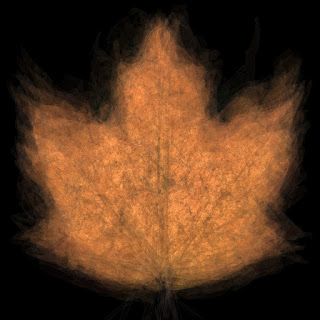
Postscript. In February of this year, I wrote about how the morning walks my wife and I took together during the pandemic (which we could do since I did not have to commute to my regular office; something which, sadly, I've had to resume doing recently) gave me an opportunity to see and appreciate how much beauty our local neighborhood offers. Back then, I was mesmerized with the "hosta-leaf corpses" that littered the sidewalks near our house, and which appeared to glow with a preternatural inner light. To communicate a sense of what first drew me to them (i.e., their radiance), I rendered them using reversed black and white tones (a small portfolio is here). Almost a year later, as we approach late autumn, I find my eye/I drawn to the radiance - or, better, to the colorful afterglow - of decaying maple leaves. Just as the all-but-decayed hosta leaves stubbornly clung to life with a mysterious and inexhaustible energy, the just-starting-to-decay maple leaves are now doing the same, but are suffused in an ineffably iridescent brilliance! There is a palpable fire burning inside that refuses to let go! I've tried to capture this ethereal energy by placing the leaves on a light table (using one that is sufficiently bright to illuminate the veins of the leaves), and rendering the final image on a dark backdrop in Photoshop. Although, as with the hostas, my maple macros only partly convey the excitement I felt as I encountered individual leaves, much of my raw emotion remains (albeit only in "Stieglitzian Equivalent" form). The image above is an amalgam of the photographs in a new "maple autumn macros" portfolio. Enjoy 😊